


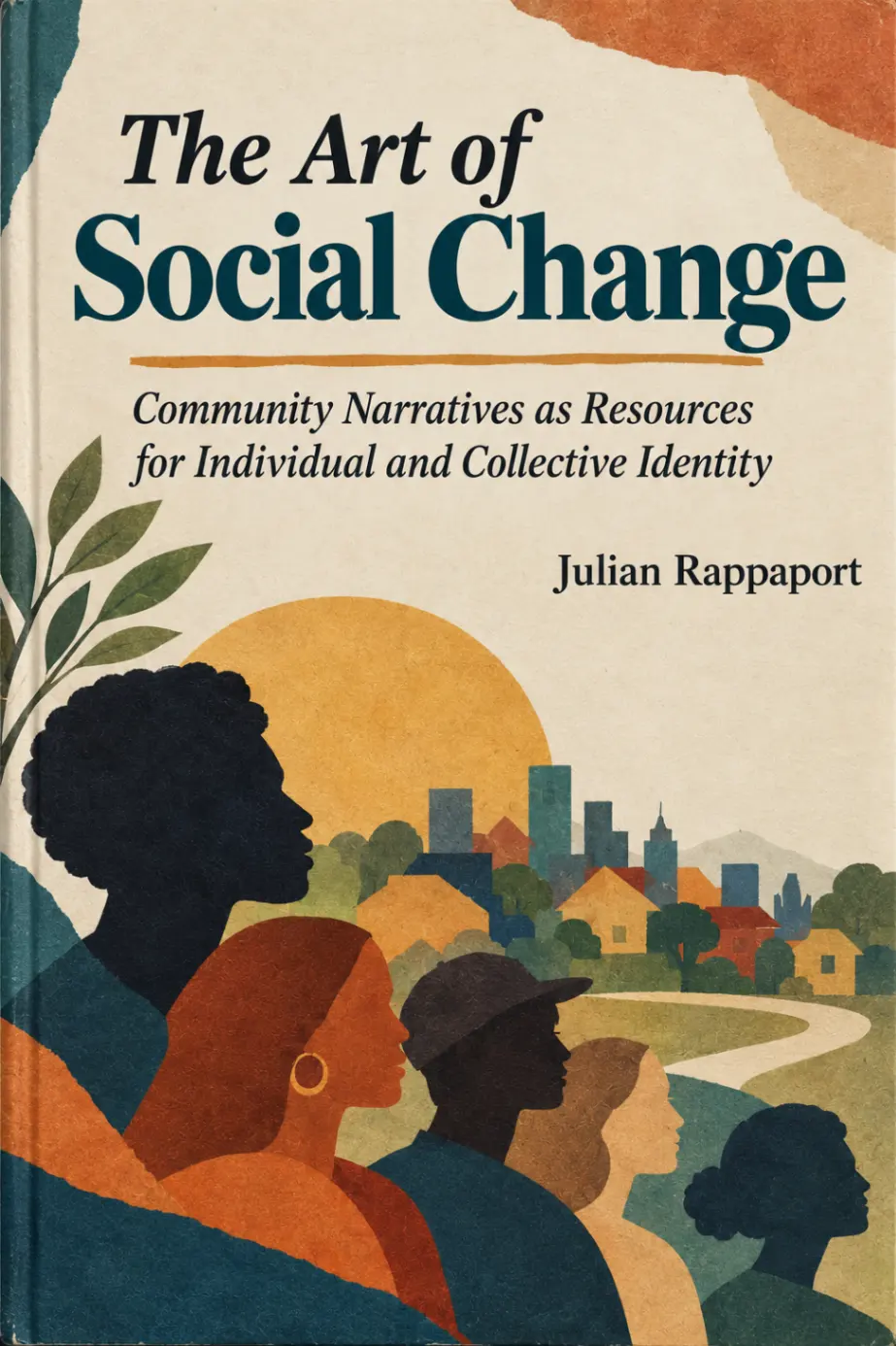
The Art of Social Change: Community Narratives as Resources for Individual and Collective Identity
 Julian Rappaport
This 1998 chapter, contributed to the Claremont Symposium on Applied Social Psychology and published in Addressing Community Problems, argues that narratives—stories shared by communities and adopted into personal life stories—are the fundamental resource for empowerment and social change. Rappaport's thesis is that community psychologists must shift from imposing professional narratives onto marginalized groups to amplifying the stories communities already tell about themselves. The chapter demonstrates this through two contrasting cases: a university's failure to include Black residents in its public self-representation, and South African communities using resistance art to narrate their own liberation. The mechanism is identification: people act on the stories available to them, so expanding available narratives expands possible selves.
Key Details
Related Books
View AllSimilar books from the same category, ranked by shared topics and reader engagement.



Key Insights — Read in 10 Minutes
What is the central argument of The Art of Social Change, and what approach to community intervention does it reject?
Rappaport argues that community narratives—stories shared among a group and communicated through texts, rituals, images, and performances—are the primary resources through which individuals construct identity and through which communities achieve empowerment. The chapter rejects what Rappaport elsewhere calls 'professional centrism': the assumption that community psychologists should impose their own frameworks and narratives onto marginalized groups. Instead, the psychologist's role is to help people discover, create, and circulate their own stories, and to build settings where such storytelling is possible. The mechanism is identification: people act on the stories available to them, so expanding available narratives expands possible selves. Social change, on this account, is fundamentally narrative change—replacing stories of deficit and exclusion with stories of agency and belonging.
What two contrasting cases does the chapter use to illustrate the argument, and what do they demonstrate?
The first case involves the Beckman Institute at the University of Illinois, where a new research building was constructed with no entrance facing the adjacent African American neighborhood and a promotional poster depicted only soybean fields, effectively erasing the Black community from the institution's self-representation. Rappaport reads this as a dominant cultural narrative that renders a community invisible. The second case involves South Africa, where communities under apartheid created resistance art—murals, sculptures, community gardens—that narrated their own experience of oppression and aspirations for liberation. Rappaport cites this as an example of communities creating alternative narratives that sustain collective identity and mobilize action. Together, the cases demonstrate the contrast between narratives imposed by institutions and narratives generated by communities themselves.
What does Rappaport mean by 'community narrative,' and how does it differ from 'personal story'?
Rappaport distinguishes between stories, which are individual cognitive representations of events organized temporally and thematically, and narratives, which are stories common among a group and shared through interaction, texts, performances, and rituals. A community narrative is not merely a collection of individual stories but a shared resource that a group uses to constitute itself as a community, independent of physical proximity. Personal stories are shaped by the narratives available in one's social environment; individuals adopt community narratives into their own life stories, and vice versa. The relationship is reciprocal: community narratives make certain personal stories possible, and when individuals tell their stories, they may reinforce, revise, or resist the available narratives.
How does this chapter relate to Rappaport's earlier concept of empowerment from In Praise of Paradox?
The chapter extends the empowerment framework Rappaport introduced in his 1981 article by specifying narrative as the medium through which empowerment operates. In the earlier work, empowerment was defined as a process through which people lacking an equal share of resources gain greater access to and control over those resources. The 1998 chapter answers the question of how this process works: empowerment happens through narrative, because stories are resources that shape identity, possibility, and collective action. Rappaport explicitly defines narratives as resources, echoing the earlier emphasis on access and control. The shift is from a structural account of empowerment to a cultural and psychological one, without abandoning the structural concerns—the cases address institutional racism and apartheid, showing that narrative empowerment engages directly with material power relations.
What does Rappaport mean by 'dominant cultural narratives,' and why are they significant for social change?
Dominant cultural narratives, or 'mass narratives,' are stories communicated through institutions like mass media, schools, churches, and gossip that are known to most members of a society. Rappaport argues that these narratives serve as an influential backdrop against which local community narratives and personal stories are told. For marginalized groups, dominant narratives can be so powerful that they make alternative stories difficult to find or sustain; the Beckman Institute poster that depicted only soybean fields is an example of a dominant narrative that erases a community. Social change, on this account, requires creating and circulating alternative narratives that challenge and supplement dominant ones. The chapter's South African case shows communities doing exactly this: using art to tell stories that the dominant culture had suppressed.
How does the chapter's argument about narratives connect to Rappaport's later work on mutual help organizations?
The chapter's narrative framework provided the theoretical foundation for Rappaport's subsequent studies of mutual help organizations, particularly his research on GROW, a self-help group for people with histories of serious mental illness. In those studies, Rappaport documented how mutual help groups offer members alternative narratives of identity that replace the stigmatizing stories prevalent in mainstream mental health settings. The 1998 chapter generalizes this insight: what mutual help organizations do for individuals, communities can do collectively—create settings where new stories can be told and adopted. The concept of 'tales of terror and joy' that Rappaport developed in his 2000 article, describing the mission of community psychology as helping turn one into the other, is a direct extension of the framework articulated here.
Show 1 more insights
What common misreading of the narrative approach should readers avoid?
A persistent misreading treats the narrative approach as a retreat from material or structural analysis—as if Rappaport is claiming that changing stories is sufficient for social change, or that narratives are merely psychological phenomena divorced from power. The chapter resists this reading: the Beckman Institute case is about institutional racism and exclusion, and the South African case is about apartheid and liberation struggle. Narratives matter because they shape what people believe is possible, and what people believe is possible shapes what they do—but the conditions under which narratives are produced and circulated are material and political. Rappaport's argument is not that stories replace politics, but that politics operates partly through stories, and that psychologists can contribute to social change by helping marginalized communities tell their own.
Wealthy Psyche is an intellectual archive. We do not host, distribute, or sell book copies — physical or digital. We provide structured knowledge to help you think better, faster.