


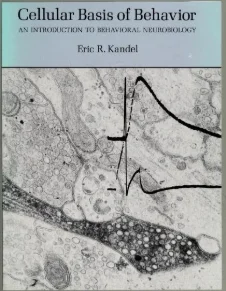
Cellular Basis of Behavior: An Introduction to Behavioral Neurobiology
 Eric Richard Kandel
Kandel's 1976 textbook argues that complex behavior can be analyzed at the level of individual nerve cells and their synaptic connections. Using Aplysia californica as the primary model system, the book demonstrates how identifiable neurons with consistent locations across individuals enable direct correlation between cellular physiology and observable behavior. The central mechanism is the reductionist strategy: identify a behavior, map its neural circuit, record from individual cells, and trace behavioral modification—specifically habituation and sensitization—to measurable changes in synaptic strength.
Key Details
Related Books
View AllSimilar books from the same category, ranked by shared topics and reader engagement.



Key Insights — Read in 10 Minutes
What is the central claim of Cellular Basis of Behavior, and what scientific skepticism did it address?
Kandel argues that meaningful correlations can be made between the cellular properties of individual nerve cells and observable behavior. The book directly addresses the question of whether a simple marine animal like Aplysia can yield insights into complex behavioral processes. When Kandel announced his plans to use Aplysia for this purpose, many colleagues were skeptical—one reviewer admitted thinking Aplysia might be 'too simple a form' for studies of higher functions . The book vindicates Kandel's position by presenting detailed correlations between identified neurons and specific behaviors, including habituation, sensitization, and reflex withdrawal. It demonstrates that behavioral modification can be traced to measurable changes in synaptic transmission at specific, identifiable connections [citation:10].
What specific model system does the book establish, and why is it suited to cellular studies of behavior?
The book establishes Aplysia californica as the model system for cellular behavioral neurobiology. Aplysia has a relatively simple nervous system (roughly 10^5 to 10^6 neurons compared to the human brain's ~10^12), and many of its nerve cell bodies are exceptionally large—up to 1 mm in the abdominal ganglion [citation:10]. Crucially, these large neurons are found in the same locations in all individuals, enabling researchers to reliably identify the same cells across experiments [citation:10]. This combination of simplicity, size, and stereotyped anatomy makes it possible to record from individual neurons while the animal performs observable behaviors, establishing the conditions for direct correlation between cellular physiology and behavioral output.
How does the book structure its argument across its three major parts?
The book is organized into three parts that build from general strategy to specific findings. Part I, 'Strategies in the Study of Behavior,' addresses the conceptual and methodological challenges of linking brain processes to behavior. Part II, 'Strategies in the Study of Nerve Cells,' provides a thorough treatment of cellular neurobiology, covering membrane excitability, synaptic transmission, and neuronal function—material that a reviewer noted 'will be extensively used in its own right in courses on physiology and biophysics' . Part III, 'Nerve Cells and Behavior,' comprising nearly half the book, presents Kandel's own research correlating identified neurons in Aplysia with specific behaviors and their modification through learning [citation:5].
How was the book received by Kandel's contemporaries in neurobiology?
Contemporary reviews were strongly positive while noting the book's unusual concentration on a single species. Robert K. Josephson, reviewing in Contemporary Psychology (1977), wrote that because of its focus on one organism, 'Kandel's book has a uniformity missing from most treatments,' and praised it as 'very good indeed' on membrane excitability, synaptic transmission, and neuronal plasticity [citation:16]. A review in Science (1977) by Charles F. Stevens called it 'clearly written' and 'an indispensable reference' for professionals, noting that Kandel's name 'has been synonymous' with the cellular basis of functional plasticity . JAMA's review described it as 'a carefully formulated personal statement' rather than a routine textbook [citation:12].
What did the book introduce that became foundational to later memory research?
The book consolidated the framework of using Aplysia's gill- and siphon-withdrawal reflexes to study learning at the cellular level. It presented the evidence that habituation involves a decrease in neurotransmitter release at sensory-motor synapses, while sensitization involves an increase—specifically through serotonin-induced presynaptic facilitation [citation:15]. This framework directly led to the molecular discoveries for which Kandel later won the Nobel Prize: that sensitization involves cAMP, protein kinase A, and phosphorylation of potassium channels [citation:15]. The National Aplysia Resource notes that figures in the book were adapted for maps of identified cells that became standard references for the field, confirming its role as a foundational text [citation:10].
What is a common misreading of this book's argument?
A common misreading treats Cellular Basis of Behavior as a general textbook of neurobiology or as claiming that all behavior can be reduced to cellular mechanisms. The book is more precisely an argument for a specific research strategy: that a carefully chosen simple organism can reveal mechanisms of behavioral plasticity that generalize across species. Kandel's stated purpose was to provide 'an introduction to the principles of cellular biology that underlie simple forms of behavior' [citation:16]. The concentration on Aplysia was a deliberate methodological choice, not a claim that Aplysia represents all nervous systems. Josephson noted that neurobiology developed as a mosaic because 'no one species has been suitable for answering all interesting questions'—the book's value lies in what this particular system reveals [citation:16].
Wealthy Psyche is an intellectual archive. We do not host, distribute, or sell book copies — physical or digital. We provide structured knowledge to help you think better, faster.