


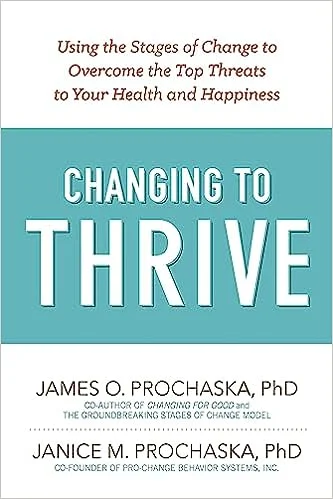
Changing to Thrive: Using the Stages of Change to Overcome the Top Threats to Your Health and Happiness
 James O. Prochaska
This applied volume translates the Transtheoretical Model's six stages of change—Precontemplation, Contemplation, Preparation, Action, Maintenance, Termination—into a practical workbook for overcoming the behavioral threats most responsible for preventable disease: smoking, alcohol misuse, poor diet, inactivity, and stress. Its central claim is that failed change attempts stem less from lack of motivation than from mismatched interventions: helping professionals typically design programs for the small minority already ready to act, while those in Precontemplation are labeled resistant and abandoned. The Prochaskas argue that meeting people at their actual stage, and addressing the emotional barriers that keep them stuck, is what enables sustainable thriving.
Key Details
Related Books
View AllSimilar books from the same category, ranked by shared topics and reader engagement.


Key Insights — Read in 10 Minutes
What is the central argument of Changing to Thrive, and what assumption about failed change does it reject?
The book argues that failed behavior change is primarily a problem of mismatched intervention, not deficient motivation. Helping professionals, the Prochaskas contend, typically design programs for the small minority of people already prepared to act—roughly 20% of those with a problem behavior—while labeling the rest as resistant, unmotivated, or in denial. This becomes a self-fulfilling prophecy: those in Precontemplation are abandoned by programs that cannot reach them, then blamed for failing. The authors' research led them to a different conclusion: it was the health professionals who were not ready for precontemplators, not the reverse . The remedy is to assess a person's actual stage of readiness and match the intervention accordingly, rather than assuming a one-size-fits-all action-oriented approach.
What are the six stages of change, and what distinguishes Precontemplation from the later stages?
The Transtheoretical Model specifies six stages: Precontemplation (not intending to change), Contemplation (aware of the problem but ambivalent), Preparation (intending to act soon and taking small steps), Action (actively modifying behavior), Maintenance (sustaining gains and preventing relapse), and Termination (no temptation to return to the old behavior) . Precontemplation is the most misunderstood stage: people here are often not aware their behavior is problematic, or have tried and failed so many times they have given up. The Prochaskas emphasize that Precontemplators are not simply stubborn—they may be demoralized by repeated failures, defensive about their behavior, or uninformed about how change actually works. Stage-matched interventions address these specific barriers rather than pressuring for immediate action.
How does this book relate to Prochaska's earlier Changing for Good, and what does it add?
Changing to Thrive applies the Transtheoretical Model developed in Changing for Good to five specific behavioral threats: smoking, alcohol problems, overeating and weight, exercise, and stress . Where Changing for Good laid out the six stages and nine processes of change as a general self-help framework, this volume integrates those stages with twelve 'principles of progress' and adds separate chapters on each behavioral domain . It also incorporates research on well-being and positive psychology—relaxation, gratitude, awe, purpose—arguing that thriving is not merely the absence of problem behaviors but the presence of positive psychological resources. The book functions as a practitioner-oriented update, addressing the emotional and psychological barriers that keep people stuck, which the authors felt earlier models underemphasized .
What specific misconceptions about Precontemplation does the book aim to correct?
A persistent misconception treats Precontemplators as resistant, unmotivated, or not ready for behavior change programs—labels that justify excluding them from intervention . The Prochaskas argue this reflects the helper's limitations, not the client's. Precontemplators may be defending their behavior through denial, rationalization, or withdrawal; they may be demoralized by repeated failures; or they may simply not know that change is a staged process with predictable setbacks rather than an all-or-none leap . The book recommends addressing these barriers head-on—normalizing the fear and doubt that accompany change, offering hope through innovative solutions, and showing understanding rather than applying scare tactics or accusations of personality defects. Meeting Precontemplators where they are is the first step toward moving them forward.
How have practitioners in clinical settings used this book, and what audience does it actually serve?
The book has found a receptive audience among addiction counselors and social service staff who use it as a resource for Motivational Interviewing training . Its stage-matched framework aligns closely with MI's emphasis on meeting clients at their current readiness rather than pushing for immediate action. However, some general readers seeking personal weight-loss guidance found the book oriented more toward clinicians, with extensive material on motivating the unmotivated and less on the specific mechanics of diet and exercise . The Prochaskas' own framing supports this: the book is designed for anyone who wants to change, but its deepest utility is for professionals guiding others through the change process .
What does the book mean by 'thriving,' and how does it extend beyond behavior change?
Thriving, in the Prochaskas' framework, is not merely the cessation of unhealthy behaviors but the cultivation of positive psychological resources that sustain well-being. The book's final chapters move beyond problem-focused change to practices including relaxation and meditation for stress reduction, gratitude, experiencing moral elevation or awe, pursuing personal interests, and finding purpose in life . This extension reflects the authors' view that sustainable behavior change requires a broader foundation than willpower or technique alone. The final stage, Termination, represents not just the absence of temptation but a transformed relationship with the former problem behavior—a state the authors acknowledge is rare but attainable. The overall arc moves from overcoming threats to actively building a life worth sustaining.
Wealthy Psyche is an intellectual archive. We do not host, distribute, or sell book copies — physical or digital. We provide structured knowledge to help you think better, faster.