


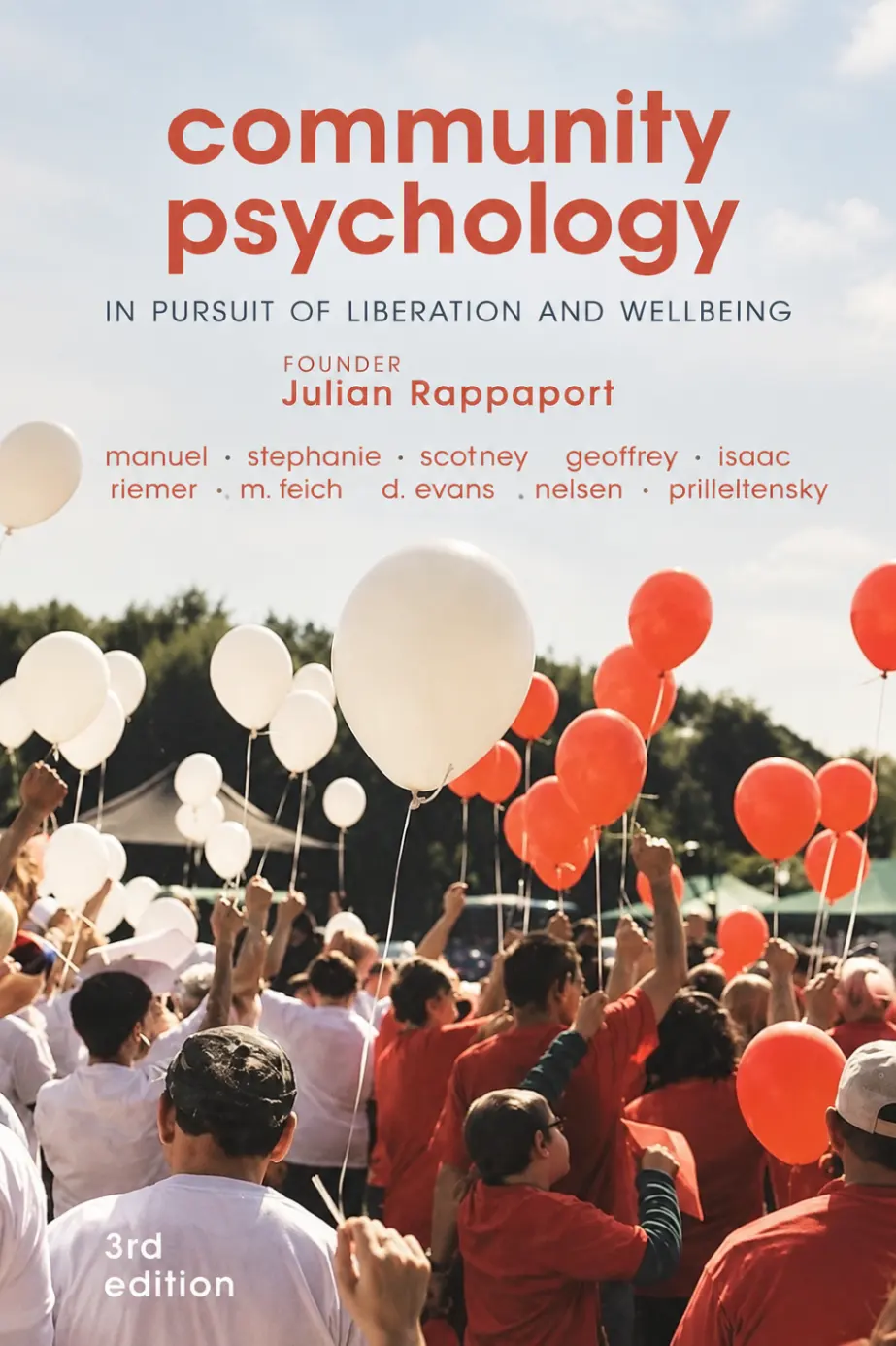
Community Psychology: Values, Research, and Action
 Julian Rappaport
Rappaport's 1977 textbook argues that community psychology is defined not by its methods or settings but by its values: cultural relativity, diversity, and the redistribution of power. The book's distinctive contribution is its insistence that research and action are inseparable from value commitments, and that community psychology must align itself with the powerless rather than the institutions that employ its practitioners. Through analysis of the community mental health movement, the War on Poverty, and the failures of professionalized intervention, Rappaport establishes empowerment and social justice as the field's organizing commitments—a framework that shaped subsequent community psychology scholarship.
Key Details
Related Books
View AllSimilar books from the same category, ranked by shared topics and reader engagement.



Key Insights — Read in 10 Minutes
What is the central argument of Community Psychology: Values, Research, and Action, and what does it reject?
Rappaport argues that community psychology is defined primarily by its values—cultural relativity, diversity, and the redistribution of power—rather than by its methods, settings, or client populations. The book rejects the assumption that psychology can be value-neutral or that community psychology is simply clinical psychology practiced in community settings. As one reviewer noted, the subtitle signals that the book is concerned with 'meta issues in the development of this subdiscipline' . Rappaport's distinctive mechanism is to treat values as constitutive of the field: without a commitment to empowering the powerless, community psychology becomes merely another professional service delivery system. This framework made the book a foundational statement of the field's identity and aspirations.
What role does the concept of empowerment play in this book?
Empowerment is the organizing value around which Rappaport structures the field. He argues that community psychology must align itself with those who lack power—the poor, the marginalized, the institutionalized—rather than with the institutions that employ psychologists. This requires a redistribution of power, not merely the provision of services to the powerless. Rappaport would later elaborate this concept in his 1981 article 'In Praise of Paradox,' where empowerment was defined as a process through which people gain greater access to and control over resources. The 1977 textbook laid the groundwork by insisting that the field's commitment to empowerment distinguishes it from clinical psychology, which operates within existing power arrangements rather than challenging them.
How does the book engage with the history of the community mental health movement and the War on Poverty?
Rappaport examines both movements as case studies in the gap between professional intentions and community empowerment. He describes the origins of the War on Poverty and the subsequent urban-black bias in the dispersion of program funds, which led to conflict between Black communities and other ethnic groups . Regarding community mental health, one reviewer noted that Rappaport's account shows the movement's imperialistic ventures into the social world and its subsequent retreat . The book treats these histories not as failures of implementation but as illustrations of a fundamental tension: programs designed to help the powerless often end up serving institutional interests. This analysis supports Rappaport's argument that community psychology must be critically aware of its own power position.
What was the reception of this textbook when it was published, and how was it evaluated?
The book was widely reviewed and generally praised for its scope and scholarly temperament. Seymour Sarason, reviewing it in Contemporary Psychology in 1978, called it 'a superb, and encouraging book' and noted that 482 double-columned pages sustain interest and provoke thinking . Sarason credited Rappaport with modesty, respect for contrasting views, and a scholarly temperament that prevented grandiosity. Augustine Baron's later mini-review described it as presenting 'a broad, yet in-depth overview of community psychology' . The book's length and density were acknowledged, but reviewers saw them as justified by the comprehensiveness of the treatment. It became a standard textbook and a foundational reference for the field.
How does this book relate to Rappaport's later work on empowerment and narrative?
The 1977 textbook establishes the value commitments that Rappaport would elaborate in subsequent decades. The empowerment framework introduced here would be fully developed in his 1981 article 'In Praise of Paradox' and later applied to mutual help organizations. The emphasis on the powerless and the redistribution of power anticipates his narrative work, where stories become resources through which marginalized communities contest dominant myths. Rappaport's later concept of 'community narratives' as instruments of social change is continuous with the value framework of the 1977 book: if community psychology is defined by its commitment to the powerless, then understanding and amplifying their stories becomes a central methodological task. The textbook is the intellectual foundation for Rappaport's entire subsequent career.
What distinguishes Rappaport's approach from George Albee's primary prevention framework, given that both are foundational to community psychology?
Both Rappaport and Albee were central figures in community psychology's critical wing, but their emphases differ. Albee's framework is epidemiological and causal: psychopathology arises from toxic social conditions, and prevention requires redistributing power to eliminate those conditions. Rappaport's framework is more axiological and interpretive: community psychology is defined by its values, and the field's task is to align itself with the powerless in whatever form that takes. Albee identifies a specific enemy (exploitation) and a specific remedy (prevention through social change). Rappaport emphasizes the value commitments that should guide practice, leaving the specific targets and methods more open. The two frameworks are complementary: Albee provides the causal case for prevention, Rappaport provides the ethical orientation for practice.
Wealthy Psyche is an intellectual archive. We do not host, distribute, or sell book copies — physical or digital. We provide structured knowledge to help you think better, faster.