


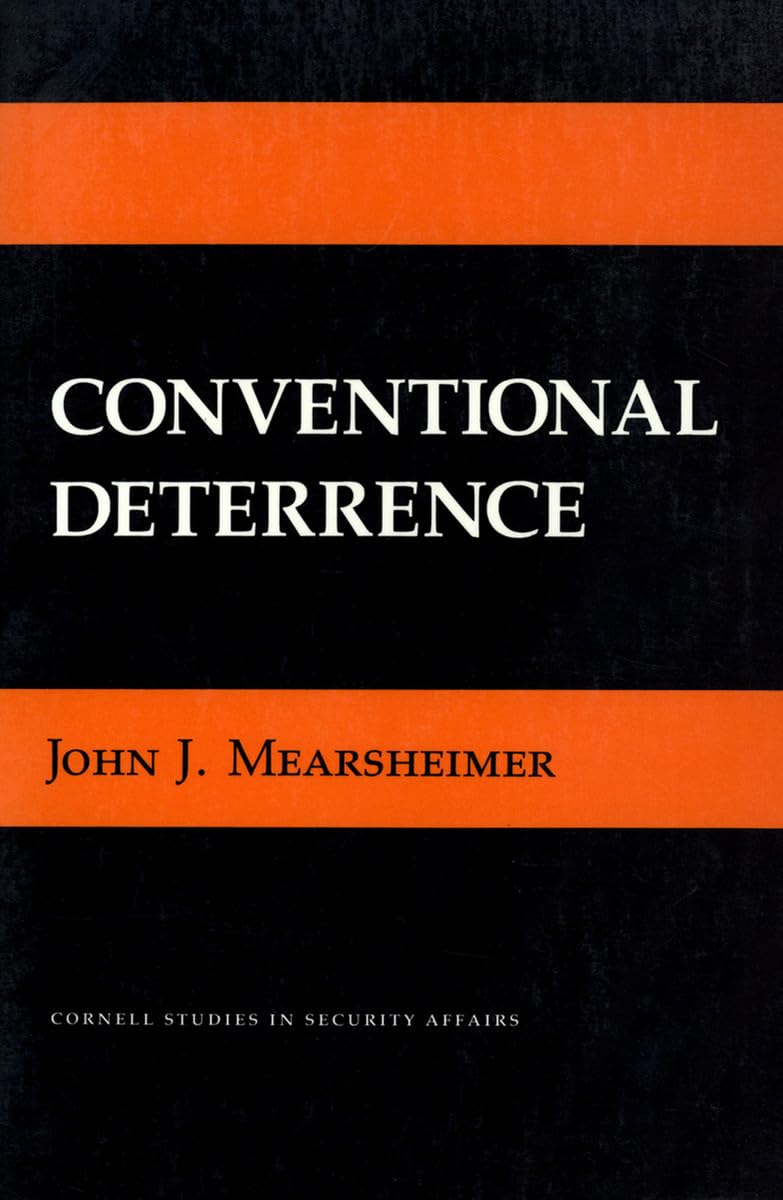
Conventional Deterrence
 John J. Mearsheimer
Mearsheimer argues that conventional deterrence succeeds or fails based on the military strategy an attacker believes it can employ. Deterrence fails when the attacker thinks a blitzkrieg—a rapid, decisive offensive—can succeed. Deterrence holds when the defender can impose attrition, making victory slow and costly. Challenging theories that reduce deterrence to numerical balances or offense-defense weaponry, Mearsheimer shows that strategy and force posture are decisive. Applying this to Cold War Europe, he concludes that NATO's prospects for deterrence were good because the Warsaw Pact could not achieve a quick victory, and that precision-guided munitions enhance stability by reducing blitzkrieg feasibility.
Key Details
Key Insights — Read in 10 Minutes
What is Mearsheimer's central argument about when conventional deterrence fails?
Mearsheimer argues that conventional deterrence fails when a potential attacker believes it can execute a successful blitzkrieg—a rapid, decisive offensive that defeats the defender before it can mobilize. Deterrence holds when the defender can impose an attrition strategy, making victory slow, costly, and uncertain . This reframes deterrence from a function of numerical force balances to a function of military strategy. The critical variable is not how many tanks each side has, but whether the attacker can translate its forces into a quick victory. If a blitzkrieg is feasible, deterrence is likely to fail regardless of overall power ratios.
How does Mearsheimer's theory challenge offense-defense balance explanations?
Mearsheimer explicitly takes issue with the school of thought that ascribes deterrence failures to the dominance of offensive weaponry . He argues that technology alone does not determine outcomes—strategy and force employment matter more. This is why he can conclude that precision-guided munitions enhance deterrence: not because they are inherently defensive weapons, but because they reduce the chances of a successful direct blitzkrieg . The offense-defense balance framework treats weapons as having fixed characteristics; Mearsheimer treats their effects as contingent on how they are integrated into a broader military strategy.
What historical cases does Mearsheimer use to develop his theory?
Mearsheimer examines crises that led to major conventional wars to explain why deterrence failed. He focuses first on Allied and German decision-making in 1939-1940, analyzing why the Allies did not strike first after declaring war and why Germany attacked the West . He then turns to the Arab-Israeli conflicts, examining differences in Israeli and Egyptian strategic doctrines prior to major wars . These cases allow him to isolate the conditions under which blitzkrieg is attempted and succeeds. The historical analysis grounds his theoretical claim that strategy, not numerical balance, determines deterrence outcomes.
What was Mearsheimer's controversial conclusion about NATO and the Warsaw Pact?
Applying his theory to Cold War Europe, Mearsheimer concluded that the prospects for conventional deterrence were actually quite good—the Warsaw Pact could not score a quick and decisive victory over NATO . This was a significant claim because NATO planners often assumed Soviet numerical superiority made deterrence fragile. Mearsheimer argued that Soviet forces lacked the ability to execute a successful blitzkrieg against NATO's defenses. His analysis suggested that NATO's conventional posture was more robust than commonly believed, and that fears of a quick Soviet victory were overstated, though he acknowledged that outcomes were scenario-dependent.
How does Conventional Deterrence relate to Mearsheimer's later offensive realism?
Conventional Deterrence is an early work that established Mearsheimer's interest in military strategy and the conditions under which states choose offensive action. The book's focus on blitzkrieg as a decisive strategy echoes his later offensive realism's emphasis on power maximization and the pursuit of regional hegemony. However, the earlier book is more narrowly focused on battlefield dynamics and deterrence credibility, while offensive realism is a systemic theory about state behavior under anarchy. Both share a realist skepticism of optimistic deterrence theories and a belief that states will exploit opportunities for decisive advantage when they arise.
What is the main criticism of Mearsheimer's deterrence theory?
Critics argue that Mearsheimer's theory relies on abstract military strategies that oversimplify the chaotic realities of international security. As one assessment notes, 'critics are skeptical of their assumptions and deductive methods and point to its deceptive simplicity as a means of conflict management' . Deterrence is fundamentally a psychological theory depending on perception and cognition, which abstract strategy models struggle to capture. The ability of one state to impose deterrence on another is doubtful given limits of rationality and barriers to effective communication . Mearsheimer's framework may be analytically elegant but empirically difficult to apply to real-world decision-making.
Show 1 more insights
How has Conventional Deterrence held up since its 1983 publication?
The book remains a foundational text in security studies and is cited as 'perhaps the broadest treatment of the issue to date' . Its central insight—that strategy and force posture matter more than raw numbers for deterrence—has influenced subsequent debates about force planning and NATO strategy. However, the specific Cold War context has passed, and the book's conclusions about Europe are historical. Its analytical framework continues to inform discussions of conventional deterrence in other theaters, including the Middle East and Asia, where questions of blitzkrieg feasibility and rapid victory remain central to stability calculations.
Wealthy Psyche is an intellectual archive. We do not host, distribute, or sell book copies — physical or digital. We provide structured knowledge to help you think better, faster.