


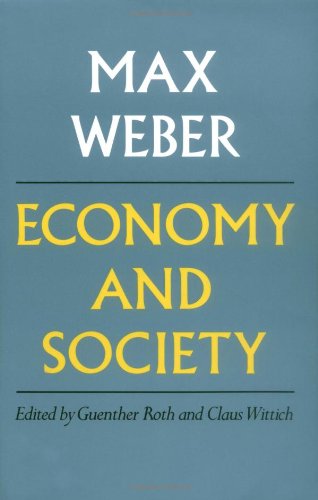
Economy and Society: An Outline of Interpretive Sociology
 Max Weber
Weber's unfinished masterwork, assembled posthumously from manuscripts he was still revising at his death in 1920, offers the most systematic account of how modern Western society became dominated by means-ends calculation. Its central architectural claim is that social action can be understood through four ideal types—instrumentally rational, value-rational, affectual, and traditional—and that modernity's distinguishing feature is the displacement of the latter three by the first. Bureaucracy appears as the 'iron cage' of this rationalization: technically superior to any alternative yet indifferent to the substantive values it displaces, it subjects both ruler and ruled to formal rules that have become ends in themselves.
Key Details
Related Books
View AllSimilar books from the same category, ranked by shared topics and reader engagement.



Key Insights — Read in 10 Minutes
What are Weber's four types of social action, and why do they matter for public administration?
Weber distinguished instrumentally rational action (calculating the most efficient means to a given end), value-rational action (pursued for its own sake regardless of consequences), affectual action (driven by emotion), and traditional action (habitual). Modern bureaucracy is the institutional embodiment of the first type: it treats rules as technical means, not moral ends. This distinction matters because it shows that bureaucratic efficiency is not neutral—it systematically privileges calculability over substantive justice or personal loyalty, reshaping the values of the officials who operate within it.
How does Weber's account of bureaucracy differ from Woodrow Wilson's politics-administration dichotomy?
Both thinkers are often grouped as founders of the politics-administration dichotomy, but their arguments diverge sharply. Wilson's separation was prescriptive—he wanted administration removed from politics to achieve accountability and efficiency. Weber's 'dichotomy' was descriptive and tragic: bureaucrats administer 'sine ira et studio,' without passion or partisanship, but this very neutrality makes them instruments of domination regardless of who holds political power. Wilson saw a solution; Weber saw an iron cage from which escape was increasingly difficult.
What did Weber mean by the 'iron cage' of bureaucracy?
The 'iron cage' (stahlhartes Gehäuse) describes how modern individuals become trapped in a rationalized order of rules, procedures, and calculability. Within bureaucratic organizations, people are reduced to functions or 'cogs,' their entire economic and ideological existence shaped by the work they perform. Weber argued this order is practically indestructible because it delivers unmatched technical efficiency—precision, stability, discipline, reliability. The tragedy is that this efficiency is achieved at the cost of meaning, autonomy, and the capacity to challenge the system's fundamental premises.
Why was Economy and Society left unfinished, and how has that shaped its reception?
Weber was still revising the manuscript when he died suddenly in 1920. His wife Marianne assembled the scattered texts and published them as Wirtschaft und Gesellschaft in 1922. Because Weber never finalized the structure, editors and translators have disagreed about the order and emphasis of its parts. The 1968 English translation by Guenther Roth and Claus Wittich became standard for decades, but the Max Weber-Gesamtausgabe (complete critical edition) has since reassessed the manuscript's history, showing Weber changed his own title from 'Economy and Society' to 'The Economy and the Societal Orders and Powers'—revealing how unsettled the work remains.
How has Weber's bureaucracy theory held up in contemporary public administration?
Scholars increasingly argue that actual government operations in the United States and elsewhere have become 'distinctly less Weberian' than his model predicts. Contracting, networks, and multi-organizational delivery systems have eroded the unified hierarchy and direct control Weber assumed. Yet policymakers, media, and the public still tend to view government through Weberian terms—expecting clear chains of command and accountable officials. This gap between the Weberian image and fragmented reality poses one of the central challenges for twenty-first-century public administration.
Wealthy Psyche is an intellectual archive. We do not host, distribute, or sell book copies — physical or digital. We provide structured knowledge to help you think better, faster.