


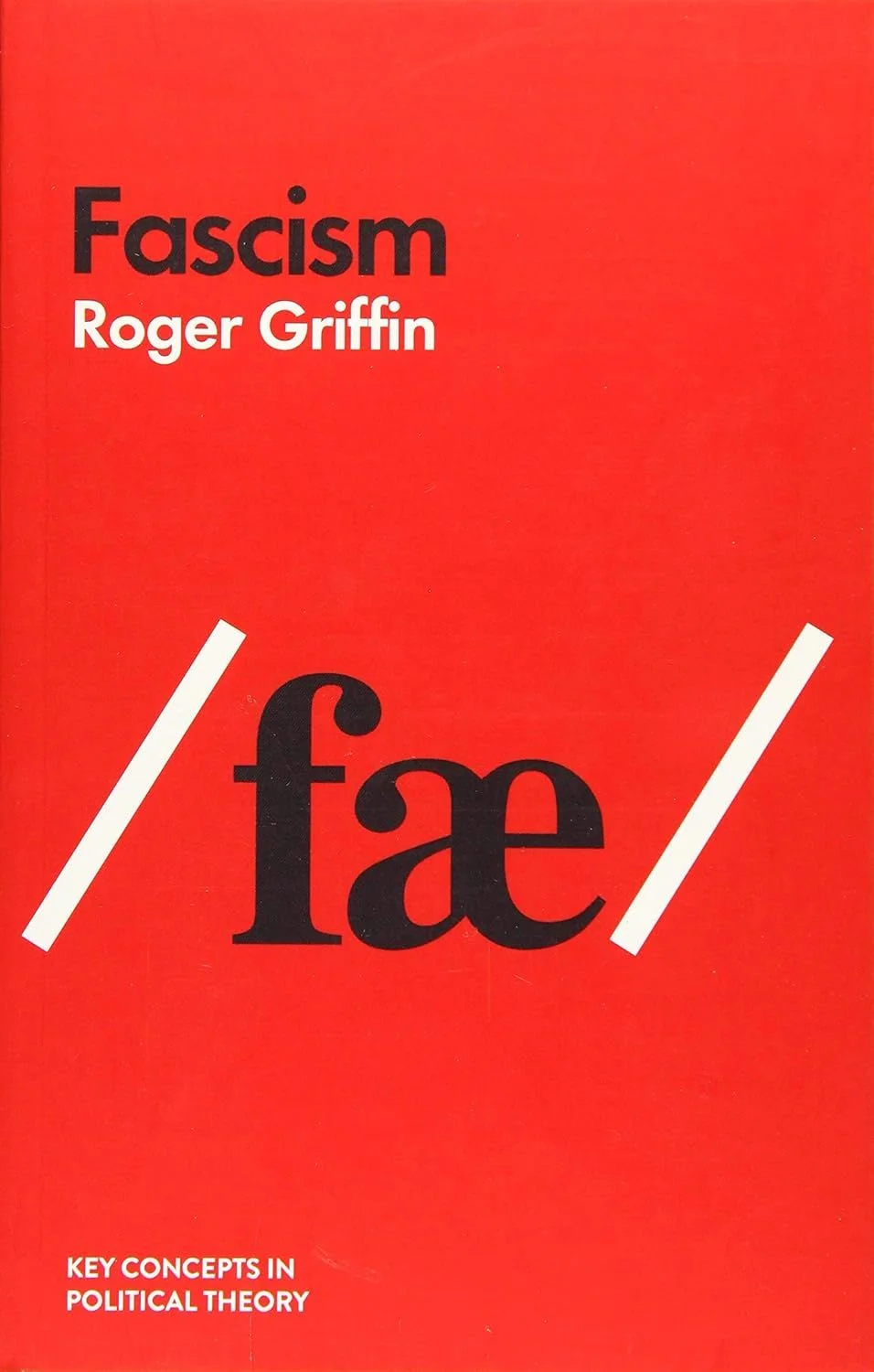
Fascism: An Introduction to Comparative Fascist Studies
Griffin's concise introduction distills his influential framework for understanding fascism as a revolutionary form of nationalism centered on a myth of national rebirth, or palingenesis. The book guides readers through the labyrinth of debates over fascism's definition, from Marxist and early liberal approaches to his own working definition of 'palingenetic ultranationalism.' Griffin then applies this framework to interwar fascist movements and examines its relevance to postwar and contemporary phenomena, including Marine Le Pen's Rassemblement National and Greece's Golden Dawn. It serves as both a primer and a synthesis of the 'new consensus' in fascist studies.
Key Details
Related Books
View AllSimilar books from the same category, ranked by shared topics and reader engagement.


Key Insights — Read in 10 Minutes
What is the central definition of fascism that Griffin presents in this book, and how does it relate to his earlier work?
Griffin presents fascism as 'a revolutionary form of nationalism' whose mythic core is palingenetic ultranationalism—the vision of national rebirth from decadence. This definition distills and updates the framework he first introduced in The Nature of Fascism (1991). The book's third chapter is explicitly titled 'A working definition: fascism as a revolutionary form of nationalism,' signaling its role as an accessible restatement of his mature position [citation:13][citation:14]. Unlike his earlier monograph, this introduction places greater emphasis on applying the definition to postwar and contemporary phenomena.
Why does Griffin dedicate substantial space to Marxist and early liberal approaches to fascism?
The book's second chapter, 'Making sense of fascism: Marxist and early liberal approaches,' addresses the historiographical labyrinth Griffin believes students must navigate. He treats Marxist definitions—which saw fascism as capitalism's reactionary vanguard—and early liberal approaches as necessary background for understanding why a new consensus emerged in the 1990s. Griffin argues these earlier frameworks were 'not obviously false or unhelpful,' but they failed to capture fascism's ideological dynamism as a revolutionary force. Surveying them allows him to position his own definition as a corrective that takes fascist ideas seriously on their own terms.
How does this book differ from Robert Paxton's The Anatomy of Fascism?
The two books embody fundamentally different approaches. Paxton, in his own words, finds Griffin's 'zeal to reduce fascism to one pithy sentence' potentially inhibiting to analysis of how fascism worked in practice [citation:2]. Paxton focuses on fascism as political behavior across five developmental stages; Griffin focuses on fascism as ideology, defined by its mythic core of national rebirth. Griffin's introduction is a work of conceptual clarification, while Paxton's is a study of political process. Both are considered essential, but they disagree about whether definition or trajectory should anchor comparative study.
What makes this book an 'introduction' rather than a monograph like Griffin's earlier works?
Published by Polity Press in its 'Key Concepts in Political Theory' series, the book is designed for students and general readers rather than specialists [citation:2][citation:7]. Its 179 pages are structured pedagogically, moving from the conceptual problem of defining fascism to a working definition, then to historical applications and contemporary relevance. Reviewer Bradley Nelson noted it is 'ideal for undergraduates who are studying the WWII era, but also for political science courses that might touch on' fascism [citation:2]. The book functions as a synthesis of Griffin's career-long argument, making his framework accessible without the dense theoretical apparatus of The Nature of Fascism.
How does the book address the applicability of 'fascism' to contemporary politics?
The fifth chapter examines 'Neo-fascism: evolution, adaption, mutation,' and the book's blurb explicitly cites contemporary phenomena including Marine Le Pen's Rassemblement National and Greece's Golden Dawn [citation:7][citation:11]. Griffin distinguishes fascism from the populist radical right, which seeks to de-liberalize the system from within rather than destroy it. He has stated that Trump, for example, is 'populist precisely because he's on the cusp'—supported by some fascists but operating within constitutional bounds [citation:2]. The book's framework allows readers to assess whether contemporary movements meet the threshold of revolutionary nationalism.
What is the most common criticism of Griffin's approach as presented in this book?
The most persistent criticism, articulated by Paxton among others, is that reducing fascism to a single ideological formula—palingenetic ultranationalism—may 'inhibit rather than stimulate analysis' of how fascism actually operated politically [citation:2]. Critics argue Griffin's ideal-type definition is too abstract to capture the messy, contingent processes by which fascist movements acquired power and governed. Some also contend that the emphasis on ideology risks underplaying the organizational and social dynamics that shaped fascism in practice. Griffin acknowledges these debates but maintains that a precise definition remains essential for comparative analysis.
Wealthy Psyche is an intellectual archive. We do not host, distribute, or sell book copies — physical or digital. We provide structured knowledge to help you think better, faster.