


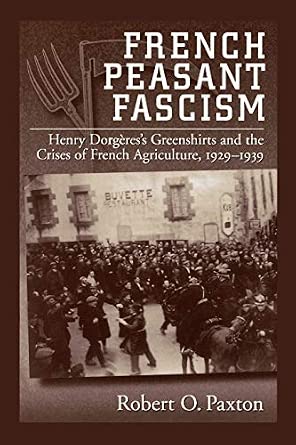
French Peasant Fascism: Henry Dorgères's Greenshirts and the Crises of French Agriculture, 1929-1939
 Robert Paxton
Paxton's study examines the Greenshirts, a militant peasant movement led by Henry Dorgères that agitated across northern and western France during the Depression. He argues that this was not truly fascism: it lacked the totalitarian aspiration to remake the entire nation. Instead, it expressed the bitterness of small farmers squeezed between collapsing prices and an intrusive bureaucracy, and it sought to restore peasant preeminence within a corporatist, authoritarian state. The book explains why fascism remained weak in the French countryside—the Republic protected landowners more effectively than Weimar Germany or Italy, and rural notables held firm social power.
Key Details
Related Books
View AllSimilar books from the same category, ranked by shared topics and reader engagement.

Key Insights — Read in 10 Minutes
What is Paxton's central claim about whether the Greenshirts were genuinely fascist?
Paxton concludes that French peasant fascism was not really fascism. The Greenshirts borrowed fascist methods—colored shirts, insignia, street confrontations—but their program was closer to the authoritarian corporatism of Salazar or Franco. Crucially, they lacked totalitarian aspirations: Dorgères spoke only to peasants and had no interest in remaking the entire nation. Their goal was to restore peasant preeminence, not to mobilize a mass movement for national rebirth. As Paxton puts it, this limitation testifies to the movement's lack of the essential fascist component of totalitarian ambition.
What specific concept or framework does the book introduce for understanding rural right-wing movements?
Paxton introduces the concept of 'peasant direct action' as a distinct political repertoire separate from fascism. The Greenshirts' real message was not ideological conquest but concrete resistance: refusing tax and social security payments, blocking forced farm sales, withdrawing savings deposits, and roughing up opponents. This tradition of direct action outlasted the Greenshirts and continues to shape French agricultural protest today. Paxton's framework separates the tactical repertoire of rural militancy from the totalitarian project of fascism, showing how movements can borrow fascist style without embracing fascist goals.
Why did fascism remain weak in the French countryside compared to Germany or Italy?
Paxton identifies structural reasons. The French state protected landowners more effectively than did Weimar Germany or Italy, so peasants had less reason to abandon the Republic for radical alternatives. French rural notables—mayors, large farmers, and traditional agricultural associations—were firmly embedded in social and economic power, leaving less space for insurgent movements. The Greenshirts also faced competition from established organizations like the syndicats agricoles, which offered more practical channels for peasant grievances. This comparative insight explains why the same economic crisis that fueled fascism elsewhere produced only a marginal rural movement in France.
How does French Peasant Fascism relate to Paxton's later work, The Anatomy of Fascism?
French Peasant Fascism, published in 1997, was written while Paxton was preparing his comparative study of fascism, which became The Anatomy of Fascism in 2004. The Greenshirts study provides a case study in what fascism is not: a movement that adopted fascist style but lacked the totalitarian ambition essential to Paxton's later definition. The book's analysis of why peasant fascism failed also anticipates the comparative framework of Anatomy, which emphasizes the contingent political conditions—alliances with elites, state capacity, party competition—that determine whether fascist movements succeed or remain marginal.
What is a common misconception about the Greenshirts' relationship to Vichy?
Many assume that a militant anti-republican peasant leader like Dorgères would have played a major role in Vichy's agrarian program. In fact, Paxton shows that Vichy largely sidelined him. He was appointed to the National Council and made one of nine directors general of the Peasant Corporation, but was given only minor propaganda functions. The Vichy regime's agrarian policies were shaped by traditional notables and Catholic-trained technicians, not by roughhouse political agitators. Dorgères's marginalization under Vichy illustrates how even a regime sympathetic to authoritarian agrarianism preferred established elites to insurgent leaders.
What sources did Paxton use to reconstruct a movement that left few organized archives?
Paxton faced formidable difficulties finding adequate sources for a movement that was never a formal party. He drew on agricultural newspapers, prefectural and police reports, local archives, and interviews with surviving participants. The Greenshirts' own publications—Dorgères's papers with titles like The Peasant's Outcry and Voice of the Soil—provided the movement's rhetorical self-presentation. Paxton also used the records of rival agricultural organizations and government ministries to triangulate the Greenshirts' actual strength and impact. Reviewers praised his ability to squeeze information from fragmentary sources, calling it a finely crafted piece of historical research.
Wealthy Psyche is an intellectual archive. We do not host, distribute, or sell book copies — physical or digital. We provide structured knowledge to help you think better, faster.