


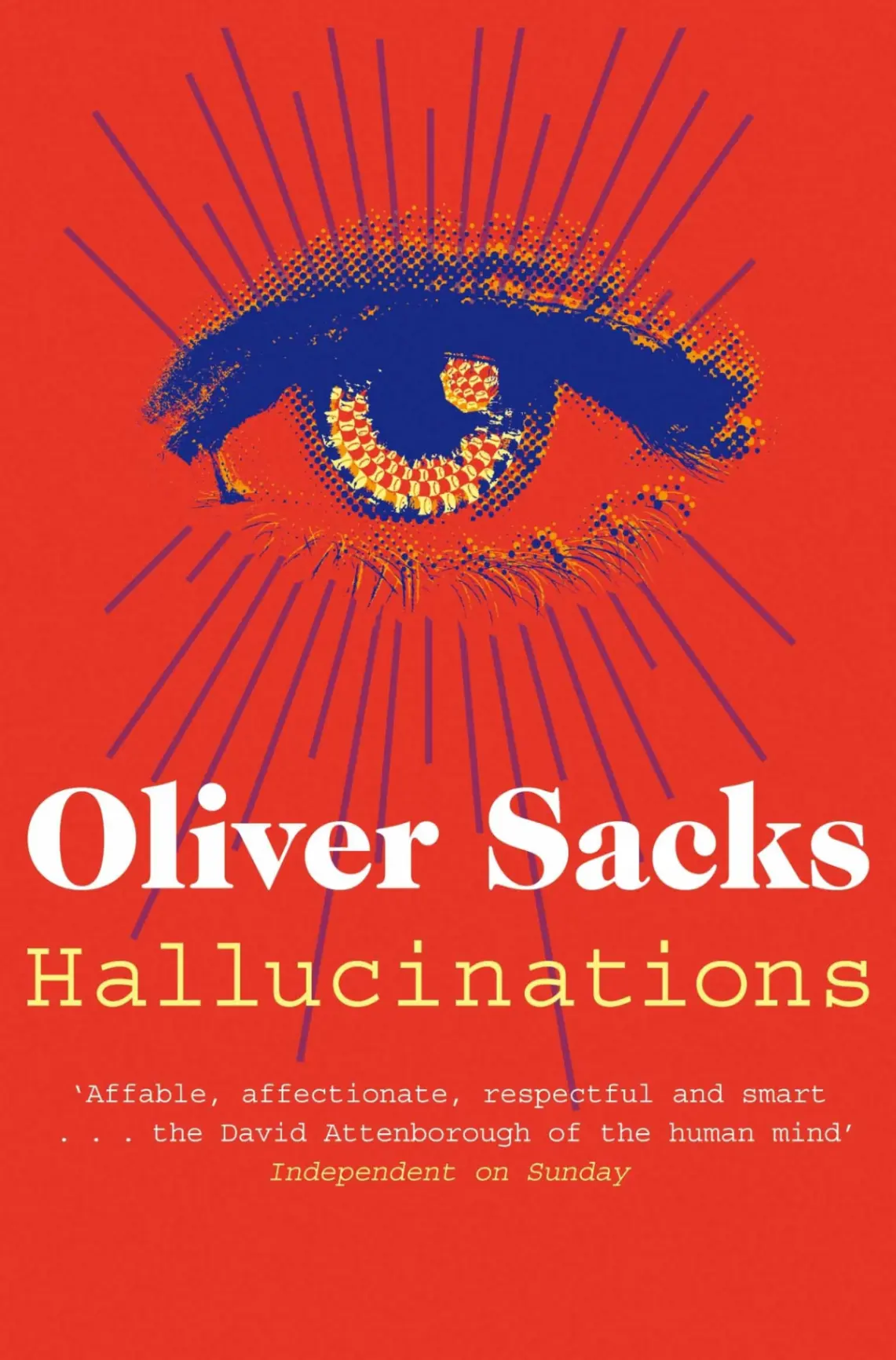
Hallucinations
 Oliver Wolf Sacks
Sacks argues that hallucinations are not exclusive to madness but a fundamental part of the human condition, arising from sensory deprivation, illness, injury, or intoxication. The book surveys their full range—from the geometric patterns of migraines and the benign visions of Charles Bonnet syndrome to the 'visits' of the bereaved and the psychedelic revelations sought across cultures. Sacks's central mechanism is that hallucinations reveal the brain's organizational principles: when normal sensory input is disrupted, the brain's own generative capacities become visible.
Key Details
Related Books
View AllSimilar books from the same category, ranked by shared topics and reader engagement.


Key Insights — Read in 10 Minutes
What is the central argument of Hallucinations, and what common misconception does it challenge?
Sacks argues that hallucinations are not exclusively symptoms of psychosis or drug use but a common, varied, and fundamentally human phenomenon [citation:1][citation:9]. He challenges the stigma that equates hallucination with insanity, showing that they arise from sensory deprivation, illness, injury, and even falling asleep [citation:4]. The book's survey ranges from the geometrical patterns of visual migraines to the benign visions of Charles Bonnet syndrome, from olfactory hallucinations to the 'visits' of the bereaved [citation:1]. Sacks's deeper claim is that studying hallucinations reveals the brain's normal organizational principles: when external input is disrupted, the brain's own generative capacities become visible.
What is Charles Bonnet syndrome, and why does Sacks treat it as a key case?
Charles Bonnet syndrome occurs when people with failing eyesight experience vivid visual hallucinations despite preserved insight—they know the visions are not real [citation:5]. Sacks treats it as a central example because it demonstrates that hallucinations need not imply psychosis. A Neurology Today review noted that the syndrome remains poorly appreciated even by doctors, with many cases overlooked or misdiagnosed, sometimes leading to inappropriate psychiatric treatment [citation:5]. Sacks's account implicates 'release' of the central visual system when it is deprived of normal input—a mechanism he suggests also underlies musical hallucinations in the hearing-impaired [citation:5]. The syndrome exemplifies his broader argument about the brain's generative capacities.
How does Sacks's personal experience with migraines and drug use shape the book?
Sacks weaves his own experiences throughout the book. His childhood migraines produced visual auras that 'excited an interest in the brain,' as he wrote in a letter to Neurology [citation:6]. As a young doctor in California in the 1960s, he had both personal and professional interests in psychedelics [citation:1]. A reviewer noted that the book 'comes alive' when Sacks describes his own drug experiences, including a moment when he mistook a friend for a hallucination and turned her away [citation:16]. These personal passages serve a methodological purpose: they demonstrate that hallucinatory experience is not foreign to the normal mind but continuous with it. Sacks positions himself as both observer and subject.
How have critics assessed the book's structure and its relation to Sacks's earlier work?
Reviews were mixed. The National called it 'a rather disappointing book of lists,' arguing that it amounts to 'little more than a taxonomy of varieties of hallucination' and lacks the narrative flair of Sacks's best work [citation:8]. Other reviewers found it repetitious, with one Amazon reviewer noting that 'the book became repetitious in the way it presents its information' [citation:18]. SuperSummary noted that 'some critics feel it is occasionally repetitive' while praising Sacks's 'engaging storytelling' [citation:10]. The book is often compared to The Man Who Mistook His Wife for a Hat and Phantoms in the Brain as a comparable work for readers interested in neurological case studies [citation:10].
What does Sacks argue about the relationship between hallucinations and cultural beliefs?
Sacks explores how hallucinations have influenced folklore, art, and religious experience across cultures. He notes that hallucinations 'can lead to religious epiphanies or even the feeling of leaving one's own body' [citation:1], and that humans have always sought such life-changing visions through hallucinogenic compounds [citation:9]. An Amazon reviewer observed that Sacks 'will sometimes allude to how hallucinations might be a source of cultural beliefs such as ghosts, fairies and other mythological creatures,' though these asides remain brief and conjectural [citation:18]. The book's final chapters on 'The Haunted Mind' and doppelgängers explore these cultural dimensions, suggesting that the potential for hallucination is 'a vital part of the human condition' [citation:1].
How does the book relate to Sacks's first book, Migraine?
Hallucinations returns to territory Sacks first explored in Migraine (1970), his first book. A study of Sacks's migraine writings notes that his auras—including rare forms like amusia and olfactory sensations—appear throughout his work, and that his descriptions gave wonderful accounts of migraine auras but 'hardly any of migraine headache' [citation:14]. In Hallucinations, the chapter 'Patterns: Visual Migraines' explicitly addresses the geometric hallucinations of migraine aura, connecting them to the book's broader survey [citation:4]. The return to migraine in his late work represents a closing of the circle: the childhood experiences that first drew Sacks to neurology become, in his final books, material for reflection on the brain's generative powers.
Wealthy Psyche is an intellectual archive. We do not host, distribute, or sell book copies — physical or digital. We provide structured knowledge to help you think better, faster.