


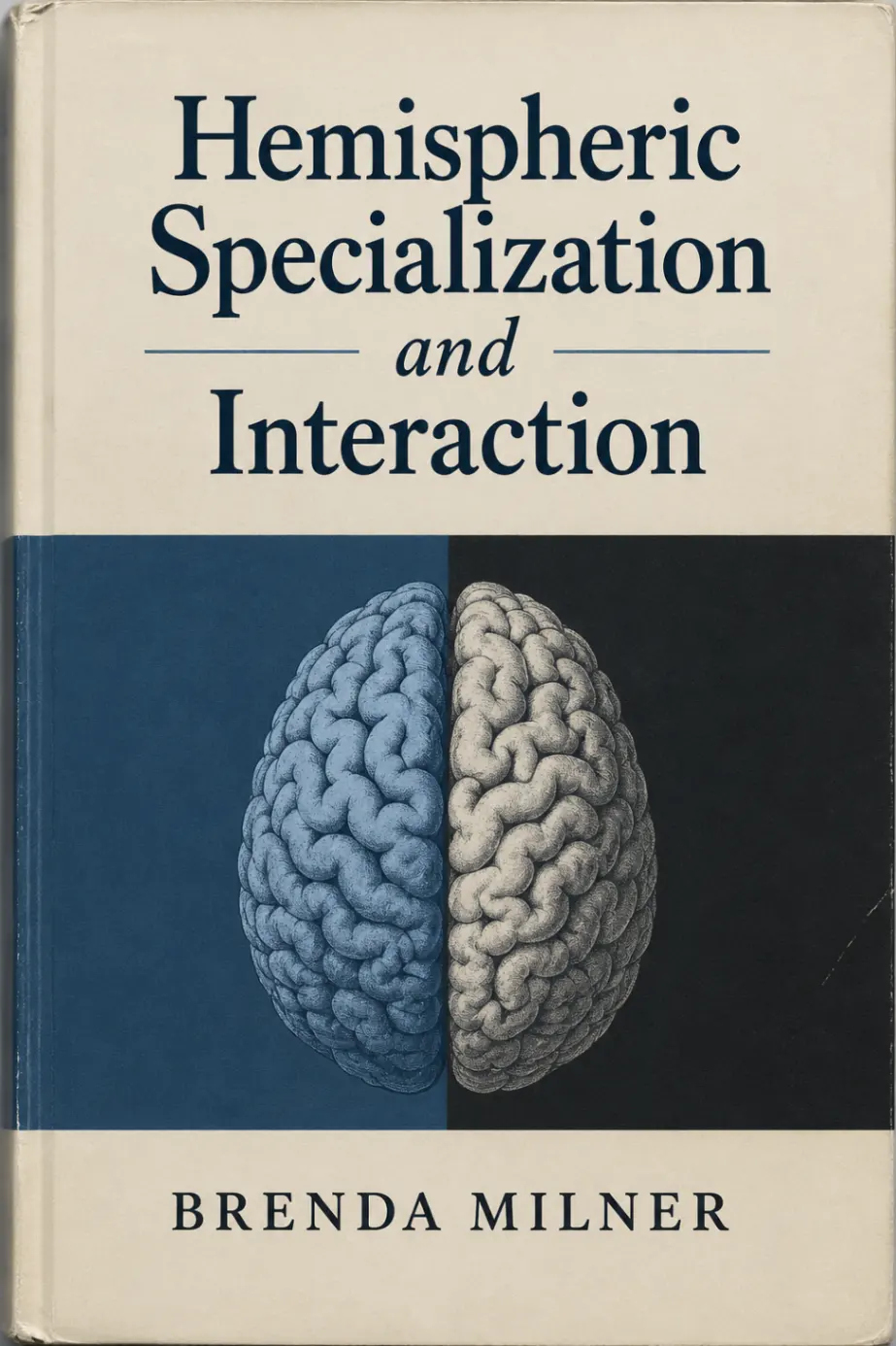
Hemispheric Specialization and Interaction
 Brenda Milner
This volume, edited by Brenda Milner, is a standalone reprint of the opening section of the 1974 Neurosciences Study Program. Its central contribution is Milner's framing of a dual research problem: decades of work had documented the contrasting specializations of the left and right hemispheres, but almost nothing was known about how the two sides interact in normal behavior. Milner argues that the field must move beyond cataloging asymmetries to investigating interhemispheric communication, drawing on commissurotomy patients, normal-subject techniques, and animal models. The section includes Milner's own chapter on the scope and limits of hemispheric specialization.
Key Details
Related Books
View AllSimilar books from the same category, ranked by shared topics and reader engagement.



Key Insights — Read in 10 Minutes
What is the central argument of Milner's introductory chapter?
Milner argues that by the early 1970s, research had firmly established that the left and right cerebral hemispheres are not functionally equivalent, but that the field had almost completely neglected the complementary question of how they interact. She notes that already by the 1860s, observations on patients with unilateral brain disease pointed to left-hemisphere dominance for speech, leading to an overgeneralized view of left-sided cognitive prepotency. It was not until World War II that studies on patients with well-lateralized lesions revealed the importance of the right hemisphere for spatial functions. The most direct evidence for dual asymmetry came from Roger Sperry's work with commissurotomy patients, whose hemispheres could be tested independently. Milner insists that understanding normal behavior requires tackling hemispheric interaction, not just specialization.
How does this volume differ from a typical authored monograph?
This is not a single sustained argument but a curated section of conference proceedings, originally published as part of The Neurosciences: Third Study Program (1974) and reprinted as a standalone paperback in 1975. The section consists of Milner's introduction, followed by contributions from R.W. Sperry, Michel Cuénod, Donald Broadbent, A.M. Liberman, C.J. Darwin, G. Berlucchi, Hans-Lukas Teuber, and Milner herself. Each chapter addresses a different facet of hemispheric specialization or interaction. Milner's editorial role was to frame the section and solicit contributions that would advance the discussion beyond simple cataloging of asymmetries, making the volume a collaborative snapshot of a field in transition.
What does Milner mean by calling hemispheric interaction 'a relatively uncharted field'?
In her introduction, Milner states that at the time of writing, the field had 'almost complete ignorance about the second half of our topic, that of hemispheric interaction, in so far as it pertains to man.' While reaction-time studies in normal subjects could make a few inferences about interhemispheric transfer, purely behavioral measures could not reveal the form in which information is transmitted between hemispheres or which pathways are essential for specific tasks. Milner argues that animal experiments are necessary to identify elementary mechanisms of commissural transfer, citing Michel Cuénod's work on pigeons as an example. This framing of interaction as the neglected half of the problem would guide Milner's own research for decades, including her later Balzan Prize-funded project on hemispheric interaction in cognitive processes.
What was the significance of this section for Milner's later research program?
The 1974/1975 section served as a foundation for Milner's subsequent decades of work on hemispheric interaction. When she received the 2009 Balzan Prize for Cognitive Neurosciences, she devoted the second half of the prize money to a research project explicitly titled 'Hemispheric Interaction in Cognitive Processes,' recruiting postdoctoral fellows to use functional imaging to explore how the two hemispheres work together in healthy volunteers and patients. The Balzan documentation cites her 1974 chapter as the origin of this line of inquiry. The project investigated how individual differences in hemispheric connectivity relate to memory capability, finding that stronger interhemispheric connectivity in the posterior hippocampus correlates with higher memory test performance.
What role did commissurotomy patients play in the argument of this section?
Commissurotomy patients—individuals who had undergone surgical severing of the corpus callosum and other interhemispheric commissures for intractable epilepsy—provided the most direct evidence for dual functional asymmetry. In Milner's introduction, she highlights Roger Sperry's work with these patients, noting that by confining sensory input and motor output to one hemisphere, Sperry and colleagues were able to 'bring out the contrasting specializations of the two sides of the adult human brain.' Sperry's contribution to the volume details findings indicating 'two distinct modes of central processing' in the disconnected hemispheres. However, Milner also observes that comparing commissurotomized patients with matched patients with intact commissures revealed that 'each hemisphere acting alone was severely handicapped on memory tasks,' which excited her interest in how the hemispheres normally cooperate.
How does the volume address the problem of hemispheric interaction in normal subjects?
Several contributions address this problem. Donald Broadbent's chapter on the division of function and integration of behavior argues that if the two hemispheres were truly different in their modes of action, it should be relatively easy to find tasks that can be performed in parallel, one by each hemisphere. The fact that interference is the rule rather than the exception suggests that at some critical stage of decision-making, humans behave as a 'single-channel organism.' This implies that researchers cannot be content with cataloging contrasting specializations but must address how the hemispheres interact in normal behavior. Giovanni Berlucchi's chapter describes asymmetries in normal vision using brief lateralized presentations, showing greater accuracy for nonverbal patterns on the left and letters on the right. These findings, Milner argues, reflect the contrasting specializations that must somehow be integrated.
Show 1 more insights
What was the original context of publication for this section?
The section was originally published as pages 3–89 of The Neurosciences: Third Study Program (MIT Press, 1974), edited by Francis O. Schmitt and Frederic G. Worden. That volume compiled the proceedings of the 1972 Intensive Study Program in the Neurosciences, held in Boulder, Colorado, organized by MIT's Neurosciences Research Program. The Third Study Program represented a deliberate shift from the comprehensive coverage of the two earlier programs toward identifying specific areas of promising research. The section on hemispheric specialization and interaction was chosen to open the volume, reflecting the growing importance of laterality research. The standalone paperback edition was issued in 1975 with the same pagination and content.
Wealthy Psyche is an intellectual archive. We do not host, distribute, or sell book copies — physical or digital. We provide structured knowledge to help you think better, faster.