


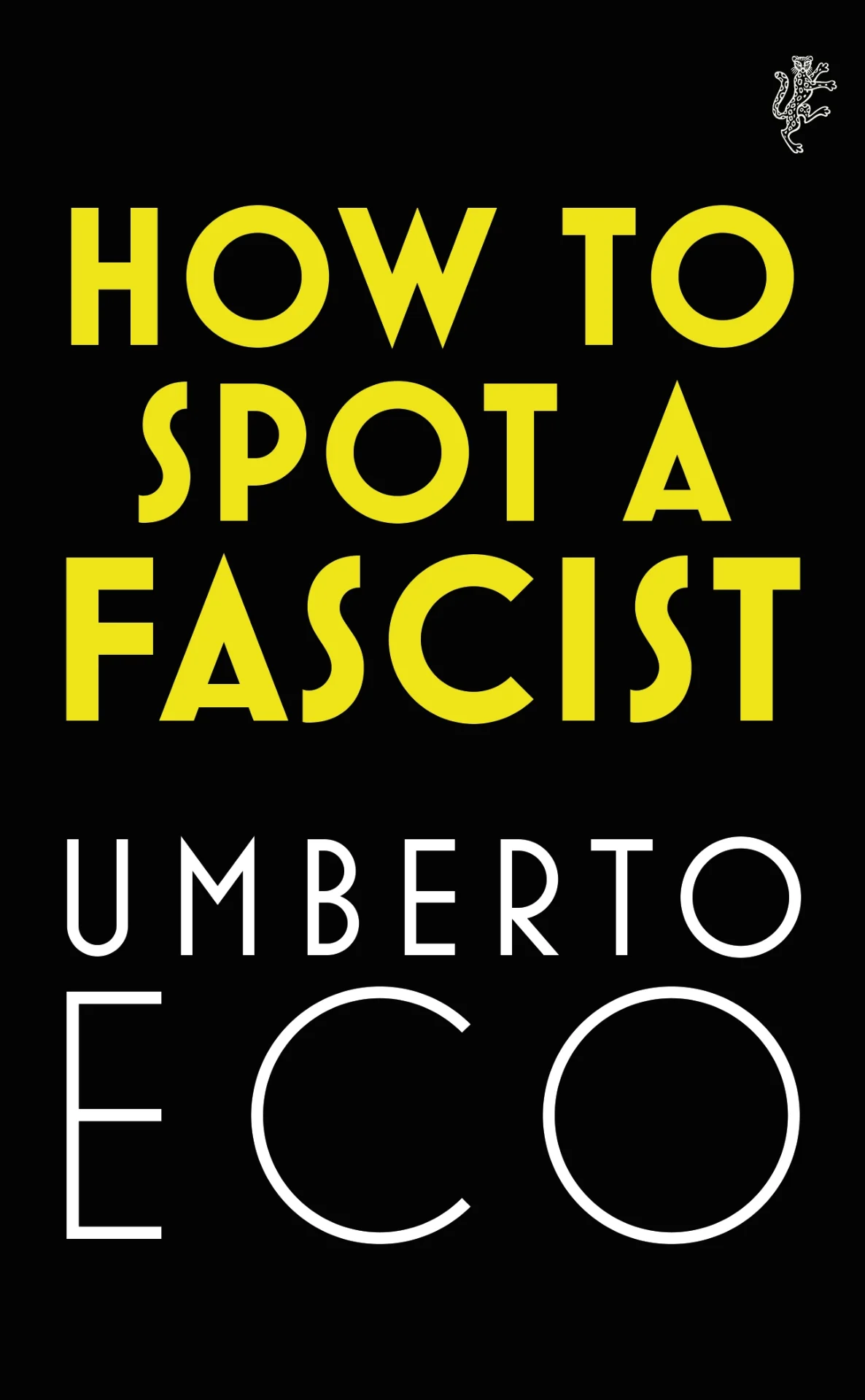
How to Spot a Fascist
 Umberto Eco
This collection gathers three essays that build a single argument: fascism is not a fixed ideology but a set of recurring cultural habits that can coagulate around any one of fourteen features. The central essay, 'Ur-Fascism,' draws on Eco's childhood in Mussolini's Italy to argue that the original Fascism contained no single essence—only a 'fuzzy' constellation of traits including the cult of tradition, fear of difference, and obsession with a plot. The companion essays on censorship and European identity extend the warning into the present, treating vigilance as a permanent civic task.
Key Details
Related Books
View AllSimilar books from the same category, ranked by shared topics and reader engagement.



Key Insights — Read in 10 Minutes
How does 'Ur-Fascism' define fascism, and what does it reject?
Eco defines fascism not as a coherent ideology but as a 'fuzzy' constellation of cultural habits and instincts—fourteen recurring features that can appear in various combinations without forming a logical system. He explicitly rejects the idea that fascism had a single essence: Italian Fascism 'contained no quintessence, and not even a single essence' [citation:5]. It was a collage of often contradictory ideas. The critical implication is that fascism is adaptable: remove some features, and it remains recognizable. This is why he calls it 'Ur-Fascism'—a permanent temptation rather than a discrete historical episode.
What are the fourteen features of Ur-Fascism, and how are they used today?
The features include: the cult of tradition, rejection of modernism, cult of action for action's sake, disagreement as treason, fear of difference, appeal to a frustrated middle class, obsession with a plot, enemies depicted as simultaneously too strong and too weak, pacifism as trafficking with the enemy, contempt for the weak, the hero cult of death, machismo, selective populism, and Newspeak [citation:1][citation:2]. The framework is widely used in political commentary and education to analyze contemporary far-right movements without reducing them to direct historical analogies. Eco's purpose is diagnostic vigilance, not accusation.
How does this collection differ from the standalone essay 'Ur-Fascism' as originally published?
How to Spot a Fascist is a curated selection of three essays, not a single work. The other two pieces—'Censorship and Silence' and 'We are European'—extend the themes of the title essay. 'Censorship and Silence' examines how access to too much information can be as harmful as its restriction, written at the dawn of the social media age [citation:3]. 'We are European' is a defence of the European idea and a warning about the fragility of peace. The collection was assembled by Harvill Secker in 2020, with translations by Richard Dixon and Alastair McEwen [citation:2][citation:11].
What is the most common misconception about Eco's fourteen features?
The essay is often read as a checklist for labeling political opponents as fascists, but Eco explicitly cautions against this. He argues the features cannot be organized into a system, that many are typical of other forms of despotism, and that 'it is enough that one of them be present to allow fascism to coagulate around it' [citation:5]. Critics have noted the framework is broad enough to describe aspects of many authoritarian ideologies. Eco's purpose is vigilance, not verdict: the features are warning signs, not a verdict.
How has the essay's argument held up since it was first delivered in 1995?
The essay has proven remarkably prescient. Its warnings about 'Internet populism'—where 'the emotional response of a selected group of citizens can be presented and accepted as the voice of the people'—anticipated contemporary digital politics. Its framework is routinely cited in analyses of far-right movements globally. However, scholars have criticized its definitional looseness: a detailed critique argues that Eco's features 'in no way describe the essential features of fascism' but rather a 'broad spectrum of authoritarian and totalitarian thought.' The essay remains more valuable as a moral warning than as a rigorous analytical definition.
What is the publication history of this collection?
How to Spot a Fascist was published by Harvill Secker in London in August 2020 [citation:2][citation:11]. The book is 51 pages and includes an introduction and notes [citation:11]. The individual essays were previously published separately. 'Ur-Fascism' was originally delivered as a lecture at Columbia University in 1995 and later collected in Five Moral Pieces. The 2020 edition was translated by Richard Dixon and Alastair McEwen [citation:2][citation:9]. It is available in paperback and has been widely reviewed as a timely intervention in contemporary political debate.
Wealthy Psyche is an intellectual archive. We do not host, distribute, or sell book copies — physical or digital. We provide structured knowledge to help you think better, faster.