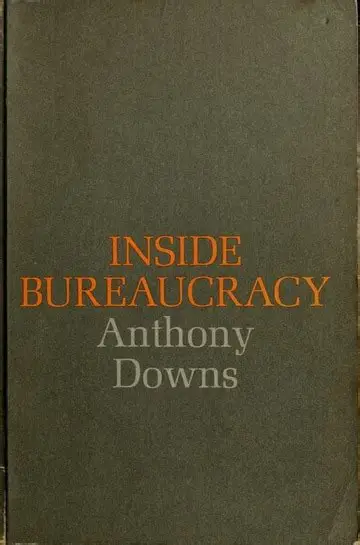
Inside Bureaucracy
 Anthony Downs
Downs's Inside Bureaucracy applies rational-choice analysis to the behavior of career public servants, arguing that bureaucratic decision-making can be predicted through the interaction of self-interest and organizational structure. Its central mechanism is a typology of five official types — climbers, conservers, zealots, advocates, and statesmen — generated by varying combinations of nine motives, five purely self-interested and four altruistic [citation:10][citation:11]. Downs derives a series of "laws" from these types, most famously the Law of Increasing Conservatism: organizations tend to become more conservative as they age, unless rapid growth or turnover intervenes [citation:5][citation:19].
What is the central argument of Inside Bureaucracy, and how does it differ from Downs's earlier work on democracy?
The book argues that bureaucratic decision-making can be analyzed through the same rational-choice framework Downs applied to voters and parties, but with a crucial modification. In An Economic Theory of Democracy, officials were assumed to be uniformly self-interested budget maximizers. In Inside Bureaucracy, Downs explicitly rejects this uniformity, positing that officials have a complex set of nine motives — five self-interested (power, income, prestige, convenience, security) and four altruistic (loyalty, pride in performance, public interest, policy commitment) [citation:10][citation:11]. The result is a theory of motivational heterogeneity, where different types of officials dominate a bureau at different stages of its life cycle [citation:9].
What are the five types of officials Downs identifies, and what distinguishes them?
Downs identifies two purely self-interested types and three mixed-motive types. Climbers maximize power, income, and prestige, seeking promotion and aggrandizement. Conservers maximize convenience and security, resisting radical change and seeking to retain what they already have. Zealots are committed to narrow policies or concepts, treating them as "sacred policies," and are poor general administrators [citation:10]. Advocates are loyal to a broader organization or client group, acting as partisans externally but impartial arbiters internally. Statesmen are loyal to society as a whole, and are often doomed to be misfits in office, forced to behave like advocates [citation:10][citation:17].
What is the Law of Increasing Conservatism, and how does Downs derive it?
The Law of Increasing Conservatism states that "all organizations tend to become more conservative as they grow older, unless they experience periods of very rapid growth or internal turnover" [citation:5][citation:19]. Downs derives it from the life-cycle dynamics of bureaus: new agencies attract disproportionate numbers of climbers and zealots, but as they age, promotion opportunities dry up, and officials who fail to advance adopt conserver attitudes. The longer an agency has existed without rapid growth or turnover, the more it becomes dominated by conservers, making it increasingly resistant to change . This is one of sixteen "laws" Downs derives from his three basic axioms [citation:2].
What is the most common criticism of Inside Bureaucracy?
The most persistent criticism is the disparity between the book's theoretical ambitions and its actual accomplishments. The American Political Science Review noted that Downs introduces "a hopeless number of variables" and fails to utilize his three basic axioms in any meaningful way, despite claiming that most conclusions are derivable from them . Public choice scholars also criticize vague and ill-defined definitions of bureaucrats' utility functions and the assumption that all bureaucracies are hierarchical line agencies [citation:8]. The book has been described as "really about bureaucratic structure" rather than bureaucratic decision-making, with relatively little that is unique about the latter .
How does Inside Bureaucracy relate to William Niskanen's work on bureaucracy?
Downs and Niskanen are the two seminal public-choice accounts of bureaucratic behavior. Downs's central innovation is his pluralist treatment: officials are motivated by a complex mix of self-interest and altruism, and their behavior is constrained by conservatism and other motivations. Niskanen's new-right thesis, by contrast, treats budget maximization as an open-ended process constrained only by external limits on agencies' ability to push up budgets [citation:8]. Downs's bureaucrats are more heterogeneous and their behavior more contingent on organizational life-cycle than Niskanen's uniform budget maximizers. The two works share a rational-choice framework but differ fundamentally in their assumptions about official motivation.
What role does the life cycle of bureaus play in Downs's theory?
The life cycle is the dynamic mechanism that generates Downs's most distinctive predictions. New bureaus are born by splitting off from existing organizations, through the entrepreneurial activities of zealots, or to routinize a leader's charisma. They attract disproportionate numbers of climbers (seeing fast-track promotion) and zealots (mission-committed to new programs). As agencies age, climbers decline to normal levels, and conservers come to dominate. The longer an agency exists without rapid growth or personnel turnover, the more resistant to change it becomes . This dynamic selection process — where different motives dominate at different stages — makes Downs's model unique in the public-choice tradition, which typically focuses on incentive properties rather than selection properties [citation:9].
Wealthy Psyche is an intellectual archive. We do not host, distribute, or sell book copies — physical or digital. We provide structured knowledge to help you think better, faster.