


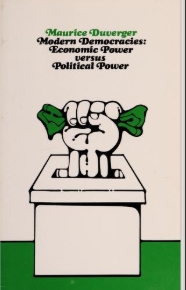
Modern Democracies: Economic Power versus Political Power
 Maurice Duverger
Duverger's Modern Democracies argues that Western democracies are inherently dualistic, a 'Janus' with two faces: political power, exercised through elections and parties, and economic power, held by capital and large firms. Its central mechanism is the claim that citizens and their organizations do not hold political power alone; they share it with the holders of capital, both individuals and corporate entities [citation:4]. The book examines the constitutional history of Europe and the United States to trace how this dualism developed, and analyzes how the balance between the two powers shapes the actual functioning of democratic regimes. A revised translation of his earlier work Janus [citation:1][citation:17].
What is the central argument of Modern Democracies, and how does it relate to Duverger's earlier work on political parties?
The book argues that modern Western democracies are fundamentally dualistic, composed of two complementary but opposed faces: the pluralism of elections, parties, and liberties on one side, and the concentrated power of capital and large firms on the other. Citizens and their organizations do not hold political power alone; they share it with the holders of economic power [citation:4]. This extends Duverger's earlier party analysis by locating parties within a broader structural conflict between political and economic power, rather than treating them in isolation.
What is the 'Janus' metaphor, and why does Duverger use it?
Janus is the Roman god with two faces looking in opposite directions. Duverger uses the metaphor to describe Western democracy as a system with two opposed but complementary faces: the political face of pluralism, liberties, and competitive elections, and the economic face of capital, industrial firms, and financial power [citation:4]. The original French title of the work was Janus: Les deux faces de l'Occident, and the English edition is a revised and updated translation [citation:1][citation:17]. The metaphor captures his claim that democracy's dualism is constitutive, not incidental.
How does Modern Democracies differ from Duverger's Political Parties?
Political Parties (1951) analyzed the organizational structures and electoral effects of parties, producing Duverger's Law. Modern Democracies (1974) shifts focus to the broader power structure within which parties operate, arguing that parties are one face of a dual system whose other face is economic power. Where the earlier work examined party systems as dependent variables of electoral law, the later work examines democracy as a contested space between political and economic forces. The two books address different levels of analysis: organizational mechanics versus structural power.
What is the most common misconception about Duverger's argument in this work?
A common misconception treats the book as a straightforward Marxist critique of capitalist democracy. Duverger's framework is not Marxist: he does not argue that economic power determines political power, but rather that the two coexist in a relationship of mutual influence and tension. He acknowledges the reality of political pluralism and electoral competition as genuine achievements, while insisting they are partial because economic power remains outside democratic control [citation:4]. The book is a liberal-pluralist diagnosis of a structural imbalance, not a call for the abolition of private capital.
What specific concepts or frameworks did this work introduce?
The book introduced the 'technodemocracy' hypothesis, which Duverger developed as a way to understand the intersection of economic and political power in advanced democracies. A 2025 article in Almanaque raises Duverger's technodemocracy hypothesis to discuss the validity of an evolutionary nexus between Stigler's economic theory of regulation and Kingdon's pluralist model of legislative actors [citation:13][citation:20]. The work also contributed to the conceptual distinction between 'political democracy' (a regime of free elections) and 'social democracy' (the pursuit of economic equality), arguing that true democracy requires their union [citation:11].
Wealthy Psyche is an intellectual archive. We do not host, distribute, or sell book copies — physical or digital. We provide structured knowledge to help you think better, faster.