


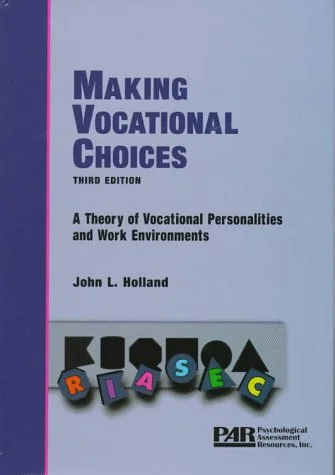
Making Vocational Choices: A Theory of Vocational Personalities and Work Environments
 John Lewis Holland
Holland's book presents the RIASEC theory: people and work environments can be classified into six types—Realistic, Investigative, Artistic, Social, Enterprising, and Conventional—and vocational choice is the search for a work environment congruent with one's personality type. The theory predicts that congruence produces satisfaction, stability, and achievement, while incongruence produces dissatisfaction and turnover. Its distinctive contribution is the hexagonal model ordering the six types by psychological similarity, which became the dominant framework for interest assessment and career counseling worldwide.
Key Details
Related Books
View AllSimilar books from the same category, ranked by shared topics and reader engagement.



Key Insights — Read in 10 Minutes
What is the RIASEC hexagon, and why is it central to Holland's theory?
The RIASEC hexagon is a structural model ordering the six vocational personality types—Realistic, Investigative, Artistic, Social, Enterprising, Conventional—by their psychological similarity. Types adjacent on the hexagon (e.g., Realistic and Investigative) are more similar than types opposite (e.g., Realistic and Social). Holland identified this structure in 1969, and it became the basis for his theory of six interest types and parallel work environments . The hexagon's practical function is to make congruence measurable: a person's profile can be summarized as a three-letter code, and the fit with an occupation's code can be calculated. Holland noted that 'a theory without a diagram cannot be science' , and the hexagon supplied the visual and mathematical structure that made the typology usable in research and counseling.
What does Holland's theory predict about the consequences of personality-environment congruence?
Holland's theory states that the more congruent a person's personality type is with their work environment, the more likely they are to experience satisfaction, stability, and achievement. A German summary of the theory formulates the central thesis: the more homogeneous and consistent the personality pattern and the greater the match between personality and vocational environment, the (a) more stable the vocational choice, (b) better the vocational and academic performance, (c) greater the personal stability, (d) greater the satisfaction, and (e) greater the creative achievement . The theory also predicts that incongruence produces dissatisfaction and turnover, making congruence a measurable predictor of vocational outcomes.
How did Holland's military and counseling experience shape the typology?
Holland served as an induction interviewer in the military from 1942 to 1946, an experience he credited with leading him 'to think that people fall into a relatively small number of types' . Later vocational counseling with college students, physically impaired clients, and psychiatric patients reinforced this belief. His counseling experience also made him 'anxious to find a way to organize occupational information so that the counseling assessment could be related more explicitly to occupations' . The typology thus emerged from practical necessity: Holland needed a classification that would connect what he learned about individuals to the occupations they might enter, and the six-type system provided that bridge.
What does the 'Self-Directed Search' have to do with this book?
The Self-Directed Search (SDS) is the self-help instrument Holland developed to operationalize the theory presented in Making Vocational Choices. Holland described it as one of the 'popular self-help devices' that the theory 'has spawned' . The SDS presents statements like 'I understand the Big Bang theory of the universe' or 'I can refinish furniture or woodwork'; participants total the statements they endorse and interpret the findings themselves . Holland characterized the technique as 'childlike they're so simple,' adding that 'personality and interest inventories are kind of an interview about life histories' . The SDS made the RIASEC framework accessible to millions of users outside formal counseling.
How has the RIASEC model held up under subsequent empirical testing?
The structural model has received substantial support but with limitations. A 2007 study evaluating the fit of the RIASEC model to the full range of US occupations found that the six types 'are not sufficient to represent the full range of occupational interests and are confounded with prestige and sex-type' . The study noted that structural studies had supported the typology primarily with measures designed to measure the six types, but that 'at the occupational level, there is surprisingly little research evaluating how well the six types represent the structure of the US labor market' . The hexagonal structure itself has broad empirical support, but its sufficiency for capturing all occupational variation remains contested.
What did Donald Super say about Holland's book, and why does that matter?
Donald Super, the eminent vocational development theorist whose approach differed fundamentally from Holland's trait-factor model, reviewed the second edition (1985) in Contemporary Psychology. Alexandra MacKenzie's later review quotes Super's conclusion: 'This volume is a monument to Holland and a must for all who work with people in relation to occupations' . The praise matters because Super and Holland represented rival traditions in vocational psychology—Super's developmental, lifespan approach versus Holland's structural typology. Super's endorsement signaled that Holland's theory had achieved recognition across theoretical boundaries, and that its practical utility for counselors was undeniable regardless of one's preferred framework.
Show 2 more insights
How does the third edition (1997) differ from the second (1985)?
The third edition includes only minor revisions. Deborah Betsworth's review in PsycCRITIQUES noted that the second edition was 'a summary of his work' providing 'a comprehensive review of the theory and relevant research up to 1985' . The third edition was judged 'helpful to those people who are newly acquainted with Holland's theory,' but 'for those people well-versed in the theory, the third edition does not offer a substantive change over the second edition' . Holland described the revisions across editions as attempts 'to provide a theory that better complies with scientific standards of logic and evidence,' noting that 'the typology has become more immune to criticism as defects have been eliminated or softened in successive revisions' .
How does Holland's approach differ from Frank Parsons's tripartite model?
Holland's theory revises Parsons's static matching model by making the matching structural and measurable. Parsons's tripartite model required the counselor to help the client understand themselves, understand the occupational world, and apply 'true reasoning' to relate the two. Holland replaced this open-ended reasoning process with a formal typology: both persons and environments are classified into six types, and congruence is calculated from the match between profiles. Where Parsons's method depended on the counselor's judgment and the client's self-understanding, Holland's method can be operationalized through inventories and codes. The revision made vocational matching scalable and testable, but sacrificed Parsons's emphasis on developmental process and individual nuance.
Wealthy Psyche is an intellectual archive. We do not host, distribute, or sell book copies — physical or digital. We provide structured knowledge to help you think better, faster.