


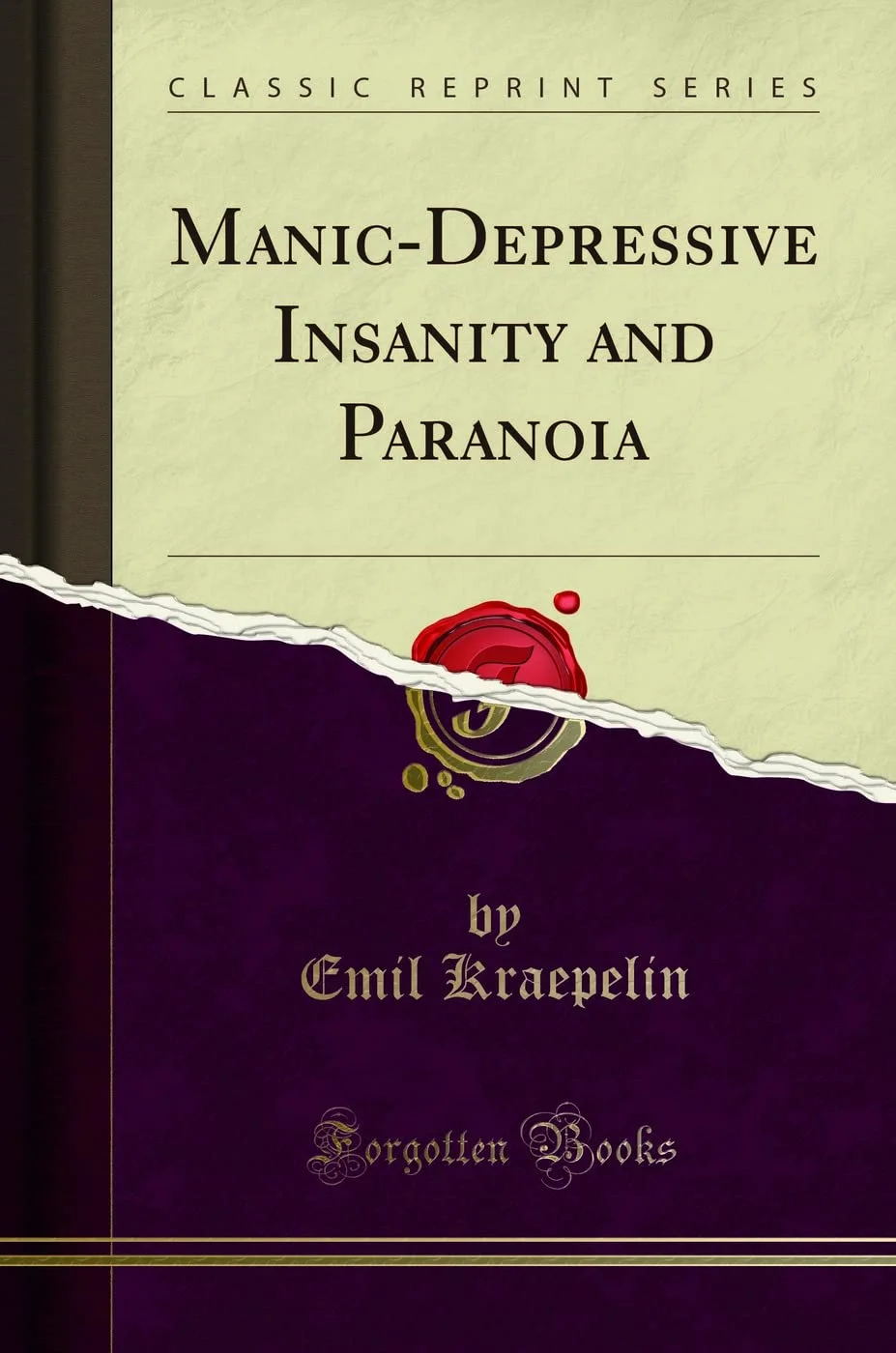
Manic-Depressive Insanity and Paranoia
 Emil Kraepelin
This volume is an English translation of selections from Kraepelin's Psychiatrie, presenting two nosological categories that sit uneasily together. Manic-depressive insanity is defined by its episodic, non-deteriorating course—an expansive category absorbing periodic, circular, and simple manic and depressive states under a single disease process. Paranoia is reserved for a chronic, logically elaborated delusional system with preserved intellect and personality. The book's central argument is that course and outcome, not symptom pictures, carve nature at its joints. Its interest today lies in the tension between these categories and the subsequent fate of each in twentieth-century psychiatry.
Key Details
Related Books
View AllSimilar books from the same category, ranked by shared topics and reader engagement.

Key Insights — Read in 10 Minutes
What is the central nosological claim of this volume, and what does it reject?
The central claim is that manic-depressive insanity is a single disease process encompassing the entire domain of periodic and circular insanity, simple mania, and melancholia, unified by an episodic, non-deteriorating course. Kraepelin states that he had become increasingly convinced these pictures were merely forms of one disease process . This rejects the earlier symptomatic nosologies that treated mania, melancholia, and periodic insanity as separate disorders based on cross-sectional presentation. The organizing criterion is prognosis: manic-depressive illness has a favorable outcome, while dementia praecox deteriorates. Paranoia, by contrast, is defined as a chronic, logically elaborated delusional system with preserved intellect—a narrow residual category after the broad affective domain has been carved out.
How was the English edition of this work produced, and what does that mean for readers?
The 1921 English volume was translated by R. Mary Barclay and edited by George M. Robertson, published in Edinburgh by E. & S. Livingstone . It is explicitly a translation of selections from Kraepelin's Psychiatrie, not a complete or standalone work . The National Library of Scotland records it as translated from the eighth German edition, volumes iii and iv . This matters because Anglophone readers encountered Kraepelin's manic-depressive concept through a curated selection rather than the full textbook. The translation's editorial choices—what was included, what omitted, how German nosological terms were rendered—shaped how English-speaking psychiatry absorbed the dichotomy. Readers should treat this volume as an entry point into Kraepelin's system, not a substitute for the Lehrbuch itself.
How has Kraepelin's manic-depressive concept held up in light of subsequent research?
The category proved remarkably durable. Contemporary bipolar disorder descends directly from Kraepelin's manic-depressive insanity, and the dichotomous framework he established remains embedded in DSM and ICD classifications . However, the paranoia half of the volume fared differently. Kraepelin's narrow definition of paranoia—chronic, systematized, intellect preserved—was progressively eroded as delusional disorders were absorbed into schizophrenia and other categories. A meta-analysis of Kraepelin's primary data suggested his original classification was consistent with the empirical evidence available to him . Yet Kraepelin himself modified his views in later editions, and critics including Adolf Meyer argued his categories were too broad and his emphasis on course misconceived . The dichotomy's persistence reflects its clinical utility, not settled etiological validity.
What were the major contemporary criticisms of the manic-depressive category?
Adolf Meyer, an early admirer of Kraepelin's clinical methodology, became a persistent critic of his nosology. In his 1896 review, Meyer characterized Kraepelin's textbook as 'decidedly dogmatic' and argued that classifying acute psychoses terminating in dementia was 'hypothetical'; he was especially concerned that Kraepelin's drive to organize clinical evidence into groups with specific course and termination was 'a problem, not a solution' . A 2018 review by Kendler and Engstrom identified six major criticisms raised during Kraepelin's lifetime: the categories were too broad and heterogeneous; the emphasis on course was misconceived because the same disease could have brief or chronic courses; the system's success rested on textbook quality and academic esteem rather than empirical findings; symptom focus neglected the whole patient; experimental psychology failed to deliver; and true natural disease entities may not exist in psychiatry .
How does this volume relate to Kraepelin's Dementia Praecox and Paraphrenia?
The two volumes are complementary halves of the Kraepelinian dichotomy, both translated as separate English books from the same German textbook. Dementia Praecox and Paraphrenia presents the deteriorating psychosis; Manic-Depressive Insanity and Paranoia presents the non-deteriorating affective disorder and the residual paranoid category. The relationship is one of contrast and boundary-drawing. Kraepelin defined manic-depressive insanity partly by what it was not: it did not lead to the intellectual deterioration characteristic of dementia praecox. The volumes were published as standalone English texts, which contributed to the impression that they were discrete works rather than chapters of a single nosological system . Reading them together reveals the logic of the dichotomy more clearly than either alone.
What is a common misreading of Kraepelin's manic-depressive insanity?
A frequent misreading treats manic-depressive insanity as equivalent to modern bipolar disorder in the narrow sense. Kraepelin's category was far broader, encompassing recurrent depression without mania, simple mania, and circular insanity under a single disease process . Another misreading assumes Kraepelin regarded it as a unified disease entity in the strict sense. In fact, he described it as 'a disease group grown from a common root with fluid transitions between the individual forms' rather than a single uniform illness . A third misreading projects modern symptom-based diagnostic criteria backward onto Kraepelin. His organizing principle was longitudinal course and prognosis, not cross-sectional symptom counts. Confusing these frameworks distorts what the book actually argued.
Show 1 more insights
How did Kraepelin's own views on these categories evolve after this volume appeared?
Kraepelin was not the static systematizer his later reputation suggests. In his late essay 'Patterns of Mental Disorder' (1920), he acknowledged that dementia praecox and manic-depressive illness could not always be satisfactorily distinguished, and he proposed a more dimensional model consonant with later neuroscience and genetics . He had already shifted involutional melancholia into manic-depressive insanity in the eighth edition (1913), driven by his student George Dreyfus's follow-up study . The English volume of 1921 reflects the eighth-edition state of his system, but Kraepelin's subsequent reflections show he was already questioning the sharp boundaries he had drawn. This intellectual restlessness is often obscured when the dichotomy is treated as a fixed doctrine rather than a working hypothesis.
Wealthy Psyche is an intellectual archive. We do not host, distribute, or sell book copies — physical or digital. We provide structured knowledge to help you think better, faster.