


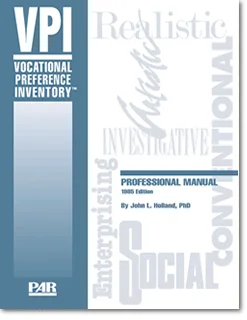
Manual for the Holland Vocational Preference Inventory
 John Lewis Holland
Holland's manual introduces the Vocational Preference Inventory (VPI), an interest inventory using occupational titles as stimuli to measure personality. Its central claim is that preferences for occupations are expressions of personality, and that a person's pattern of likes and dislikes across six vocational types—Realistic, Investigative, Artistic, Social, Enterprising, Conventional—reveals their personality profile. The manual provides administration and scoring instructions, normative data, and validity evidence, presenting the VPI as an economical instrument that avoids the threat of obvious personality assessment by using occupational content.
Key Details
Related Books
View AllSimilar books from the same category, ranked by shared topics and reader engagement.



Key Insights — Read in 10 Minutes
What is the Vocational Preference Inventory, and how does it measure personality?
The VPI is an interest inventory consisting of occupational titles that respondents mark as liked or disliked . The instrument rests on Holland's claim that occupational preferences are expressions of personality—that what a person likes or dislikes among jobs reveals their personality type. Each of the six scales corresponds to one of Holland's vocational orientations, and selecting an occupation title as 'liked' constitutes a response on that scale . The primary characteristic of a person's profile is the scale with the highest score; the secondary is the next highest . The VPI thus translates personality assessment into a task that appears to be about jobs, not about the self.
Why did Holland use occupational titles rather than direct personality questions?
Holland listed several practical advantages of the occupational-title format. The titles provide 'subtle stimuli' that avoid the negative reactions provoked by the ambiguity and threat of inventories that are obviously personality assessments . Because occupational content is not usually perceived as related to personal adjustment, there is less need to fake responses . Respondents request test interpretation less often than with more transparent personality tests, and the VPI is economical in time and money . Holland did not claim the VPI was more valid than comparable inventories, but rather that its worth lay in obtaining a broad range of reliable information economically, with short testing and scoring time and no special equipment .
What did the sixth revision of the manual, published in 1965, contain?
The 1965 sixth revision of the manual was published by Educational Research Associates in Iowa City . It included normative samples that researchers used for comparison—for example, a 'National Sample' of freshmen and groups of employed adults . Notably, no adult female groups were listed among the normative samples in this revision, a limitation that researchers had to work around by selecting two male groups when studying female populations . The manual also provided the scoring keys and interpretation guidelines for the six vocational interest scales and the five additional tendency scales: Self-Control, Masculinity-Femininity, Status, Infrequency, and Acquiescence .
What five additional tendency scales does the VPI measure beyond the six vocational types?
Beyond the six RIASEC scales, the VPI measures five psychological tendency scales . Self-Control (Co) indicates how much a person controls impulsive behavior and thoughts. Masculinity-Femininity (Mf) indicates adherence to traditional sex roles. Status (St) indicates how much a person values social prestige, fame, position, and power. Infrequency (Inf) indicates how unique a person's views of occupations are. Acquiescence (Ac) indicates how broadly a person is interested in a wide variety of occupations . These scales provided additional interpretive context beyond the vocational type profile, though the primary use of the VPI remained the six-type classification.
How did researchers test Holland's predictions using the VPI in the years after this manual?
A 1976 study at the Gordon Institute of Technology administered the VPI to 230 first-year students to test whether the instrument could measure course-student compatibility and whether congruence affected achievement . The VPI discriminated meaningfully between students in different courses, and the mean intercorrelations between scale scores were consistent with Holland's hexagonal ordering . However, the predictions about congruence affecting satisfaction and achievement were only weakly supported: differences were in the predicted direction but not statistically significant . Other studies used the VPI to examine working women, finding that congruent women achieved higher salaries, but that congruence made no significant difference for job satisfaction .
What criticisms were raised about the VPI's applicability beyond college populations?
Walsh's 1978 review criticized the VPI for the lack of validity studies in large non-college populations, the fact that many occupational titles were not appropriate for women, and the absence of specific occupational alternatives being suggested to respondents . Research also indicated that the personality types were not mutually exclusive and independent classes . Despite these limitations, the coefficients of stability indicated acceptable reliability, and validity studies were generally believed to support the meaning attributed to the scales . The VPI's occupational content, designed to reduce faking and threat, also meant that its items reflected the occupational structure of its era, including its gender composition.
Show 2 more insights
How does the VPI relate to Holland's later Self-Directed Search?
The Self-Directed Search (SDS), developed in 1970, operationalizes the same RIASEC theory but for self-administration rather than counselor use . The SDS has four sections: activities liked or disliked, competencies self-assessed, occupational titles appealing, and self-ratings of abilities . Like the VPI, it yields a three-digit code representing the three highest types, which can then be matched to occupational codes . The VPI was designed for professional administration and scoring; the SDS was designed so individuals could score it themselves and interpret the results without a counselor. The shift from VPI to SDS reflects Holland's growing emphasis on making his theory directly accessible to the public.
What was the publication history of the VPI manual across its revisions?
Holland first published the VPI through Educational Research Associates in Iowa City. The 1965 edition is identified as the sixth revision in some sources . By 1967, the manual was being published by Consulting Psychologists Press in Palo Alto, California, still identified as the sixth revision . The instrument was later adapted for international use; a Japanese version administered by the Japan Institute for Labour Policy and Training uses 160 occupational titles with carbon-copy scoring . The VPI remained in use through the 1980s alongside the SDS, though the SDS eventually became the more widely administered Holland instrument.
Wealthy Psyche is an intellectual archive. We do not host, distribute, or sell book copies — physical or digital. We provide structured knowledge to help you think better, faster.