


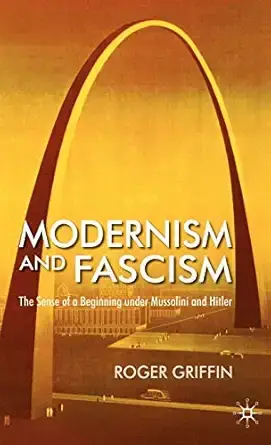
Modernism and Fascism: The Sense of a Beginning under Mussolini and Hitler
Griffin's ambitious synthesis argues that fascism was not anti-modern but a 'total' form of modernism in its own right. Both modernism and fascism, he contends, emerge from the same crisis of meaning in Western modernity—a reaction to the loss of transcendent value and a yearning for renewal. Fascism sought national rebirth through a mythic, aestheticized politics that embraced technology, experimentation, and the creation of a 'new man.' The book offers a nested framework: Italian Fascism and Nazism fit within fascism, which fits within modernism, which fits within modernity itself.
Key Details
Related Books
View AllSimilar books from the same category, ranked by shared topics and reader engagement.

Key Insights — Read in 10 Minutes
What is the central claim of Modernism and Fascism, and what does it reject?
Griffin argues that fascism was not the enemy of modernism but a 'total' form of modernism in its own right. He rejects the longstanding assumption that fascism was anti-modern—that the Third Reich barbarically destroyed modernism while Italian Fascism cynically exploited avant-garde artists for reactionary ends. Instead, both regimes embraced aesthetic modernism and pursued a politically modernist project of national rebirth through creative destruction. The book's nested framework places Italian Fascism and Nazism within fascism, which fits within modernism, which fits within modernity itself.
What specific concept does Griffin introduce to connect modernism and fascism?
Griffin extends his earlier concept of palingenesis—the myth of national rebirth—to modernism as a whole. He argues that modernism and fascism share a fundamental response to the 'disenchantment' of Western modernity: a quest for transcendence and a 'sense of a beginning' after perceived decadence. Both turn to mythopoiesis, the creation of new myths and sacred meanings, to re-enchant a world drained of transcendent value. Fascism's distinctive contribution was to politicize this modernist yearning, seeking national regeneration through a totalizing, aestheticized politics.
How does this book relate to Griffin's earlier The Nature of Fascism?
Modernism and Fascism is the logical extension of Griffin's 1991 breakthrough. The Nature of Fascism established the definition of fascism as 'palingenetic populist ultranationalism.' This later book takes that core insight and situates it within a much grander framework: the crisis of meaning in Western modernity and the various modernist responses to it. If The Nature of Fascism defined fascism's ideological core, Modernism and Fascism explains why that core emerged when it did and why it appealed to millions of educated Europeans—by locating it within the broader cultural history of modernism.
What is the most common misconception about Griffin's argument in this book?
The book is sometimes read as equating fascism with modernism or absolving fascism of its destructiveness. Griffin does neither. He argues that fascism was one variant of modernism, alongside others—not that all modernism was fascist or that fascism's crimes were less real. His point is analytical: fascism must be understood as a modern phenomenon, not a throwback to pre-modern barbarism. This reframing has profound implications for how we understand modernity itself: if fascism was modernist, then modernism cannot be automatically equated with liberal or progressive politics.
How has Modernism and Fascism been received by scholars in the field?
Reception has been overwhelmingly positive, with some reviewers calling it a potential 'paradigm shift' in fascist studies. Stanley G. Payne described it as 'the most important to appear on the history of fascism in a decade or more,' while Zygmunt Bauman praised it for saying something genuinely new about a topic he thought exhausted. Critics have noted that the theoretical sections can be repetitive and the prose jargon-heavy, but even skeptics acknowledge the book's ambition and erudition. It is now a standard reference for the relationship between fascism and modernity.
What does the book's subtitle, 'The Sense of a Beginning,' refer to?
The subtitle plays on Frank Kermode's The Sense of an Ending, which analyzed how narratives impose meaning on time. Griffin inverts this: fascism offered a 'sense of a beginning,' a promise of radical renewal after a period of perceived decline. This sense of beginning was experienced as an epiphanic moment—a break in the empty, meaningless time of modernity (chronos) into a moment filled with significance (kairos). Both modernists and fascists sought to create this experience of transcendence, though fascism sought to institutionalize it through a totalitarian state and a politics of aestheticized spectacle.
Wealthy Psyche is an intellectual archive. We do not host, distribute, or sell book copies — physical or digital. We provide structured knowledge to help you think better, faster.