


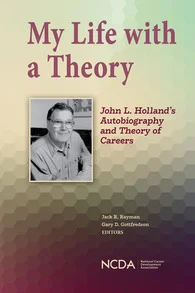
My Life with a Theory: John L. Holland's Autobiography and Theory of Careers
 John Lewis Holland
This posthumous volume publishes Holland's previously unpublished autobiography alongside original statements of his RIASEC theory, correspondence, and tributes from colleagues. Its central claim is that the subjective side of theory development—the rejections, editorial battles, practical frustrations, and personal quirks—is as instructive as the formal theory itself. Holland argues that his typology emerged from hands-on clinical frustration with unworkable interest inventories, not abstract speculation. The book functions as memoir, research manual, and archival exhibit, showing how a nearly blind psychologist built one of the most cited career theories of the twentieth century.
Key Details
Related Books
View AllSimilar books from the same category, ranked by shared topics and reader engagement.



Key Insights — Read in 10 Minutes
What is the central claim of this posthumous volume, and how does it differ from Holland's theoretical books?
The book argues that the subjective side of research—the unexpected problems, tasks, and personal struggles an author encounters—is a neglected but essential dimension of theory development. Holland states his purpose was to document 'the subjective side of the discovery and developmental processes in research that psychological training neglects with its emphasis on research design and statistical analysis or on clinical practice' . Unlike Making Vocational Choices, which presents the finished RIASEC system, this volume shows the theory's messy origins: Holland's frustration with interest inventories that had to be shipped off for scoring, his finding the Dictionary of Occupational Titles cumbersome, and the practical experiences that fueled his desire to create a self-scorable instrument . The book is as much about how to build a theory as about the theory itself.
How does Holland describe the origin of the Self-Directed Search in his autobiography?
Holland traces the SDS directly to his practical frustrations as a counselor. Early in his career, he administered interest inventories so complicated they had to be shipped off for scoring, and he found the Dictionary of Occupational Titles cumbersome to use . These experiences led him to create an interest inventory that could be scored immediately and give clients not just a list of occupations but a schema for understanding what types of work they would enjoy. A graduate student reviewer highlighted this as a key insight: 'Had Holland not reflected on his frustrations as a practitioner, the SDS might never have come to be' . The autobiography thus shows how theory construction can begin with mundane professional annoyance rather than abstract intellectual ambition.
What do the book's editorial encounters reveal about Holland's character and approach to publishing?
The section on 'Editorial Encounters' and the exhibits of correspondence reveal a combative, humorous, and persistent researcher. Holland made no secret of his many journal article rejections, some of which he considered unfair; the volume includes his 'entertaining response to a particularly ill-judged review' in a 1973 letter to Ralph F. Berdie . Reviews note that Holland 'does not hesitate to hold himself to account for his own foibles as a spouse, colleague, and theoretician' and that criticism of his work, especially around gender equity, 'motivated him to reexamine and improve his theory' . The letters show a man who was 'introverted, caring, and a warm individual despite having a biting sarcasm and a sometimes-dark sense of humor' .
What do readers learn about Holland's own RIASEC profile, and why does it surprise people?
Holland's actual RIASEC scores are reported in the volume and have surprised many readers. Students often predict that Holland must have been a high-point Conventional type because his theory has such symmetry and orderliness. In fact, C was the type he least resembled, and his highest score was for the diametrically opposed Artistic type . This revelation serves a pedagogical purpose: it demonstrates that having an undifferentiated profile or not matching one's own theory's 'ideal' type 'does not doom one to an unremarkable and unsatisfying career' . The autobiography offers insights into the 'deep intellectual curiosity and tenacious work that were necessary to develop a theory that has such deceptive simplicity' .
How did Holland's near-blindness affect his career and shape his approach to work?
Jack Rayman's tribute reveals that 'for most of his professional life, he was nearly blind' . Rayman notes the irony: 'a person with such poor vision could be such a visionary.' This fact is not presented as a disability narrative but as a practical condition that shaped Holland's work habits and career choices. The autobiography and exhibits show how he navigated research and publishing with limited vision, and how he prioritized person-environment fit in his own life by 'finding his niche planning research and developing assessments' rather than forcing himself into roles that did not fit his strengths . His approach of recruiting research partners to fill gaps was a practical adaptation that also reflected his theoretical principles.
What is the structure of the volume, and how do the editors frame its purpose?
The book is organized into seven sections: Holland's theory in his own words, the autobiography itself, exhibits (correspondence, notes, papers), perspectives on Holland's contributions, personal recollections, instructional resources, and appendices including a glossary . Editors Rayman and Gottfredson state their principal intent was to make public Holland's autobiography titled 'My Life with a Theory,' supplemented with book chapters and journal articles to enhance understanding of both the theory and the scientist . The material is 'intended to serve as a resource for teaching graduate students about Holland's theory, the scientist, and the tools and methods he developed' . Reviews confirm it succeeds: 'This book is a masterclass on John Holland' .
Show 2 more insights
How has the book been received by the career development community?
Reception has been strongly positive. Brian Montalvo called it 'a masterclass on John Holland' and 'unlike any other career book you have read or will ever read' . Darrin Carr noted that 'readers from other disciplines such as history and philosophy of science, gender studies, higher education, and psychometrics will find value' . The volume prompted a Festschrift—a collection of nine review essays published by Florida State Open Publishing—with contributors reflecting on how the autobiography 'humanized research' and 'normalized' the challenges graduate students face . The book is recommended for career services professionals, counselor educators, and graduate students, though reviewers note it 'should not be considered a replacement for other Holland-based training materials' .
What controversy around gender and measurement does the volume address?
The exhibits include a section on 'Gender and Theoretical Controversy' with papers such as 'Reducing Sexual Inequality' and 'Toward Beneficial Resolution of the Interest Inventory Controversy' . Among the criticisms Holland found most distressing were claims that Holland-based instruments perpetuate and exacerbate gender stereotypes. Holland acknowledged gender differences in RIASEC scores but held they reflect prior socialization, and he took issue with what he viewed as untested claims that taking RIASEC measures exaggerates gender bias . He insisted that assumptions about assessment tools' effects need empirical verification. Recent studies cited in the Festschrift are consistent with the need Holland identified to examine assumptions about test format effects on scores .
Wealthy Psyche is an intellectual archive. We do not host, distribute, or sell book copies — physical or digital. We provide structured knowledge to help you think better, faster.