


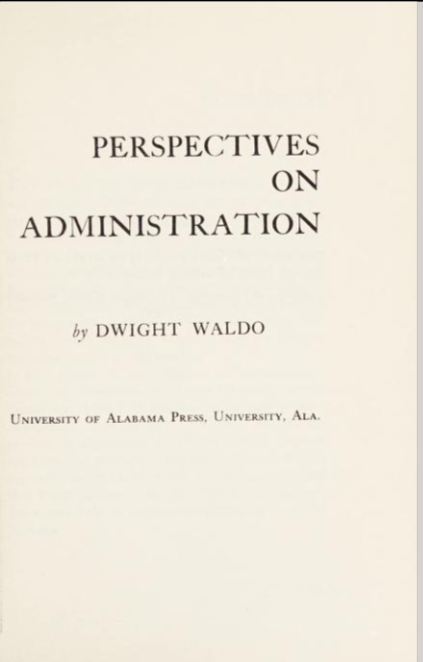
Perspectives on Administration
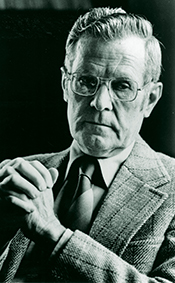 Dwight Waldo
Waldo's 1956 volume collects lectures that deliberately reverse the usual lens: instead of looking at administration from within its own discipline, he examines it through the perspectives of science, philosophy, history, literature, and the social sciences. The central claim is that administration is 'where you least expect to find it'—that its study is impoverished when confined to POSDCORB and formal organization, and enriched when it draws on history's lessons, literature's insights into human motive, and the social sciences' comparative findings. The book closes with Waldo's nagging fear that the field, grown so broad at its periphery, might be dissolving at its center.
Key Details
Related Books
View AllSimilar books from the same category, ranked by shared topics and reader engagement.



Key Insights — Read in 10 Minutes
What is the central argument of Perspectives on Administration?
Waldo argues that public administration is best understood not in isolation but through external perspectives—science, philosophy, history, literature, and the social sciences. A contemporary review described the method as 'reversing the glass': whereas previous lecturers examined administrative problems within the discipline itself, Waldo 'takes a look at administration from the perspectives of science, philosophy, history, literature, and the social sciences'. The recurring motif is that 'administration is where you least expect to find it'—history, literature, and other fields contain lessons that professional administrative writing alone cannot supply. The book closes with Waldo's anxiety that the field, expansive at its edges, might be losing coherence at its center.
What does Waldo mean by 'models' in the philosophy lecture, and why does he find them all good?
In the philosophy lecture, Waldo explores 'models' or organizing ideas around which thinking about administrative problems has been or may be constructed—including law, the machine, organic analogies, business administration, military organization, religious organization, ideology, economics, society, art, science, ethics, communication systems, the brain, and systems. His survey finds that each model illuminates some aspect of administration while obscuring others. The point is not to choose one correct model but to recognize that administrative thought is always shaped by underlying analogies, often unconsciously. This pluralistic stance reflects Waldo's resistance to any single orthodoxy, whether scientific management or behavioralism.
Why did Waldo turn to history and literature for understanding administration?
Waldo argued that public administration's early revolt from history—mirroring its revolt from law—left the field impoverished. In the history lecture, he suggested that 'history has lessons that reach beyond the recent past' and outlined areas needing investigation, including ancient administration, mercantilism, American state and local administrative history, church administration, and comparative administrative history. In the literature lecture, a reviewer called it a 'veritable tour de force,' with Waldo concluding that 'what we can learn from literature complements and supplements what we can learn from the professional writings; it does not necessarily replace or nullify what we can learn from the professional writings'.
How does this book's treatment of the social sciences compare to Waldo's other works?
Perspectives on Administration treats the social sciences as a resource for understanding administration rather than as a foundation for a science of administration. Waldo argued that 'the social sciences, including public administration, closely comparable to the physical sciences on many counts' regarding control, predictability, and self-consistent theoretical systems, concluding that 'in a very real sense, all sciences are social'. This positioned him between the behavioralists, who sought nomothetic social science, and the traditionalists, who resisted scientific pretensions. A later scholar identified Waldo's project as 'deconstructing, demystifying and derelifying the myth of science of public administration'.
What was the original occasion for these lectures, and how does that shape the book?
The book collects the 1954 lectures sponsored by the University of Alabama in connection with the Southern Regional Training Program. A contemporary review noted it was 'a worthy addition to an enterprise that has done much to broaden the horizons and deepen the intellectual content of academic public administration in the United States'. The lecture format gives the book its exploratory, essayistic quality. A reviewer observed that Waldo 'raises, as he intended, many more questions than he answers,' making it 'certain to be the source of many ideas for further work by others'. The book is 143 pages and was published by the University of Alabama Press in 1956.
What is the significance of Waldo's closing fear about the 'center' of the discipline?
The final paragraph of Perspectives on Administration provides the point of departure for Martin Landau's chapter on 'field' and decision-making. Waldo cited Fritz Morstein Marx's fear that public administration, grown so broad and involved at its periphery with other activities and disciplines, stood 'in danger of disappearing completely as a recognizable focus of study.' Waldo admitted this first struck him as misplaced, but added: 'I have a nagging worry of late, a fear that all is not as healthy as it should be at the center of the discipline'. This anxiety anticipated the 'identity crisis' of the 1960s and remained a persistent theme in Waldo's later work.
Wealthy Psyche is an intellectual archive. We do not host, distribute, or sell book copies — physical or digital. We provide structured knowledge to help you think better, faster.