


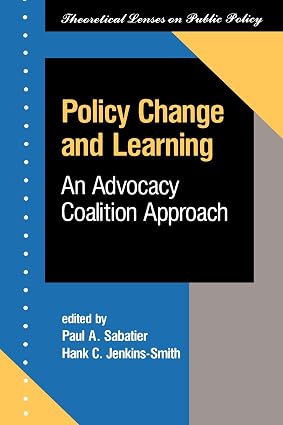
Policy Change and Learning: An Advocacy Coalition Approach
Edited by Paul Sabatier and Hank Jenkins-Smith, this volume lays out the fullest exposition of the Advocacy Coalition Framework (ACF) to date. The ACF argues that policy change must be understood over a decade or more, within policy subsystems where actors organize into coalitions bound by shared belief systems. Competing coalitions—not individual decision-makers or the classic stages model—drive policy evolution through both external shocks and policy-oriented learning. Case studies apply the framework to education, airline deregulation, communications, energy, and environmental policy, while revising the approach for future research.
Key Details
Related Books
View AllSimilar books from the same category, ranked by shared topics and reader engagement.


.webp?alt=media&token=d5823825-9200-4590-80ba-207a9f340b65)
Key Insights — Read in 10 Minutes
What is the central claim of Policy Change and Learning?
The book argues that understanding policy change requires a time horizon of a decade or more, focusing on policy subsystems where actors coalesce into advocacy coalitions bound by shared belief systems. Competing coalitions struggle over policy, and change occurs either through external shocks to the subsystem or through policy-oriented learning that alters coalition beliefs. This framework rejects the classic stages heuristic—agenda setting, formulation, implementation—as inadequate for explaining causal drivers of change.
What specific framework did this book fully articulate?
It provided the fullest exposition and application of the Advocacy Coalition Framework (ACF), which Sabatier and Jenkins-Smith had been developing since the early 1980s. The ACF posits that policy subsystems are populated by advocacy coalitions organized around shared policy core beliefs, and that policy change results from external perturbations or policy-oriented learning. The 1993 volume revised the approach in significant ways, including refinements to the model of individual behavior, subsystem dynamics, and coalition structure.
What policy domains do the case studies cover?
The volume includes qualitative and quantitative case studies across education (Canadian education policy), airline deregulation, federal communications policy, offshore energy politics, and California water politics and environmental policy at Lake Tahoe. Contributors test the ACF's propositions in these arenas, examining how competing coalitions form, how policy-oriented learning occurs, and how external shocks trigger subsystem change. The case studies illustrate the framework's utility for illuminating policy dynamics that elude the stages model.
How was the Advocacy Coalition Framework received by the broader policy studies field?
The ACF became one of the most widely applied frameworks in policy process research. By the late 2000s, reviews identified approximately 80 applications with increasing globalization, particularly in Europe. However, scholars like Lertzman et al. found that the ACF is useful for approaching policy change but argued that finer discriminations are needed to detect policy learning, contending that Sabatier underestimates how the legitimation function of key ideas forces coalitions to respond to criticism in ways that promote learning without external crises.
What is the relationship between this book and Sabatier's later Theories of the Policy Process?
Policy Change and Learning (1993) was the foundational statement of the ACF. Sabatier later included a revised and condensed version of the framework in Theories of the Policy Process (first edition 1999), an edited volume he created to showcase competing policy process theories. The ACF chapter in Theories of the Policy Process underwent further revisions across subsequent editions, incorporating clarifications on coalition opportunity structures and the framework-theory distinction, but the 1993 volume remains the original comprehensive articulation.
Wealthy Psyche is an intellectual archive. We do not host, distribute, or sell book copies — physical or digital. We provide structured knowledge to help you think better, faster.