


Paul A. Sabatier
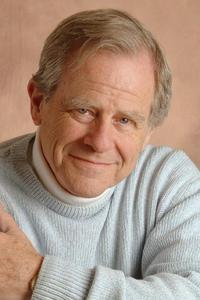
Paul Sabatier transformed the study of public policy by creating the Advocacy Coalition Framework (ACF), a causal model designed to explain policy change over decades. Developed with Hank Jenkins-Smith in the late 1980s[reference:0][reference:1], the ACF contends that policy subsystems are populated by advocacy coalitions—groups of actors from diverse positions who share deep core beliefs and coordinate over time[reference:2]. Major policy change occurs through policy-oriented learning, external shocks, or negotiated agreements[reference:3]. A professor at UC Davis from 1972 until his retirement in 2011[reference:4], Sabatier also edited the seminal volume *Theories of the Policy Process*[reference:5] and received the Aaron Wildavsky Award for his enduring contribution to policy studies[reference:6].




✦What is the Advocacy Coalition Framework (ACF)?
The ACF is a framework of the policy process developed by Paul Sabatier and Hank Jenkins-Smith to deal with 'wicked' problems involving substantial goal conflicts, important technical disputes, and multiple actors from several levels of government[reference:7]. It posits that policy subsystems are the main unit of analysis[reference:8] and that actors organize into advocacy coalitions based on shared belief systems[reference:9]. The ACF explains policy change over long periods—typically a decade or more—through policy-oriented learning, external shocks, internal shocks, or negotiated agreements[reference:10].
✦How does the ACF differ from the stages heuristic or rational-comprehensive models?
The stages heuristic presents policy-making as a linear, sequential process. The ACF rejects this, offering instead a causal theory that accounts for the complexity, conflict, and long time horizons of real-world policy[reference:11]. Unlike rational-comprehensive models that assume actors systematically weigh all alternatives against clear goals, the ACF recognizes that actors have bounded rationality and are guided by deeply held belief systems that filter new information[reference:12]. It explains why policies often remain stable for decades and how they can change dramatically.
✦What is Sabatier's most influential book?
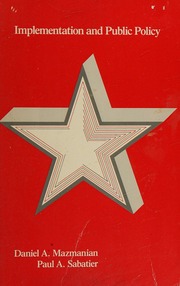
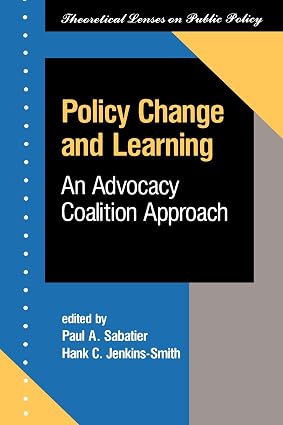
Sabatier edited *Theories of the Policy Process*, which became a cornerstone textbook for upper-division and graduate courses in policy studies worldwide[reference:13]. He also co-authored *Policy Change and Learning: An Advocacy Coalition Approach* (1993) with Hank Jenkins-Smith, which provided the fullest early exposition of the ACF[reference:14][reference:15]. Earlier, with Daniel Mazmanian, he co-wrote *Implementation and Public Policy* (1983), which won the Aaron Wildavsky Award for enduring contribution to policy studies[reference:16].
✦Where and how has the ACF been applied?
Since its introduction in 1988, the ACF has been applied in over 100 empirical studies and used as the foundation for hundreds of papers[reference:17][reference:18]. It has been used to study policy in over 50 different countries across all continents, in arenas ranging from environmental policy and land use to education and health[reference:19]. Sabatier himself applied it to the U.S. Forest Service, watershed management, and air pollution policy[reference:20]. The framework continues to be refined by a global community of scholars[reference:21].
✦What is a common misconception about Sabatier's work?
Some assume the ACF is merely a descriptive typology of policy actors. In fact, it is a rigorous causal theory with 15 main hypotheses that can be empirically tested[reference:22]. Sabatier was known for demanding scientific rigor—his motto was 'clarity begets clarity, mush begets mush'[reference:23]. He engaged in fierce but productive debates with colleagues, including Nobel laureate Elinor Ostrom, whom he challenged to improve the clarity of her arguments in *Governing the Commons*[reference:24].
✦What honors did Sabatier receive during his career?
Sabatier received the Aaron Wildavsky Award from the American Political Science Association in 1997 for his enduring contribution to policy studies[reference:25][reference:26]. In 2009, he received the APSA's Excellence in Mentoring Award from the Public Policy Section, which he considered his most cherished recognition[reference:27]. He was a founding faculty member of the Department of Environmental Science and Policy at UC Davis, where he taught from 1972 until his retirement in 2011[reference:28].