


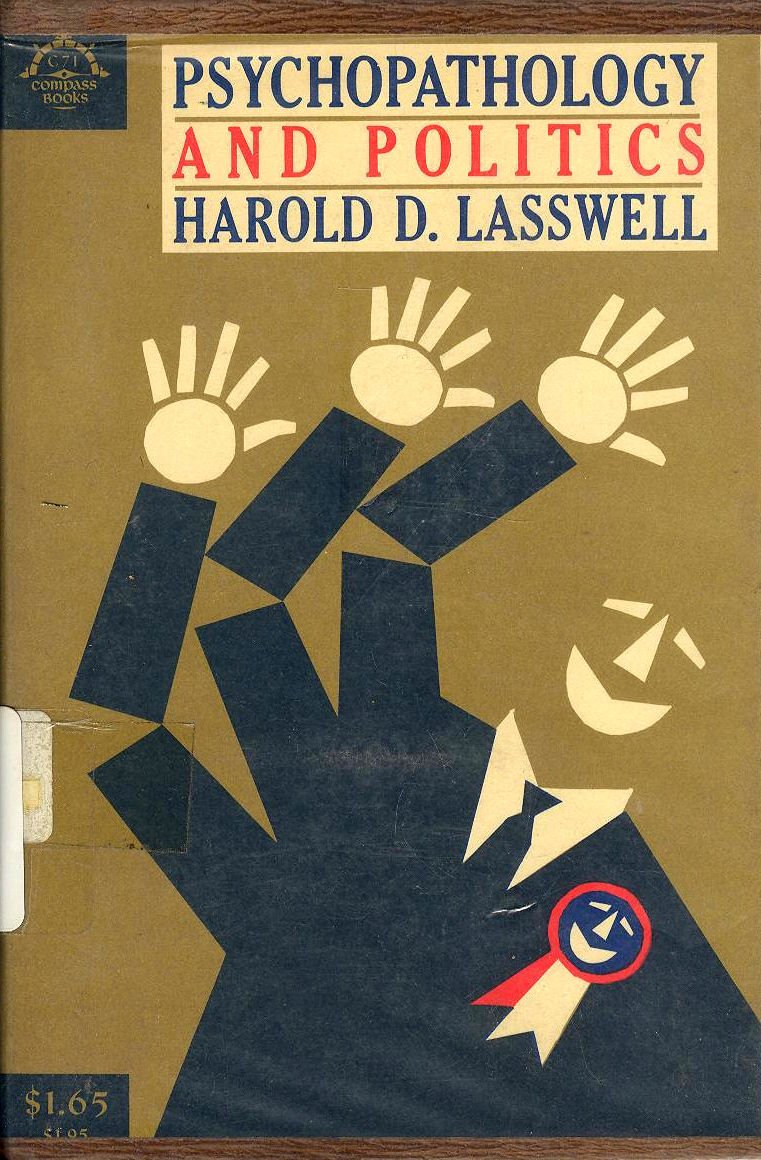
Psychopathology and Politics
 Harold D. Lasswell
Lasswell applies psychoanalytic methods to political behavior, arguing that political opinions and actions are displacements of private motives onto public objects. His formula p}d}r = P—private motives displaced onto public objects and rationalized in terms of public interest—produces the political man. Through case histories of political agitators and administrators, Lasswell demonstrates how early childhood experiences shape adult political convictions. He concludes that political psychologists, not politicians, should prevent conflict by auditing the psychological effects of political life on those who lead it.
Key Details
Related Books
View AllSimilar books from the same category, ranked by shared topics and reader engagement.


.webp?alt=media&token=d5823825-9200-4590-80ba-207a9f340b65)
Key Insights — Read in 10 Minutes
What is the central argument of Psychopathology and Politics?
Lasswell contends that political opinions are not to be grasped apart from the private motives they symbolize. Political movements derive their vitality from the displacement of private affairs upon public objects. Using psychoanalytic case histories, he demonstrates that the political man emerges when private motives are displaced onto public objects and then rationalized in terms of public interest—captured in his formula p}d}r = P. This framework rejected purely rationalistic accounts of political behavior.
What specific concept or formula did Lasswell introduce in this book?
Lasswell introduced the formula p}d}r = P, where private motives (p) are displaced (d) onto public objects, rationalized (r) in terms of public interest, and transformed into the political man (P). This became one of the earliest systematic attempts to apply psychoanalytic theory to political science. The formula directed attention to how childhood experiences—particularly relationships with family members—shape adult political convictions, a method Lasswell called configurative analysis.
How did critics respond to the book's psychoanalytic approach?
Critics acknowledged the book's merits while pointing to its bias toward psychoanalytic interpretation of political motives and its inattention to large-scale, objective social factors. A 1937 reviewer described it as offering an original and realistic introduction to politics, though noting the psychoanalytic framework's limitations. Later assessments recognized Lasswell himself sought to overcome the individualistic reductionism and psychologization in his vision of political phenomena, moving toward structural-functional and systemic approaches.
What is the 'politics of prevention' Lasswell advocates?
Lasswell argues that instead of relying on politicians to resolve conflict, political psychologists should prevent it by reducing strain and maladaptation in society. This requires intense auditing of the effects of politics upon politicians—asking, for example, what happens to a judge after thirty years on the bench or an agitator after thirty years of agitation. The politics of prevention aims to channel the desire to lead into healthy expression through insight into the hidden motivations of societal leaders.
How has the book's influence held up in political psychology?
Psychopathology and Politics is widely credited with establishing political psychology as a sub-discipline. Lasswell is regarded as one of its pioneers, having undergone psychoanalysis in Europe through a 1927-28 Social Science Research Council grant. While later scholars often cite him as the first American political psychologist rather than the sole founder, the book's case-study method and attention to personality in politics remain foundational. The International Society of Political Psychology now serves the field he helped create.
Wealthy Psyche is an intellectual archive. We do not host, distribute, or sell book copies — physical or digital. We provide structured knowledge to help you think better, faster.