


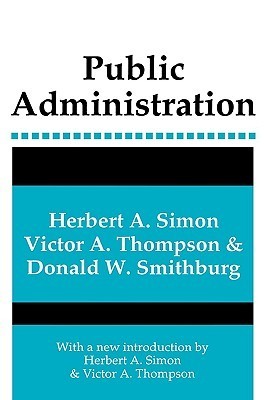
Public Administration
 Herbert A. Simon
Simon, Smithburg, and Thompson's 1950 textbook argues that administration is fundamentally a problem of human cooperation and decision-making, not merely organizational structure. Its central claim is that administrative organizations must be understood behaviorally: the decisions of individuals, shaped by their roles, loyalties, and limited information, determine whether cooperative action succeeds or fails. The book introduces two major emphases that helped define the field—an orientation toward human behavior and human relations, and an emphasis on the interaction between administration, politics, and policy. It also collapses the supposed divide between public and private administration, arguing that large organizations share more similarities than differences.
Key Details
Related Books
View AllSimilar books from the same category, ranked by shared topics and reader engagement.



Key Insights — Read in 10 Minutes
What is the central argument of Simon, Smithburg, and Thompson's Public Administration?
The book argues that administration is best understood as a problem of securing effective cooperative action among individuals with limited information and divergent interests. Rather than focusing primarily on organizational charts or formal authority, the authors examine how human behavior in organizations—motivations, loyalties, communication, and decision-making—determines administrative outcomes. The Taylor & Francis abstract states that the book introduced two major new emphases: 'an orientation toward human behavior and human relations in organizations, and an emphasis on the interaction between administration, politics, and policy.' This behavioral framing distinguished it from earlier structural or legal treatments of public administration.
How does this textbook's approach differ from Simon's earlier Administrative Behavior?
Administrative Behavior (1947) was a theoretical monograph arguing that decision-making is the heart of administration and introducing satisficing as a behavioral alternative to optimizing. Public Administration (1950) is a co-authored textbook that applies those behavioral insights to the full range of administrative problems—personnel, budgeting, communication, and organizational loyalty—in a systematic instructional format. The textbook was published just three years after the monograph and represents the collaborative effort to 'redefine the field through a decision-making lens.' It is broader in scope but less theoretically original than Administrative Behavior.
Why did the authors argue that public and private administration are not fundamentally different?
The book explicitly rejects the sharp distinction between governmental and private administration as 'too sharp to fit the facts.' The authors observe that large-scale public and private organizations share far more similarities than differences: both face problems of coordination, communication, and motivation. They illustrate this with the example of a hospital, where the differences between a 1,000-bed and a 50-bed facility are far greater than the differences between public and private ownership. This argument supported their methodological choice to draw on research conducted in private business when analyzing public administration.
What is the 'zone of indifference' concept, and does it appear in this book?
The 'zone of indifference' is a concept associated with Chester Barnard, not Simon, Smithburg, and Thompson. Barnard introduced it in The Functions of the Executive (1938) to describe the range of orders an individual will accept without questioning their authority. Simon engaged extensively with Barnard's work and incorporated similar behavioral insights into his own theoretical framework, but the zone of indifference is Barnard's coinage. Readers searching for that specific term should consult Barnard's work, not this textbook. The distinction matters for tracing the intellectual lineage of behavioral public administration.
What reception did Public Administration receive when it was published in 1950?
The book was reviewed in the American Political Science Review in 1951, with Wallace S. Sayre noting its publication by Alfred A. Knopf at a price of $6.00. It was adopted as a standard textbook and helped define the field's behavioral turn. The book's enduring significance is reflected in the fact that it has been reissued multiple times, including a 1991 edition by Transaction Publishers with a new introduction. While it never achieved the canonical status of Administrative Behavior, it played a crucial role in transmitting Simon's decision-making perspective to a generation of students and practitioners.
Wealthy Psyche is an intellectual archive. We do not host, distribute, or sell book copies — physical or digital. We provide structured knowledge to help you think better, faster.