


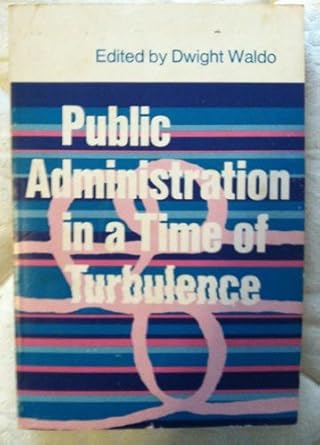
Public Administration in a Time of Turbulence
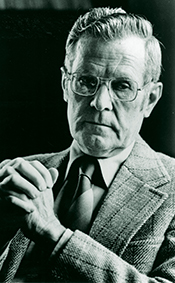 Dwight Waldo
Waldo's 1971 edited volume carries forward the Minnowbrook impulse by asking whether the field's inherited doctrines can survive a society in revolt. Its organizing claim is that turbulence is not a temporary disturbance but a permanent condition: the decades of abundance, consensus, and growth that shaped orthodox public administration have given way to scarcity, conflict, and a crisis of legitimacy. The essays, drawn from 1969 APSA panels, press the question of whether administration can become an instrument of social equity and democratic renewal rather than merely a machinery of efficiency. The book's unity lies in its collective insistence that the field's identity crisis is a symptom of a deeper political dislocation.
Key Details
Related Books
View AllSimilar books from the same category, ranked by shared topics and reader engagement.



Key Insights — Read in 10 Minutes
What is the central argument of Public Administration in a Time of Turbulence?
The book argues that American public administration had been built on a foundation of economic growth, abundance, and social consensus—and that this foundation was crumbling. The essays, organized around the theme Waldo had explored in his 1968 Public Administration Review essay 'Public Administration in a Time of Revolutions,' ask whether the field's inherited doctrines (efficiency, neutral competence, the politics-administration separation) could survive a society marked by scarcity, racial conflict, and a crisis of institutional trust. The collective answer is that turbulence is not an interruption but a new permanent condition, requiring the field to rethink its purposes and its relationship to democratic values .
How does this volume relate to the Minnowbrook Conference and the New Public Administration movement?
The book was Waldo's deliberate attempt to carry forward the Minnowbrook idea to a broader audience. The 1968 Minnowbrook Conference, convened by Waldo, had brought together young scholars to challenge the field's orthodoxies; the resulting volume, Toward a New Public Administration, was edited by Frank Marini. Public Administration in a Time of Turbulence grew from a series of panels Waldo organized for the 1969 American Political Science Association convention, with the same theme as the book's title. Waldo's intent was to extend the conversation beyond the original Minnowbrook participants, though a reviewer noted he 'ended up with several panelists who had passed over the Great Divide of a thirtieth birthday' .
What specific contributions do Herbert Kaufman and Frederick Mosher make to the volume?
Waldo added essays by Herbert Kaufman and Frederick Mosher to the APSA panel papers. Kaufman's contribution restates his influential formulation of the three dominant values in American administrative history—representativeness, politically neutral competence, and executive leadership—and argues that the 'new' thrust toward decentralization and dispersion is partly a cyclical return rather than an entirely novel development. Mosher's essay addresses the relationship between public administration and the broader political system. These two senior voices were intended to balance the younger contributors' sense of urgency with a longer historical perspective .
What did reviewers see as the book's limitations compared to the Minnowbrook volume?
A contemporary review observed that the essays in Waldo's volume show 'a little less urgency, a little more sense of personal detachment' than the Minnowbrook papers, with 'somewhat less attention to general philosophy and theory' and more focus on particularized aspects of the field. The review also noted that while both volumes express an 'obsession with the notion of relevance,' the essays 'make more of a contribution to Public Administration than to public administration'—that is, they advance the academic discipline more than the practical activity. This tension between scholarly self-examination and practical engagement remained a persistent critique of the New Public Administration movement .
How does this book's diagnosis of 'turbulence' differ from Waldo's earlier The Administrative State?
The Administrative State (1948) was a critique of the field's unexamined political theory—the 'gospel of efficiency' and the politics-administration dichotomy. It was primarily an intellectual history and philosophical unmasking. Public Administration in a Time of Turbulence (1971) is a response to a specific historical moment of social and political crisis, asking not what the field's hidden assumptions were but whether it could survive and adapt to a world in which those assumptions no longer held. The earlier book dismantled orthodox theory; the later volume asks what can be built in its place amid scarcity, conflict, and a legitimacy crisis .
What does the book's title 'turbulence' signify in Waldo's usage?
For Waldo, turbulence was not merely a metaphor for difficult times but a diagnosis of a structural shift. The 1960s had witnessed urban uprisings, racial conflict, the Vietnam War, and a widespread loss of confidence in government. Waldo argued in his 1968 essay that public administration had been 'insensitive' to these problems and needed to take active responsibility for creating a livable environment, reducing violence and poverty, and promoting equality and justice. The title of the 1971 volume carries this charge: turbulence names the condition to which the field must respond, not a temporary disturbance to be waited out .
Wealthy Psyche is an intellectual archive. We do not host, distribute, or sell book copies — physical or digital. We provide structured knowledge to help you think better, faster.