


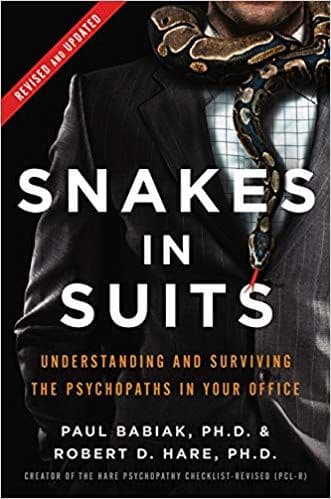
Snakes in Suits: When Psychopaths Go to Work

Babiak and Hare argue that the modern, flexible, high-risk corporate environment is an ideal habitat for psychopaths—individuals who charm, manipulate, and exploit colleagues while leaving organizations in shambles. Drawing on Hare's PCL-R framework, the book profiles how corporate psychopaths negotiate hiring, control influential victims, and abandon the no-longer-useful, all while hiding within corporate culture. Its central contribution is not a new clinical theory but the application of forensic psychopathy assessment to the workplace, culminating in the B-Scan 360, a research tool designed for business professionals to identify destructive personalities before they cause irreversible damage.
Key Insights
✦What is the central claim of Snakes in Suits, and what assumption about psychopaths does it overturn?
The book's core argument is that psychopaths are not confined to prisons or forensic wards—many operate successfully in the corporate world, and the modern business environment actively selects for them. Babiak and Hare overturn the popular image of the psychopath as a violent criminal like Hannibal Lecter, insisting instead that the traits defining psychopathy—charm, grandiosity, deceit, remorselessness—can function as competitive advantages in flexible, high-risk corporate cultures that reward boldness and tolerate rule-bending. The book contends that organizations unknowingly hire and promote such individuals because they mistake the psychopathic mask of confidence and vision for genuine leadership. The result is not just individual suffering but systemic organizational damage as trust networks erode and ethical standards collapse.
✦How does the book apply Hare's PCL-R framework to a non-clinical business context?
The PCL-R was designed for clinical and forensic populations and requires interview plus collateral file review, making it impractical for routine workplace screening. Babiak and Hare therefore adapted the construct for corporate use by developing the B-Scan 360, a research tool that translates psychopathic traits into observable workplace behaviors and collects ratings from multiple colleagues rather than relying on a single clinician. The book explains that while the B-Scan 360 is not a diagnostic instrument and should not be used to label individuals, it helps organizations recognize patterns of manipulation, blame-shifting, and superficial charm before they become entrenched. The adaptation is significant because it moves psychopathy assessment from the forensic interview room into the human resources office, a shift with substantial ethical and practical implications.
✦What is the publication history of Snakes in Suits, and how does the revised edition differ from the original?
The original edition was published in 2006 by Regan Books, an imprint of HarperCollins, with the subtitle When Psychopaths Go to Work. A revised and updated edition appeared in 2019 from HarperBusiness under the subtitle Understanding and Surviving the Psychopaths in Your Office. The revised edition incorporates a decade of additional research on corporate psychopathy, updated case studies, and expanded practical guidance. The publication timeline matters for readers assessing the book's evidence base: the original edition drew on early empirical work by Babiak and colleagues that was among the first to systematically study psychopathic traits in corporate samples. The revised edition reflects subsequent developments in the field, including refinements to the B-Scan 360 and broader recognition of the corporate psychopath phenomenon in management literature.
✦How has the book been received by critics, and what are its documented limitations?
Reception has been mixed. Many readers and reviewers praise the book for making psychopathy research accessible and for validating workplace experiences that victims previously struggled to name or explain. However, critics have identified several recurring problems. Some reviewers find the book repetitive and note that its narrative case study structure, while engaging, can obscure the practical guidance [citation:6][citation:13]. A more substantive critique concerns the book's advice for dealing with workplace psychopaths: one reviewer observed that the long-running scenario in the book ends in the triumph of psychopathy, and that the recommended strategies may leave targets surviving but not prevailing [citation:6]. The book also faces the general challenge that lay readers may over-apply the label 'psychopath' to difficult colleagues, a risk the authors acknowledge but cannot fully control.
✦What is the relationship between Snakes in Suits and Hare's earlier book Without Conscience?
Without Conscience, published in 1993, introduced Hare's psychopathy research to a general readership, focusing on psychopaths in forensic, criminal, and interpersonal contexts. Snakes in Suits extends that project into a specific institutional domain: the corporation. Where Without Conscience asked readers to recognize psychopaths among them in everyday life, Snakes in Suits asks how a particular organizational form—the modern, flexible, high-risk corporation—creates conditions in which psychopathic traits become assets rather than liabilities. The later book is less a theoretical advance than an application: the clinical construct is held constant while the ecology of expression shifts from criminal predation to corporate advancement. Read together, the two books trace Hare's career-long campaign to demonstrate that psychopathy is not a rare forensic curiosity but a pervasive social phenomenon.
Wealthy Psyche is an intellectual archive. We do not host, distribute, or sell book copies — physical or digital. We provide structured knowledge to help you think better, faster.