


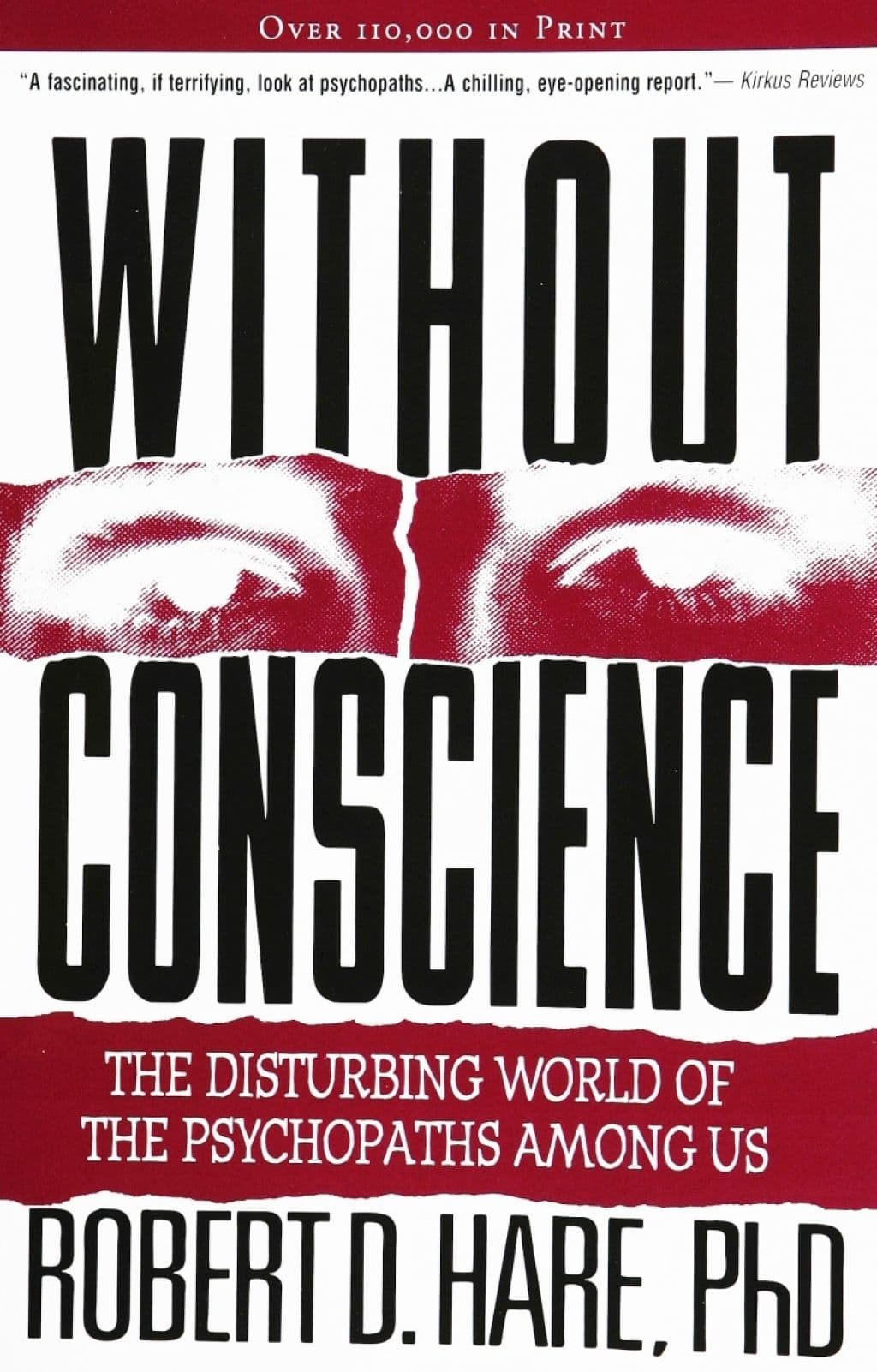
Without Conscience: The Disturbing World of the Psychopaths Among Us

Hare's trade book translates his PCL-R research into a public warning: psychopaths are not rare monsters but social predators who move through ordinary life—boardrooms, marriages, churches—charming, manipulating, and leaving wreckage without remorse. The book's central mechanism is the mismatch between the psychopath's outward performance and inner emptiness. Hare argues that the same traits scored in forensic settings (glibness, grandiosity, callousness) operate in non-criminal populations, making recognition difficult and treatment unlikely. Written for a general audience, it is less a clinical manual than an argument that society's refusal to see psychopathy outside prisons enables the predators among us.
Key Insights
✦What is the central argument of Without Conscience, and what misconception about psychopaths does it attack?
Hare's target is the popular association of psychopathy with serial killers and dramatic violence. He argues that most psychopaths are not murderers; they are social predators operating in ordinary settings—business, family, clergy, medicine—who charm, manipulate, and exploit without remorse. The book's mechanism is the gap between surface performance and inner emptiness: psychopaths learn to mimic normal emotion convincingly enough to evade detection, while leaving a trail of financial, emotional, and sometimes physical damage. Hare's argument is that this invisibility is the problem. If society equates psychopathy with extreme criminality, it will fail to recognize the charming colleague, the remorseless spouse, the manipulative superior. Recognition, not treatment, becomes the book's practical prescription.
✦How does the book relate to Hare's PCL-R manual and his earlier academic work?
Without Conscience is the public-facing translation of the PCL-R research program. The manual, published two years earlier in 1991, provided the 20-item clinical instrument and the two-factor structure. The trade book strips away the technical apparatus and presents the same construct through case narratives and accessible prose. Hare explicitly draws on his decades of interviews with prisoners, but he extends the argument beyond forensic populations, insisting that the traits measured by the PCL-R appear in non-criminal individuals as well. The book thus functions as an application of the PCL-R's logic to everyday life, a move that later culminated in Snakes in Suits (2006), which applied the same framework specifically to corporate environments.
✦How was Without Conscience received by critics and reviewers?
Reception was divided along lines of audience and purpose. Kirkus Reviews called it 'fascinating, if terrifying' and credited Hare with making a strong case that psychopaths are born, not made, while warning that little can be done to change them [citation:11]. Library Journal judged the content 'good' and the explanations 'accessible to lay readers' but found the presentation 'choppy and repetitious' [citation:11]. Publishers Weekly warned that listeners might find themselves 'suspicious of everyone' after reading it [citation:6]. Academic reviewers were more measured. Stephen Wormith, reviewing the 1999 Guilford reissue in Canadian Psychology, acknowledged the book's value while situating it as a popular work rather than a scholarly contribution [citation:3]. The pattern is consistent: accessible and gripping for general readers, less rigorous than Hare's technical publications.
✦What does the book claim about treatment and rehabilitation of psychopaths?
Hare's position is notably pessimistic. He argues that conventional therapeutic approaches may actually make psychopaths worse by teaching them new manipulation techniques and providing them with vocabulary for excusing their behavior. The book's epilogue is often cited for its claim that the goal should be socialization rather than resocialization—teaching psychopaths to consider consequences rationally rather than attempting to instill empathy or conscience where none exists [citation:20]. This position has been influential but not uncontested. A 2020 systematic review by Larsen, Jalava, and Griffiths in Psychology, Public Policy, and Law found no evidence that PCL psychopathy predicted treatment and rehabilitation outcomes, a finding that complicates the book's therapeutic pessimism while also questioning whether any treatment currently works [citation:9].
✦What is the publication history of the book, and why does it matter for readers?
The original edition was published in 1993 by Pocket Books, a mass-market imprint, which signals its intended general audience [citation:7][citation:12]. A British edition appeared from Warner in 1994. Guilford Press, a scholarly publisher, reissued it in 1999 with a new preface and the now-standard subtitle [citation:3][citation:7]. The 1999 Guilford edition remains the most widely cited in academic contexts. The publication history matters because the book's tone and evidentiary standards reflect its trade origins: case narratives dominate, footnotes are sparse, and the prose is designed for accessibility rather than scholarly precision. Readers seeking the empirical basis for Hare's claims should consult the PCL-R manual and the peer-reviewed literature rather than the trade book itself.
✦How has the book's central claim held up given subsequent research on psychopathy?
The claim that psychopathy extends beyond criminal populations has been substantially supported. Research on corporate psychopathy, including Babiak and Hare's own later work, has documented psychopathic traits in non-incarcerated samples. However, the book's treatment of conscience has been directly challenged. The 2020 systematic review by Larsen, Jalava, and Griffiths found no evidence that PCL psychopathy is predictive of a lack of conscience, despite this being a fundamental justification for the instrument's forensic use [citation:9]. This does not refute Hare's broader argument about social predators, but it complicates the book's confident equation of psychopathy with 'without conscience.' The title's central metaphor rests on an empirical claim that the evidence has not uniformly sustained.
Wealthy Psyche is an intellectual archive. We do not host, distribute, or sell book copies — physical or digital. We provide structured knowledge to help you think better, faster.