


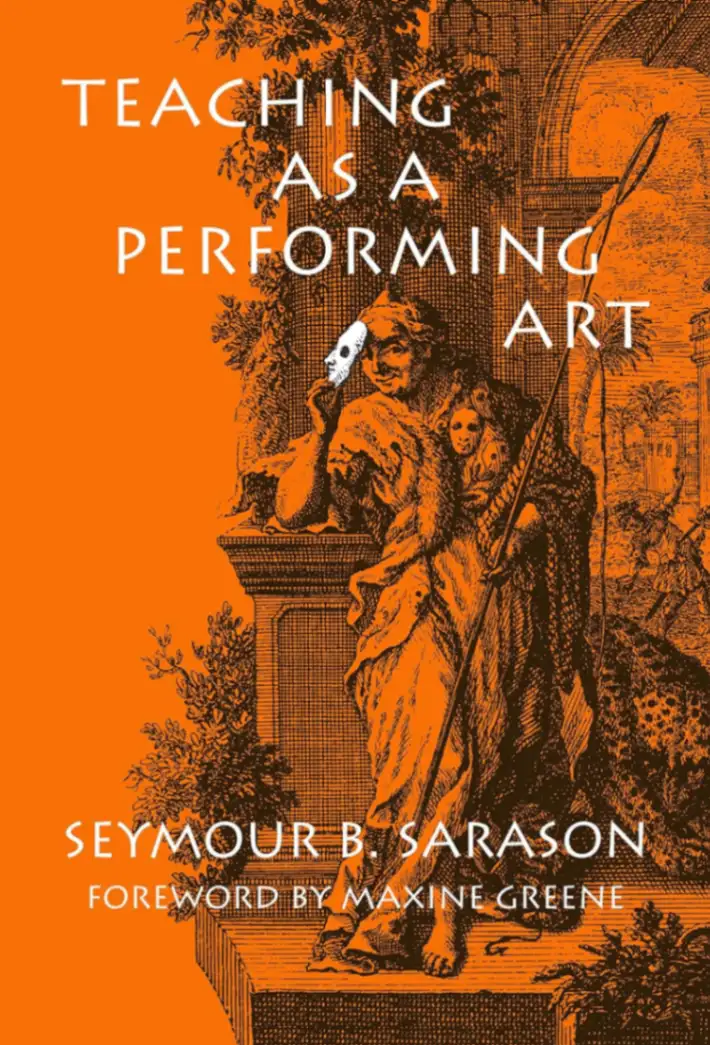
Teaching as a Performing Art
Sarason's 1999 book argues that teachers are performers and that the artistry of engaging an audience—students—is the most neglected dimension of teacher preparation. Drawing on Stanislavski's system and the rehearsal processes of stage actors, Sarason contends that teaching requires the same cultivation of authenticity, spontaneity, and connection that performers develop. The book's distinctive mechanism is its insistence that the classroom's failure to hold interest is not a curriculum problem but a performance problem: teachers are not trained to understand their students as audiences, and teacher education treats theory as sufficient when it is not. The result is a radical rethinking of what it means to prepare teachers.
Key Details
Related Books
View AllSimilar books from the same category, ranked by shared topics and reader engagement.


Key Insights — Read in 10 Minutes
What is Sarason's central claim about the relationship between teaching and performance?
Sarason argues that teachers are performers and that the essence of good teaching lies in the artistry of engaging an audience—the students. He focuses on the often-overlooked role of teachers in galvanizing learners, suggesting that teachers will better engage students if they are prepared in the artistry of doing so [citation:2][citation:4]. Drawing on the traditions of stage performance, Sarason uses actors' rehearsal processes and the direction they receive as models for what teacher preparation could become. The claim is not metaphorical decoration but a substantive argument: teaching is a performing art, and the skills of performance—timing, presence, authenticity, audience awareness—are learnable and essential, yet almost entirely absent from teacher training [citation:2].
How does Sarason draw on Stanislavski's system of acting to illuminate teaching?
Richard Sparkes's review of the book explains that Sarason draws from Stanislavski's system of creating the ideal, 'authentic' performance, suggesting that in teaching, the desired outcomes ought to directly influence the manner in which we affect those outcomes. The reviewer quotes Sarason's observation that audiences come to be transported, not to remain their accustomed selves, and that performers discharge their obligation to the audience to the extent they can engender that illusion. Applied to teaching, this means the teacher's job is to 'get' students 'out of themselves'—to transport them into the subject matter in a way that makes it meaningful. The dialectic of Stanislavski's system—asking how to achieve a flawless performance and what preparatory steps are required—becomes a template for reconsidering what teacher preparation should involve.
What specific changes to teacher education does Sarason argue are necessary?
Sarason argues that implementing his ideas would require a profound rethinking of teacher training programs, and he urges why such changes are crucial to excellence in education [citation:2][citation:4]. The book includes chapters on 'The Selection of Teachers' and 'The Problematic Place of Theory in the Preparation of Teachers,' indicating that Sarason sees both who becomes a teacher and how they are trained as sites of reform [citation:4]. His critique of theory's place in preparation suggests that current programs overemphasize abstract knowledge at the expense of the performative skills that actually engage learners. The argument is not merely that teacher education should add a drama course, but that its fundamental conception of what teaching is—and therefore what preparation should cultivate—needs to change.
How does Teaching as a Performing Art relate to Sarason's earlier work on school culture and reform?
The book extends Sarason's career-long concern with the culture of schools and the failure of reform efforts. His earlier work, particularly The Culture of the School and the Problem of Change, established that schools have their own organizational cultures and regularities that resist change. Teaching as a Performing Art shifts focus from the school as a setting to the teacher as an actor within it. Sarason's critique of teacher preparation is continuous with his broader argument that reform efforts fail because they ignore the existing culture and the people within it. John Goodlad's endorsement notes that the book adds an audience Sarason had always wanted to reach: teachers in and out of schools [citation:2][citation:6]. It is a culminating statement of his educational philosophy rather than a departure.
What did reviewers identify as the book's distinctive contribution?
Reviewers emphasized the novelty of Sarason's focus. John Goodlad wrote that Sarason 'writes about a domain anyone who has taught in educational institutions identifies with immediately but is almost barren of attention' [citation:2][citation:4]. Jeannie Oakes noted that the book 'reshapes what we previously thought of as the art of teaching' [citation:2][citation:6]. Richard Sparkes's review in TRIC observed that 'though little has been written on teaching as a performing art, Dr. Sarason provides a substantial thesis for educators and performers alike to modify and adopt as they reconsider the implications of their professional roles.' The distinctiveness lies in treating performance not as a metaphor for charisma but as a rigorous discipline with its own methods of preparation, authenticity, and audience engagement—methods that teacher education has systematically ignored.
What is the significance of the book's final chapter, 'Criticism and Scapegoating'?
The chapter title echoes the subtitle of Sarason's 1983 book Schooling in America: Scapegoat and Salvation, and it signals his consistent argument that teachers are blamed for failures that are structural and systemic. Placing this chapter at the end suggests that Sarason's performance framework is not a way of holding individual teachers responsible for engagement problems, but rather a way of offering them tools that the system has failed to provide [citation:4]. The criticism he engages is likely directed at both the critics of teachers and at teacher educators who have neglected the performative dimension of the work. The book thus ends not with blame but with a redefinition of what teachers need—a redefinition that, if taken seriously, would shift responsibility from individual inadequacy to institutional failure.
Wealthy Psyche is an intellectual archive. We do not host, distribute, or sell book copies — physical or digital. We provide structured knowledge to help you think better, faster.