


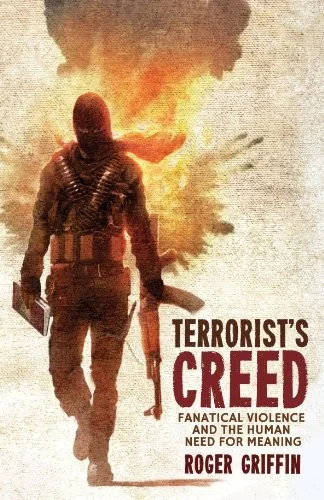
Terrorist's Creed: Fanatical Violence and the Human Need for Meaning
Griffin extends his analysis of fascism's palingenetic myth to terrorism, arguing that fanatical violence stems from a profoundly human need to imbue existence with meaning and transcendence. Drawing on sociology, psychology, novels, and films, he shows how the need to defend or create a 'home' in an unforgiving universe precipitates a process of 'heroic doubling'—where the terrorist sees himself as a warrior in a cosmic battle between good and evil. Terrorist acts are thus symbolic, existential interventions against meaninglessness, not merely instrumental political violence.
Key Details
Related Books
View AllSimilar books from the same category, ranked by shared topics and reader engagement.

Key Insights — Read in 10 Minutes
What is Griffin's central argument about the motivation behind terrorism?
Griffin argues that terrorism is fundamentally a response to the threat of meaninglessness—what he calls 'anomy'—and a violent attempt to create or defend a sacred 'nomos' or meaningful world. Terrorists are not simply driven by political grievance or mental pathology; they are engaged in 'mythopoeia,' the creation of myth, to imbue existence with transcendence. The fanaticism terrorism demands stems from the profoundly human need to feel that one's life and death matter within a larger cosmic narrative. This framework applies across ideological and religious varieties of terrorism.
What specific concept does Griffin introduce to explain how ordinary people become terrorists?
Griffin introduces 'heroic doubling,' a psychological process through which an individual bifurcates the self: the ordinary, compromised person is left behind, while a heroic, purified self emerges as a warrior in a cosmic battle between good and evil. This doubling is precipitated by a 'liminoid crisis'—a state of extreme alienation and anomy—that enables the fanatic to carry out 'violent symbolic action' legitimating murder and suicide for a 'higher' cause. The concept draws on literary and cinematic depictions of radicalization, including Fight Club's Tyler Durden as a fictional model.
How does Terrorist's Creed relate to Griffin's earlier work on fascism?
The book extends Griffin's analysis of fascism's palingenetic myth—the vision of national rebirth from decadence—to terrorism as a broader phenomenon. Both fascism and terrorism, in Griffin's account, emerge from the same crisis of meaning in Western modernity and represent violent attempts at 'nomos-building' through myth. The book explicitly builds on Modernism and Fascism, arguing that modern terrorism can only be understood within the context of the threats to meaning posed by modernism itself. The continuity is thematic: Griffin is tracing variations of the same human response to anomy across different political and cultural forms.
What is the most significant criticism leveled against Griffin's argument in this book?
A detailed review in Project MUSE argues that Griffin's model is too universalizing and essentialist. The reviewer notes that 'not all terrorists—quite few, in fact—are like Griffin's fictional model,' and that baser motives like hatred, self-interest, or mental illness more often act as radicalizing agents. The criticism centers on Griffin's claim that every act of terrorism is a 'primordial human response to anomy'—a condition so universal that it explains virtually all human meaning-making, from religion to yoga, and therefore fails to explain terrorism as a contingent phenomenon. The review calls this an 'essentialism initially denied in strenuous terms and yet quite difficult to miss.'
What sources does Griffin draw on to build his theory of terrorist motivation?
Griffin draws on an unusually wide range of sources: sociology, psychology, novels, and films. The book's chapter structure includes 'The Metapolitics of Terrorism in Fiction' and 'The Metapolitics of Terrorist Radicalization,' indicating that literary and cinematic depictions of radicalization are treated as serious analytical material. The fictional model of Tyler Durden from Fight Club is explicitly referenced in critical reviews as a central exemplar. This interdisciplinary method distinguishes the book from more conventional terrorism studies, which tend to focus on organizational logistics or regional case studies.
How has the book been received by scholars in terrorism studies?
The book has received strong praise from prominent scholars. Hayden White called it an analysis 'at once philosophical, psychological, political, and historical,' while Faisal Devji of Oxford praised Griffin for locating terrorism in a context 'that is ethical and epistemological as much as it is political.' Jeffrey Bale called it 'an original, insightful, and innovative contribution to the literature on terrorism.' However, a detailed critical review in Project MUSE argued that the book's universalizing framework tends to render terrorists as 'mildly endearing Bond villains' and that its essentialism undermines its explanatory power.
Wealthy Psyche is an intellectual archive. We do not host, distribute, or sell book copies — physical or digital. We provide structured knowledge to help you think better, faster.