


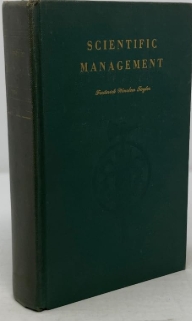
Testimony Before the Special House Committee
 Frederick Winslow Taylor
Taylor's 1912 testimony before the Special Committee of the House of Representatives to Investigate the Taylor and Other Systems of Shop Management is his most extended public defense of scientific management. Testifying for over twelve hours across four days in January 1912, Taylor faced hostile questioning from committee members and labor representatives about time study, fatigue, wages, unemployment, and union opposition. His testimony reveals what the written works omit: Taylor's confidence in his system alongside the ambiguities and evasions in his account of workers' autonomy, surplus distribution, and the actual mechanics of the 'mental revolution.'
Key Details
Related Books
View AllSimilar books from the same category, ranked by shared topics and reader engagement.



Key Insights — Read in 10 Minutes
What was the Special House Committee investigating, and why did it summon Taylor?
The House of Representatives established a Special Committee in 1911 to investigate the 'Taylor and Other Systems of Shop Management' after widespread labor unrest and union complaints about scientific management's effects on workers . The committee sought to determine whether Taylor's methods caused overwork, wage reductions, unemployment, and the dehumanization of labor. Taylor testified on January 25, 26, 27, and 30, 1912, speaking for a total of more than twelve hours . His testimony was his most sustained public defense of the system he had developed over three decades .
What specific concerns did committee members raise about scientific management?
Committee members and labor representatives questioned Taylor about time study and its alleged use to speed up work beyond human endurance; long hours, intensification of labor, fatigue, and mechanization; wage systems and whether workers actually received the higher pay Taylor promised; unemployment caused by efficiency gains; and labor relations, including Taylor's opposition to collective bargaining and strikes. These concerns reflected the unions' core fears: overwork, adverse wage effects, job loss, treating workers as machines, and denial of worker participation in determining working conditions .
What does Taylor's testimony reveal that his published works do not?
The testimony reveals Taylor's unscripted confidence and his willingness to make sweeping claims under pressure. Scholars analyzing the hearings note that despite Taylor's apparent certainty, his assertions contained 'questions and ambiguities' regarding workers' autonomy and the distribution of surplus . Unlike the polished prose of The Principles of Scientific Management, the testimony shows Taylor improvising—asserting that scientific management would eliminate strikes, defending his record at Bethlehem Steel, and insisting that workers under his system were better off. The transcript captures both the persuasive force of his convictions and the gaps in his evidence .
How was Taylor's testimony published and circulated?
The full transcript was reprinted in Scientific Management (1947), a three-volume collection published by Harper & Brothers that also included Shop Management and The Principles of Scientific Management . Volume 3 consists entirely of the testimony, running 287 pages . An earlier stand-alone edition was published by the Taylor Society in 1926 as Testimony of Frederick W. Taylor at Hearings Before Special Committee of the House of Representatives, January, 1912, reprinted from the rare public document . The Routledge edition (2004) also includes the testimony as one of the three works comprising Taylor's corpus .
What did the committee ultimately conclude, and did the testimony damage or vindicate Taylor?
The committee's report did not ban scientific management but was critical of certain practices, particularly the arbitrary application of time study and the failure of some employers to share efficiency gains with workers. The hearings marked a turning point in public perception: Taylorism was now a matter of national political debate rather than a private management technique. Taylor himself viewed the testimony as a vindication, believing he had answered all charges. Yet the hearings also exposed the gap between his ideals and the practices of employers who claimed to follow him—a gap that later scholars and critics would repeatedly invoke.
Wealthy Psyche is an intellectual archive. We do not host, distribute, or sell book copies — physical or digital. We provide structured knowledge to help you think better, faster.