


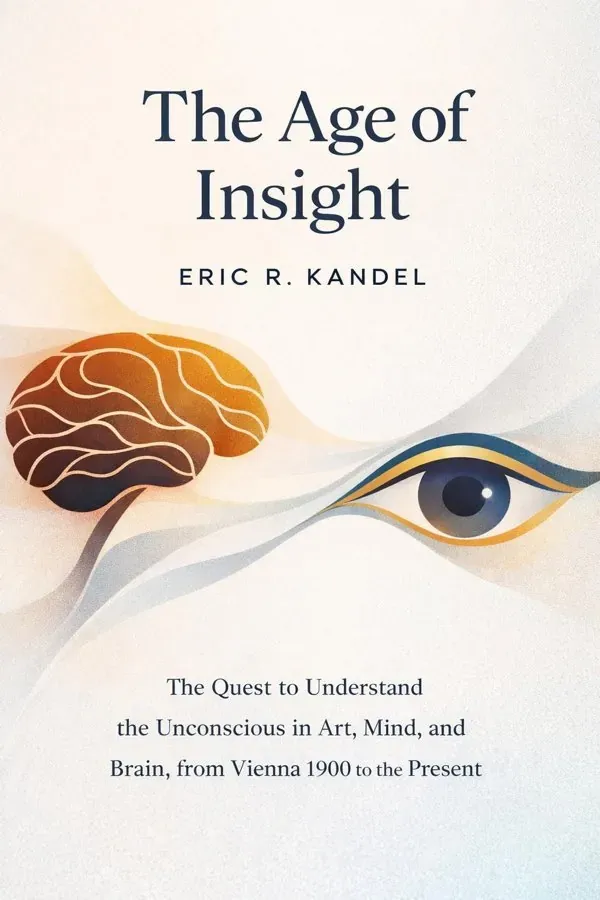
The Age of Insight: The Quest to Understand the Unconscious in Art, Mind, and Brain, from Vienna 1900 to the Present
 Eric Richard Kandel
Kandel argues that the modernist portrait painters of Vienna 1900—Klimt, Kokoschka, and Schiele—anticipated modern neuroscience's discoveries about unconscious perception and emotional response. The book traces a lineage from the Vienna School of Medicine's principle that truth lies hidden beneath surfaces, through Freud's dynamic unconscious, to contemporary brain science. Its central mechanism is the 'beholder's share': the viewer's brain actively reconstructs a painting using memory, expectation, and top-down inference, making perception itself a creative act. Kandel thereby attempts to unify the sciences and humanities through a shared biology of the unconscious.
Key Details
Related Books
View AllSimilar books from the same category, ranked by shared topics and reader engagement.



Key Insights — Read in 10 Minutes
What is the central argument of The Age of Insight, and what intellectual divide does it attempt to bridge?
Kandel argues that the modernist portrait painters of Vienna 1900—Gustav Klimt, Oskar Kokoschka, and Egon Schiele—were engaged in an intuitive investigation of unconscious emotion that parallels and anticipates the discoveries of contemporary neuroscience. The book's central mechanism is the 'beholder's share': perception is not passive reception but an active, top-down reconstruction in which the viewer's brain generates hypotheses about what it sees, informed by memory, emotion, and expectation. By tracing this idea from the Vienna School of Medicine through Freud, Ernst Kris, and E. H. Gombrich to modern brain imaging, Kandel attempts to dissolve C. P. Snow's 'two cultures' divide between science and the humanities [citation:5][citation:17].
How does the book's treatment of Freud differ from the prevailing view in contemporary neuroscience?
Kandel treats Freud with measured enthusiasm, arguing that Freud's core insight—that mental activity adheres to scientific laws and that much of it is unconscious—remains foundational. He identifies in Freud's early writings a coherent cognitive psychology based on the idea that all mental acts have a cause and an internal representation in the brain [citation:4]. This is more sympathetic than the stance of many neuroscientists, who dismiss Freudian theory as unfalsifiable. Science reviewer Charles Gross noted that Kandel's 'hagiographic views of Freud are hardly widespread among neuroscientists,' though Kandel has held them consistently [citation:19]. The book's reception therefore reflects a genuine disciplinary divide over Freud's scientific legacy.
What is the 'beholder's share,' and how does Kandel connect it to specific brain mechanisms?
The 'beholder's share' is the concept, developed by Ernst Kris and E. H. Gombrich, that the viewer of a painting actively completes and interprets it using their own memories, expectations, and emotional history [citation:4]. Kandel connects this to neuroscience through top-down processing in the visual system: the brain does not simply record retinal images but generates predictions and hypotheses, using feedback connections from higher cortical areas to interpret ambiguous sensory input . He also links it to mirror neurons and empathy research, arguing that our ability to model other minds—'entering the private theater of another's mind'—underlies the emotional response to portraiture [citation:10].
How has The Age of Insight been critiqued by philosophers of art and aestheticians?
Philosopher Patrick Maynard, writing in the British Journal of Aesthetics, offered a detailed critique of Kandel's case for neuroaesthetics. Maynard credits Kandel for his valuable account of Gombrich's psychology but argues that Kandel's neuroaesthetic program is inconsistent with the reductionist principles of his own science and contradicts a basic Darwinian principle that genuine novelty can arise from the rearrangement of older materials. Maynard concludes that while neuroscience may contribute to aesthetics, there is as yet no basis for holding that it could produce an aesthetics [citation:13]. This critique targets the book's ambitious claim that brain science can explain aesthetic experience.
How does this book relate to Kandel's earlier work, particularly In Search of Memory?
The Age of Insight extends the intellectual project of Kandel's memoir In Search of Memory (2006), but shifts focus from the cellular mechanisms of memory to the neural basis of aesthetic perception and emotional response [citation:13]. Where the earlier book traced Kandel's own scientific journey from Vienna to the Aplysia laboratories, The Age of Insight returns to Vienna as a cultural and intellectual origin point, using the city's artistic and scientific ferment as a framework for synthesizing neuroscience and the humanities. It also applies the reductionist principles articulated in the memoir to a new domain—art—which Maynard argues creates tensions with those same principles [citation:13].
Wealthy Psyche is an intellectual archive. We do not host, distribute, or sell book copies — physical or digital. We provide structured knowledge to help you think better, faster.