


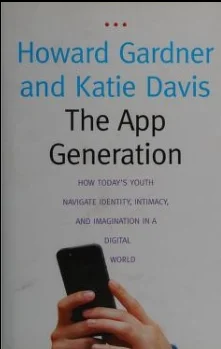
The App Generation: How Today's Youth Navigate Identity, Intimacy, and Imagination in a Digital World
 Howard Earl Gardner
Gardner and Davis argue that the defining feature of contemporary youth is not simply digital media use but an 'app mentality'—the tendency to experience life as a string of discrete, ordered applications, each designed to solve a specific problem. The central distinction is between being app-enabled, where apps serve as springboards for exploration and creativity, and app-dependent, where young people look to apps before looking inside themselves. Through interviews, focus groups, and a comparison of artistic productions before and after the digital revolution, the book examines how this mentality shapes identity, intimacy, and imagination.
Key Details
Related Books
View AllSimilar books from the same category, ranked by shared topics and reader engagement.


Key Insights — Read in 10 Minutes
What specific distinction do Gardner and Davis draw between being app-enabled and app-dependent?
The book's central distinction is between two modes of engaging with digital technology. To be app-enabled is to use apps as tools that extend one's capacities—finding information, connecting with others, or creating something new—while maintaining the capacity to look inward and think independently. To be app-dependent is to look to apps before looking inside oneself, treating them as the primary source for how to express identity, manage relationships, or solve problems [citation:9]. Gardner and Davis argue that dependency risks foreclosing the slow, uncertain work of adolescent identity formation by offering a prefabricated, packaged self that is 'glammed up and rose-colored' [citation:2]. The distinction is not about which apps one uses but about the orientation one brings to them.
What research methods did the authors use, and what did they find about young people's identity formation?
Gardner and Davis conducted 40 in-depth interviews with teachers and youth workers, convened seven focus groups, surveyed over 2,000 young people, and analyzed a unique comparison of youthful artistic productions before and after the digital revolution [citation:9]. They found that young people increasingly present a 'packaged' or 'self-branded' identity online, spending time crafting marketable personas rather than engaging in inner reflection [citation:9]. Davis describes the risk as 'premature identity consolidation'—adolescents locking into a crystallized self-presentation before they have had the developmental space to explore who they might become [citation:9]. The authors note that this pressure to present a perfect, formed identity 'goes against what adolescence is all about' [citation:9].
How do apps affect intimate relationships according to the book's findings?
The authors report that while apps make communication quick, easy, and low-risk, they also encourage what they call 'transactional' rather than 'transformational' relationships [citation:9]. Young people can be connected to anyone at any time, but this constant connection does not necessarily produce deep intimacy. Davis and Gardner found a reluctance among youth to be vulnerable or share personal feelings face-to-face, with some preferring typed exchanges that may 'even feel more intimate than face-to-face conversations' [citation:2][citation:9]. The result is a paradox: more communication, less genuine connection. Sherry Turkle, author of Alone Together, endorsed the book as a constructive analysis that shows how technology can be used to 'open up the world rather than close it down' [citation:8].
What did the comparison of artistic productions before and after the digital revolution reveal about creativity?
The book includes a unique comparison of youthful artistic productions from before and after the digital revolution, examining both visual and literary works [citation:1][citation:9]. The findings were mixed: today's youth showed more graphic imagination but less literary imagination [citation:9]. Gardner and Davis also reported that on the Torrance Test of Creative Thinking, measurements over twenty years showed declines in the ability to generate multiple ideas at once, engage in in-depth thinking, create original ideas, employ a range of reactions including humor and passion, and maintain curiosity [citation:11]. The authors do not conclude that digital media necessarily stunts creativity, but that app-dependent use can circumscribe imaginative exploration.
How was the book received by critics, and what were the main criticisms?
The New York Times review called it an 'ambitious and admirable project' that was 'meticulously researched and thoughtful,' but noted that the work 'still feels trapped in a kind of nostalgia, pining for a lost world' [citation:2]. The reviewer found this bias most evident when the book contrasted Gardner's 1950s childhood with those of kids today, arguing that such radically different realities make meaningful value comparisons difficult [citation:2]. Publishers Weekly suggested the book's argument was 'really an unequivocal' warning about apps becoming shortcuts for critical thinking [citation:3]. The Financial Times praised it for building 'a strong case that a dependency on apps is having a reductive effect on young people' [citation:8].
How does The App Generation relate to Gardner's earlier work on multiple intelligences?
The book applies Gardner's longstanding interest in cognitive diversity and development to the digital environment. Gardner's theory of multiple intelligences, first articulated in Frames of Mind (1983), argued that intelligence is not a single general capacity but a set of relatively independent computational capacities [citation:4]. In The App Generation, Gardner and Davis examine how digital media might either enable or constrain different forms of intelligence and creativity. The book also extends themes from Gardner's later work on 'goodness'—Truth, Beauty, and Goodness Reframed (2011)—by asking what kinds of digital practices foster genuine goods like deep relationships and authentic creativity rather than superficial substitutes [citation:4].
Show 1 more insights
What is the most common misconception about the book's argument?
The most persistent misconception treats The App Generation as a blanket condemnation of digital technology or a nostalgic argument that young people were better off before smartphones. Gardner and Davis explicitly reject this framing. They state that apps can be 'wondrous' and that the challenge is to 'venture beyond the ways that apps are designed to be used' [citation:1][citation:6]. The book is not anti-technology; it argues for a distinction between enabling and dependent uses of technology. Gardner advised audiences to 'not allow apps to become dictators of our lives' and encouraged adults to model moderation by getting off their own phones [citation:9]. The authors' concern is with dependency and foreclosure of possibilities, not with the devices themselves.
Wealthy Psyche is an intellectual archive. We do not host, distribute, or sell book copies — physical or digital. We provide structured knowledge to help you think better, faster.