


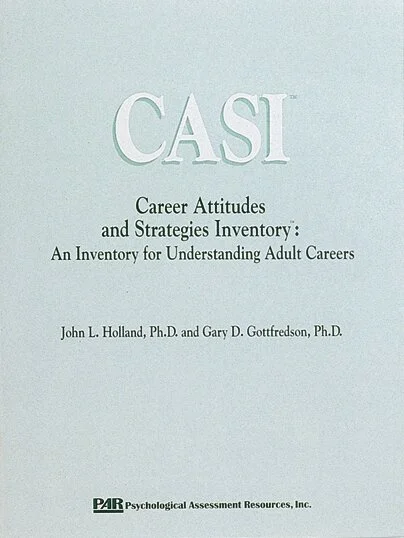
The Career Attitudes and Strategies Inventory
 John Lewis Holland
Holland and Gottfredson's manual introduces the CASI, a 130-item self-report instrument that assesses adult career status directly rather than inferring it from interest profiles. Its central claim is that career stability and change are predictable from nine measurable attitudes and strategies—Job Satisfaction, Work Involvement, Skill Development, Dominant Style, Career Worries, Interpersonal Abuse, Family Commitment, Risk-Taking Style, and Geographical Barriers. The CASI functions as a career checkup, surveying beliefs, events, and forces affecting an individual's work life, and identifying obstacles meriting further exploration in counseling.
Key Details
Related Books
View AllSimilar books from the same category, ranked by shared topics and reader engagement.



Key Insights — Read in 10 Minutes
What is the central claim of the CASI manual, and how does it differ from Holland's earlier interest inventories?
The CASI manual claims the instrument 'provides an assessment of the likelihood of job stability or change'. Unlike the Vocational Preference Inventory or Self-Directed Search, which classify personality types and match them to occupations, the CASI assesses career status directly—allowing respondents to express concerns and beliefs across personal and situational influences on their work lives. Holland argued that by questioning respondents about beliefs, strategies, and activities, the CASI provides assessment that is 'more direct and closer to the phenomena' of career persistence and change than measures based on his typology. The instrument thus extends Holland's framework from matching to prediction of career dynamics.
What are the nine CASI scales, and what does each measure?
The nine scales are: Job Satisfaction, Work Involvement, Skill Development, Dominant Style, Career Worries, Interpersonal Abuse, Family Commitment, Risk-Taking Style, and Geographical Barriers. These survey attitudes, barriers, experiences, or strategies meriting further exploration. In addition, the answer sheet includes a section allowing clients to check specific concerns from 21 potential career obstacles such as health or emotional problems, financial worries, and education. The manual describes typical characteristics of high and low scorers on each scale and profiles sixteen individual cases to illustrate use.
What did subsequent research find about the CASI's ability to differentiate career persisters from changers?
Donohue's 2007 study in the Journal of Vocational Behavior was the first to test Holland and Gottfredson's assertion empirically. With 249 persisters and 200 changers, results indicated that changers were more likely to take risks and were more motivated toward skill development, while persisters were more satisfied in their jobs and reported greater career concerns. However, support for Holland's propositions about the directionality of individual scales was 'more equivocal due to the mixed findings'. The CASI was deemed useful for prediction, but not all hypothesized scale differences emerged as expected.
What psychometric limitations have reviewers identified in the CASI?
The Sage Encyclopedia entry notes that reviewers warned the CASI should be used as a screener or to facilitate discussion due to 'some questionable psychometric data'. Most agree the instrument could use more refinement to address issues such as norms for special groups and better definition of broad subscales. The normative group comprised 774 men and women ages 17 to 77, with 79% European American—a demographic skew raising questions about generalizability. Despite these concerns, the CASI is described as 'an interesting, attractive, and easy to use instrument' useful enough to justify continued research.
How has the CASI been applied in organizational and counseling contexts?
Counselors use the CASI as a career check-up or screen to identify areas of concern for counseling focus. The instrument has applications in organizational needs assessment, program evaluation, and assessing counseling outcomes. Potential organizational uses include general assessment of a company's work environment, sources of worker dissatisfaction, and degree of interpersonal abuse. A 2014 case study explored CASI use with a client with a history of intimate partner violence, demonstrating how trauma history can affect career exploration and how CASI results help both counselor and client understand obstacles and self-talk hindering action.
What is the administration and scoring format of the CASI?
The CASI is self-administered, self-scored, self-profiled, and self-interpreted in approximately 35 minutes. The Inventory Booklet contains 130 items answered on a 4-point Likert-type scale (false, mostly false, mostly true, true). Test-takers mark answers on a carbonless answer sheet whose bottom portion contains scoring directions; raw scores are transferred to the Interpretive Summary booklet providing three score ranges with interpretations. Test-takers can plot scores on a profile sheet for a graphic picture. The CASI Manual presents normative data, correlations with other career instruments, and a self-test for administrators.
Show 2 more insights
What is the relationship between the CASI and Holland's RIASEC theory?
The CASI was developed by Holland and Gottfredson, whose work typically addresses Holland's RIASEC theory. However, the CASI measures different constructs: career attitudes and strategies rather than personality types. The manual notes the CASI 'should be a supplement to rather than a substitution of interest and ability measures,' and makes frequent mention of using the CASI with other instruments developed to operationalize Holland's theory. The CASI thus complements RIASEC-based interest assessment by adding prediction of career stability, change intent, and obstacles—dimensions not captured by typology classification alone.
What is the publication history and current availability of the CASI?
The CASI was published in 1994 by Psychological Assessment Resources (PAR) in Odessa, Florida. The introductory kit includes the manual, 25 inventory booklets, 25 hand-scorable answer sheets, and 25 interpretive summary booklets. Current prices from distributors include $265 for the CASI kit, $68 for the manual alone, and £275 for the introductory kit in the UK. The test is reviewed in the Thirteenth Mental Measurements Yearbook and remains available through PAR. No Chinese revision exists according to Nanjing University's scale database.
Wealthy Psyche is an intellectual archive. We do not host, distribute, or sell book copies — physical or digital. We provide structured knowledge to help you think better, faster.