


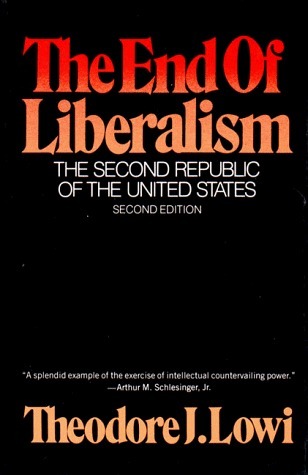
The End of Liberalism: The Second Republic of the United States
 Theodore J. Lowi
Lowi argues that modern American liberalism has failed because it substitutes discretionary delegation for law. In the 'Second Republic,' Congress passes vague statutes that hand broad authority to administrative agencies, creating interest-group liberalism—a system where policy is parceled out to organized interests rather than governed by clear legal rules. This destroys the rule of law, weakens democratic accountability, and makes government incapable of planning. Lowi's remedy is 'juridical democracy': a return to specific, enforceable legislative standards that constrain bureaucratic discretion and restore Congress as the lawmaking body.
Key Details
Related Books
View AllSimilar books from the same category, ranked by shared topics and reader engagement.


.webp?alt=media&token=d5823825-9200-4590-80ba-207a9f340b65)
Key Insights — Read in 10 Minutes
What is the central claim of The End of Liberalism?
Lowi argues that modern American liberalism has failed by substituting discretionary delegation for law. Congress passes vague statutes that hand broad authority to administrative agencies, producing 'interest-group liberalism'—a system where policy is parceled out to organized interests rather than governed by clear legal rules. This destroys the rule of law, weakens democratic accountability, and makes government incapable of coherent planning. Lowi calls for a return to 'juridical democracy': specific, enforceable legislative standards that constrain bureaucratic discretion and restore Congress as the lawmaking body .
What specific concept did Lowi introduce with this book?
Lowi introduced the concept of 'interest-group liberalism,' a critique of pluralist theory that had dominated American political science. He argued that liberalism had abandoned its commitment to limited government and the rule of law, instead creating a system where government delegates broad power to agencies that share authority with organized interest groups. The result is not democratic pluralism but a form of neo-feudalism where policy is private property. His proposed alternative, 'juridical democracy,' demanded that Congress legislate clear standards rather than delegate open-ended authority .
How did Lowi's argument differ from the pluralism of Robert Dahl?
Dahl's pluralism celebrated interest-group competition as the essence of democratic politics, viewing competing groups as checking one another and ensuring representation. Lowi rejected this as both descriptively inadequate and normatively dangerous. He argued that pluralism had become an ideology justifying the abandonment of lawmaking, where agencies and organized interests negotiated policy without legislative standards. Where Dahl saw healthy competition, Lowi saw the corruption of democratic governance and the erosion of the rule of law. The End of Liberalism was a direct challenge to the behavioral revolution's complacent acceptance of group politics .
What does Lowi mean by 'juridical democracy'?
Juridical democracy is Lowi's proposed remedy for interest-group liberalism. It demands that Congress pass laws with specific, enforceable standards that direct administrative agencies, rather than delegating broad discretionary authority. Under juridical democracy, the rule of law replaces bargains struck between agencies and interest groups. Lowi insists that law must precede policy, that Congress must reclaim its lawmaking function, and that courts must enforce legislative standards against administrative overreach. The goal is to restore government by law rather than government by negotiation among organized interests .
How has The End of Liberalism held up since its original publication in 1969?
The book remains a foundational critique of the administrative state and is widely cited in debates over delegation, deregulation, and the rule of law. Its concept of interest-group liberalism influenced subsequent scholarship on regulatory capture and public choice. However, critics note that Lowi's sharp distinction between law and discretion is difficult to maintain in practice, and that the book's critique was not always able to move beyond the political and social vision of the New Deal it attacked. A 1979 second edition added analysis of the Carter presidency and further reflections on juridical democracy .
Wealthy Psyche is an intellectual archive. We do not host, distribute, or sell book copies — physical or digital. We provide structured knowledge to help you think better, faster.