


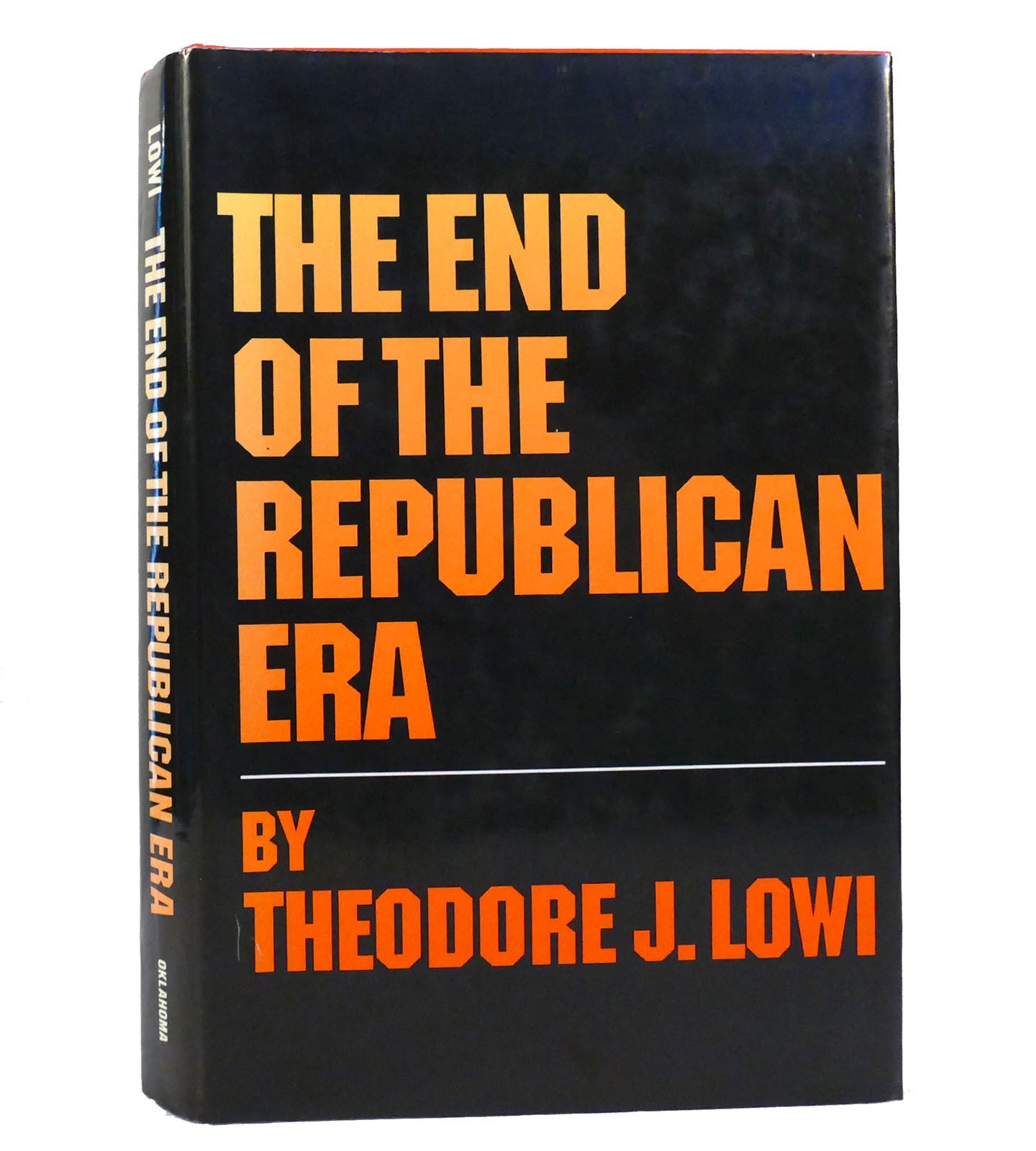
The End of the Republican Era
 Theodore J. Lowi
Lowi argues that the Republican Party's 1994 congressional takeover marked not a realignment but the end of the Republican era that began in 1968. He contends that the GOP's coalition—built on race, region, and reaction to Democratic overreach—had exhausted itself, and that its governing strategy of attacking government while expanding executive power was internally contradictory. The book diagnoses the disintegration of the New Deal party system, the rise of divided government, and the erosion of congressional accountability. Lowi's central claim is that the Republican coalition's ideological exhaustion opened a period of unstable, dealigned politics rather than durable conservative dominance.
Key Details
Related Books
View AllSimilar books from the same category, ranked by shared topics and reader engagement.


.webp?alt=media&token=d5823825-9200-4590-80ba-207a9f340b65)
Key Insights — Read in 10 Minutes
What is the central claim of The End of the Republican Era?
Lowi argues that the Republican Party's 1994 congressional takeover did not signal a durable realignment but instead marked the end of the Republican era that began with Nixon's 1968 victory. The GOP coalition—built on race, region, and reaction to Democratic overreach—had exhausted its ideological resources. Its governing strategy of simultaneously attacking government and expanding executive power was internally contradictory and unsustainable. Lowi contends this exhaustion opened a period of unstable, dealigned politics rather than lasting conservative dominance.
What does Lowi mean by 'the end of the Republican era'?
Lowi uses the phrase to describe the collapse of the Republican coalition that had dominated presidential politics since 1968. That coalition relied on white southerners, suburbanites, and business interests united by opposition to civil rights and big government. By the 1990s, these groups' demands had become incompatible, and the party's anti-government rhetoric clashed with its actual governance. Lowi argues the 1994 takeover exposed rather than resolved these contradictions, ending the era's coherence without establishing a new dominant coalition.
How does Lowi's argument in this book relate to The End of Liberalism?
The End of Liberalism (1969) diagnosed the failure of Democratic governance through interest-group liberalism and discretionary delegation. The End of the Republican Era extends that analysis to the Republican side, arguing that the GOP's response—anti-government rhetoric combined with executive aggrandizement—was equally unable to restore accountable lawmaking. Both books share Lowi's concern with the erosion of congressional responsibility and the rule of law, but the later book focuses on the party system's disintegration rather than administrative delegation.
How was The End of the Republican Era received by reviewers?
Reviews were mixed but respectful of Lowi's analytical ambition. Critics praised his diagnosis of dealignment and divided government but questioned whether the Republican era had truly ended, given the party's continued electoral successes. Some reviewers found the argument overly deterministic, suggesting Lowi underestimated the GOP's capacity for reinvention. Others noted that his prediction of unstable dealigned politics proved partially accurate, though the subsequent Bush and Trump eras complicated any simple narrative of Republican decline.
What is the most common misconception about Lowi's thesis in this book?
The title is often read as a prediction of Republican electoral collapse. Lowi's actual argument is more structural: he claims the Republican coalition's ideological and programmatic resources were exhausted, not that the party would disappear. He describes a period of unstable, dealigned politics in which neither party could construct a durable governing majority. The book is a diagnosis of party system disintegration, not a partisan forecast of one party's demise.
Wealthy Psyche is an intellectual archive. We do not host, distribute, or sell book copies — physical or digital. We provide structured knowledge to help you think better, faster.