


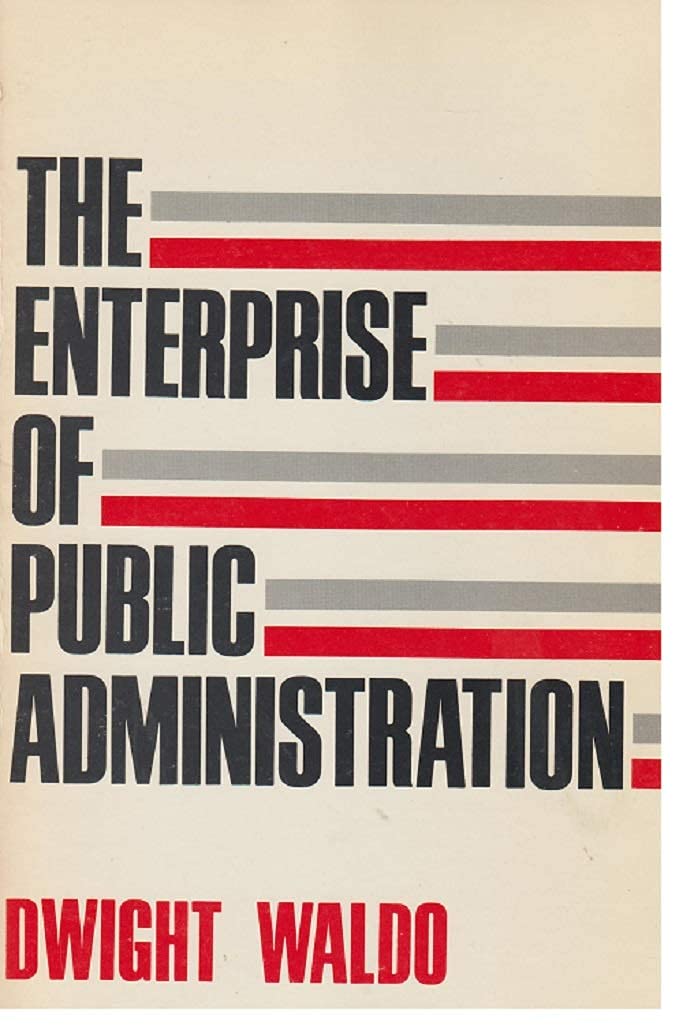
The Enterprise of Public Administration: A Summary View
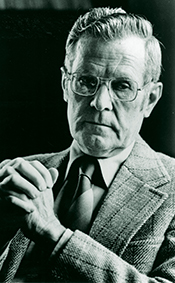 Dwight Waldo
Waldo's 1980 book is a retrospective summary written near the end of his career, and its central claim is diagnostic rather than prescriptive: public administration faces a coming paradigm shift from a foundation of economic growth, abundance, and consensus to one of scarcity, decay, and conflict. Waldo asks what happens when government can no longer promise more—when the glue holding society together, the expectation of continual improvement, dissolves. He identifies five future pressure points—legitimacy, authority, institutional knowledge, control, and confidence—and insists that the conflict between bureaucracy and democracy obliges public servants to protect democratic values, not merely pursue efficiency.
Key Details
Related Books
View AllSimilar books from the same category, ranked by shared topics and reader engagement.



Key Insights — Read in 10 Minutes
What is the central argument of The Enterprise of Public Administration?
Waldo argues that public administration was built on a foundation of economic growth, abundance, and consensus—the expectation that government would always deliver more services and benefits. He foresaw a coming paradigm shift to scarcity, decay, and conflict, and asked what happens when that expectation can no longer be met. The book is a 'summary view' of his career-long concerns, organized around the tension between bureaucracy and democracy. Waldo insists that public servants must protect democratic values, not merely pursue efficiency, and that government is fundamentally more complex than business because of its constitutional and multi-stakeholder context.
What five future problem areas did Waldo identify for public administration?
Waldo predicted five areas that would become increasingly problematic: legitimacy (the capability and focus to deliver the 'good society'), authority (the ability to implement policy with public acceptance), institutional knowledge (arranging and utilizing knowledge within bureaucracies), control (managing a growing government with parallel programs that generate entropy), and confidence (public trust that government can deliver the good society in the future). These five areas, articulated in 1979, anticipated the debt crises, austerity measures, and trust deficits that would dominate public sector discourse decades later.
How does this book relate to Waldo's earlier The Administrative State?
The Administrative State (1948) was Waldo's critique of public administration's unexamined political theory—the 'gospel of efficiency' that smuggled in philosophical commitments. The Enterprise of Public Administration (1980) is a retrospective summary written after a long career, looking both backward at what the field had learned and forward at the challenges it would face. One reviewer noted it demonstrates 'without rancor how criminally unjust' the early dismissal of public administration as intellectually suspect had been. Together the two books bracket Waldo's career: the first dismantles orthodox assumptions, the second surveys what remains after the dismantling.
What does Waldo mean by saying efficiency must be offset by consideration of public access?
Waldo argues that the ruthless pursuit of efficiency can become excessive and harmful to the interests of the people. If efficiency is the only consideration, bureaucracy fails to serve the people. This insight has become increasingly relevant in the age of e-government, where bureaucracies may prefer administrative excellence—faster, more accurate online processing—while a citizen-centric approach might actually increase administrative burden and cost. Waldo's point is that democratic values like accessibility, fairness, and responsiveness cannot be subordinated to a narrow calculus of cost per transaction. Government must serve citizens, not merely process them.
How have Waldo's predictions held up since the book was published?
Commentators writing during the 2011 debt ceiling crisis found Waldo's 1979 book 'remarkably relevant,' noting that his discussion of debt crisis, e-government, trust in government, and confidence in the welfare state read like contemporary commentary. His question—what happens when society is built on the expectation of more, but there is only less?—had become urgent. Waldo's principles, particularly that government must be managed differently from business because of constitutional complexity and democratic obligations, remain central to debates over public sector reform, austerity, and the legitimacy of administrative institutions.
What does Waldo mean by saying there is no dichotomy between politics and bureaucracy?
For Waldo, the traditional separation between politics and administration—the principal-agent model of elected officials deciding and bureaucrats merely executing—was 'theoretically interesting, but realistically impossible.' He viewed the two as fundamentally intertwined in practice. This position distinguished him from the orthodox public administration of the 1920s and 1930s, which had treated democracy and efficiency as reconcilable, administration as a science, and business methods as generally applicable to government. Waldo's rejection of the dichotomy was part of his broader insistence that administration is inherently political and value-laden.
Wealthy Psyche is an intellectual archive. We do not host, distribute, or sell book copies — physical or digital. We provide structured knowledge to help you think better, faster.