


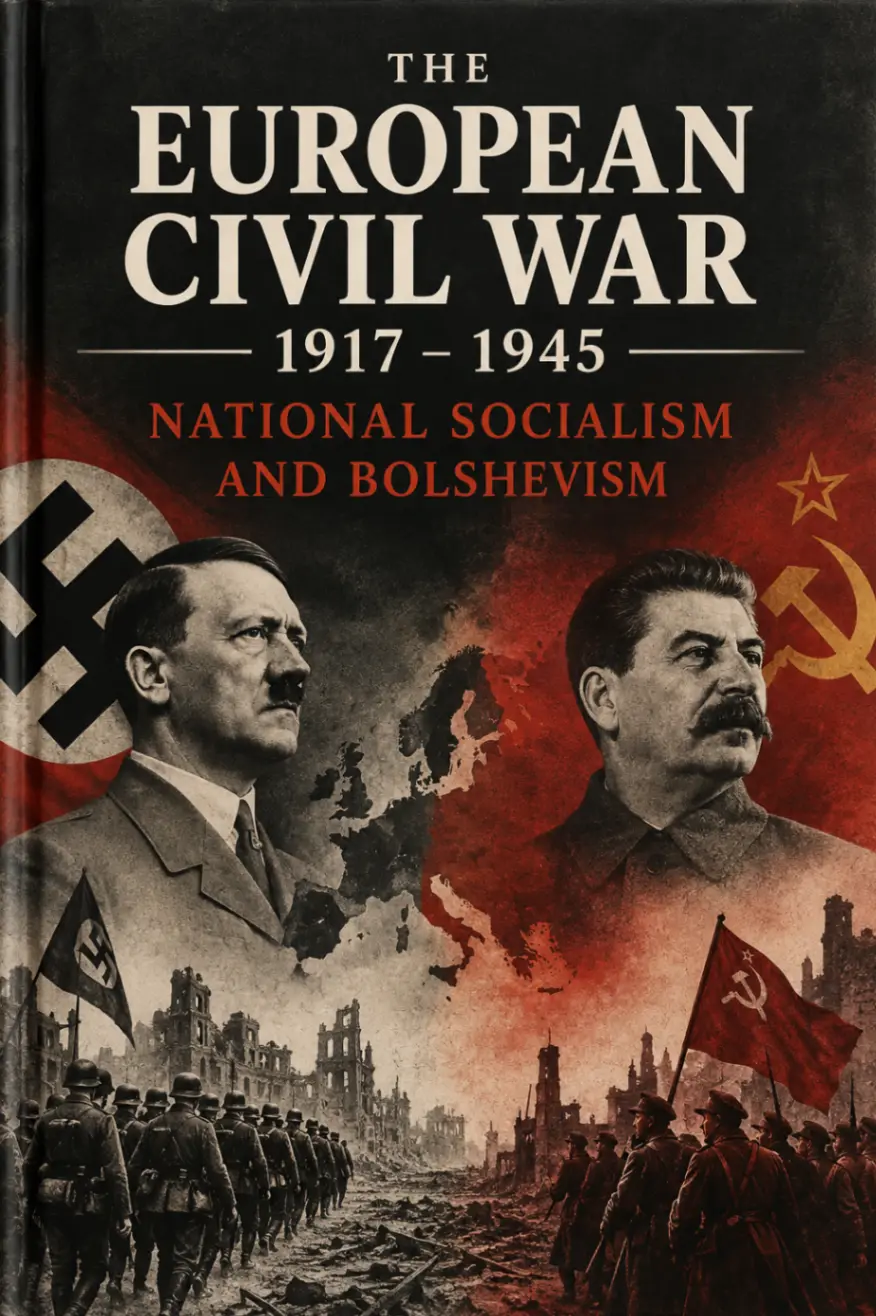
The European Civil War, 1917-1945: National Socialism and Bolshevism
 Ernst Nolte
Nolte's most controversial work advances a single causal thesis: that National Socialism must be understood primarily as a reaction to Bolshevism. The Nazi regime, in this account, was a 'counter-revolution' whose exterminatory practices were modelled on and provoked by the prior crimes of Soviet communism. The book argues that the Holocaust can be explained as a defensive response to the perceived threat of 'Asiatic' Bolshevism, a claim that provoked the German Historikerstreit of 1986-87 and led critics to accuse Nolte of relativizing Nazi crimes and challenging the uniqueness of the Holocaust.
Key Details
Related Books
View AllSimilar books from the same category, ranked by shared topics and reader engagement.

Key Insights — Read in 10 Minutes
What is Nolte's central thesis in The European Civil War, and what does it reject?
Nolte argues that the period 1917-1945 should be understood as a single European civil war between Bolshevism and its counter-revolutionary opponents, with National Socialism as the most consequential of those opponents. He rejects the view that Nazism was an original, sui generis evil. Instead, he posits a 'causal nexus' in which Bolshevik crimes preceded and provoked Nazi crimes, making the Holocaust a defensive reaction to a perceived existential threat from the East. This thesis directly challenged the postwar consensus about the uniqueness of the Holocaust.
What was the Historikerstreit, and how did this book trigger it?
The Historikerstreit (Historians' Dispute) was a public controversy in West Germany in 1986-87 over how to interpret the Nazi past. Nolte fired the opening shot with a June 1986 article in the Frankfurter Allgemeine Zeitung that outlined the theses later developed in The European Civil War. Jürgen Habermas responded by accusing Nolte and other conservative historians of attempting to relativize and normalize Nazi crimes. The dispute became a national debate about German identity, memory, and the moral status of the Holocaust, with Nolte's book serving as the central provocation.
What specific concept did Nolte introduce with this work, and how is it used today?
Nolte introduced the concept of the 'European Civil War' as a framework for understanding the two world wars and the interwar period as a single ideological conflict. This concept has been taken up by later historians, most notably Enzo Traverso in Fire and Blood: The European Civil War, 1914-1945 (2016), though Traverso deploys it for very different political purposes. The term remains contested: some historians find it analytically useful for grasping the transnational dimensions of interwar conflict, while others, including Richard Evans, reject it as an 'absurdity' that blurs the distinction between interstate war and civil war.
How did contemporaries and later scholars respond to Nolte's evidence and method?
Critics argued that Nolte's key primary sources were counter-revolutionary propaganda rather than verified historical records. Enzo Traverso noted that Nolte's evidence for Bolshevik atrocities relied on White émigré accounts, including the legend of the 'cage of rats,' which had been circulated by Nazi propaganda. Hans-Ulrich Wehler traced one of Nolte's central quotations to a 1920 White propaganda pamphlet devoted to describing Cheka atrocities. Critics concluded that Nolte lacked critical distance from his sources, accepting the Nazi perception of Bolshevism as historical reality rather than analyzing it as an ideological construct.
What is the most common misconception about Nolte's argument?
The most common misconception is that Nolte simply equated communism and Nazism. His argument was more specific: he claimed a causal and temporal priority for Bolshevik crimes, with Nazi crimes as a response. The 'rational core' of Hitler's anti-Semitism, in Nolte's formulation, was a defensive reaction to a genuine threat. This is distinct from equating the two systems. Critics, however, argued that the practical effect of the argument was to position Nazi Germany as a victim of circumstances rather than the perpetrator of an unparalleled genocide, effectively reversing the moral framework of postwar historiography.
How has The European Civil War's argument been received in the decades since publication?
The book remains one of the most contested works in twentieth-century historiography. Its central theses were widely condemned by mainstream historians, with some arguing that Nolte's studies were subsequently isolated from comparative genocide scholarship. However, the collapse of the Soviet Union and the publication of The Black Book of Communism in 1997 created a new context in which Nolte's emphasis on Communist crimes gained wider resonance, and Stéphane Courtois wrote a laudatory preface to the French translation. The book is now read primarily as a document of the Historikerstreit and as a case study in the politics of historical memory.
Wealthy Psyche is an intellectual archive. We do not host, distribute, or sell book copies — physical or digital. We provide structured knowledge to help you think better, faster.