


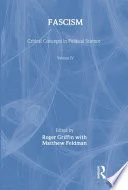
The Fascist Epoch
 Ernst Nolte
This volume is the historical companion to Nolte's philosophical Three Faces of Fascism, describing the epoch of fascism in its entirety and the several fascist movements as variations of a basic type. Nolte characterizes fascism as resistance to practical and theoretical transcendence—a force opposing the liberal thrust of the nineteenth century and its Marxist culmination. The book traces how fascist movements emerged from the crisis of the liberal system, presenting them not as isolated national pathologies but as interrelated European phenomena sharing a common origin in anti-Marxism.
Key Details
Related Books
View AllSimilar books from the same category, ranked by shared topics and reader engagement.

Key Insights — Read in 10 Minutes
How does The Fascist Epoch relate to Nolte's Three Faces of Fascism?
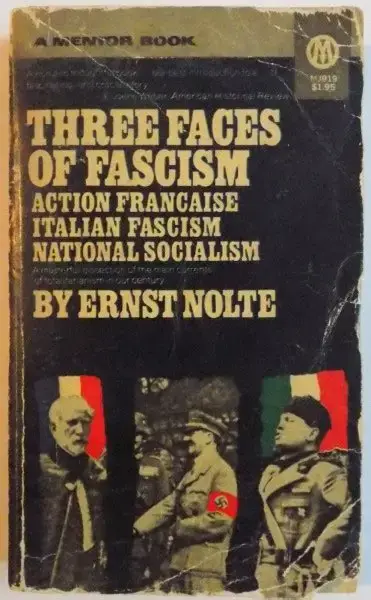
Nolte himself described the relationship: Three Faces 'develops the concept of fascism by considering its three most important forms—it is philosophical,' while The Fascist Epoch 'describes the epoch of fascism in its entirety and the several fascist movements as variations of a basic type—it is historical' [citation:6]. The two works form parts of a single phenomenology of fascism. The Fascist Epoch provides the broad historical survey that complements the philosophical analysis of the three paradigmatic movements.
What is Nolte's central definition of fascism as presented in this work?
Nolte defines fascism as 'anti-Marxism which seeks to destroy the enemy by the evolvement of a radically opposed and yet related ideology and by the use of almost identical and yet typically modified methods, always within the unyielding framework of national self-assertion and autonomy' [citation:6]. Fascism is thus understood not merely as reaction but as a related antagonist to Marxism, sharing its revolutionary structure while opposing its goals. This definition grounds the historical analysis of fascist movements across Europe.
What does Nolte mean by fascism as 'resistance to transcendence'?
Nolte's metapolitical definition holds that fascism is 'at the same time resistance to practical transcendence and struggle against theoretical transcendence' [citation:1]. 'Practical transcendence' refers to the physical transformation of society through liberal-democratic and socialist movements; 'theoretical transcendence' is the philosophical change in bourgeois society's self-understanding. Fascism, in this framework, resists the entire liberal thrust of the nineteenth century and the human capacity to conceive of progress itself [citation:1].
How does this book fit into Nolte's broader phenomenology of fascism?
Nolte described his fascism project as having four parts: Three Faces (philosophical), The Fascist Epoch (historical), Theories on Fascism (political science), and Fascism (popular/illustrated) [citation:6]. He acknowledged these approaches 'were not planned from the outset, but developed at the suggestions of others after the first one, the Three Faces, had made its appearance' [citation:6]. The Fascist Epoch thus extends the initial conceptual work into a comprehensive historical account of fascist movements as a European phenomenon.
What were the critical reactions to Nolte's historical approach in this work?
Reviews of Nolte's broader project noted both its ambition and its methodological problems. A reviewer in The New York Times observed that professional historians would be 'wary of Nolte's technique of selecting only the historical detail which supports his thesis' [citation:1]. Klaus Epstein praised Three Faces as 'a work of exceptionally broad range that combines description, comparison and interpretation in an admirable manner,' while acknowledging the selectivity [citation:6]. The Fascist Epoch inherits both the strengths and the interpretive risks of Nolte's philosophical framework.
How did Nolte's later work on fascism and the Cold War develop from this foundation?
Nolte's subsequent works extended the themes of The Fascist Epoch into new territory. His Germany and the Cold War (1974) analyzed the postwar confrontation through the conduct of the United States, the Soviet Union, and Germany, characterizing it as 'only superficially clad in ideological differences' [citation:3]. The continuity lies in Nolte's phenomenological approach: understanding political conflicts through the ideas and worldviews that animate them, while remaining skeptical of moral interpretations of history.
Wealthy Psyche is an intellectual archive. We do not host, distribute, or sell book copies — physical or digital. We provide structured knowledge to help you think better, faster.