


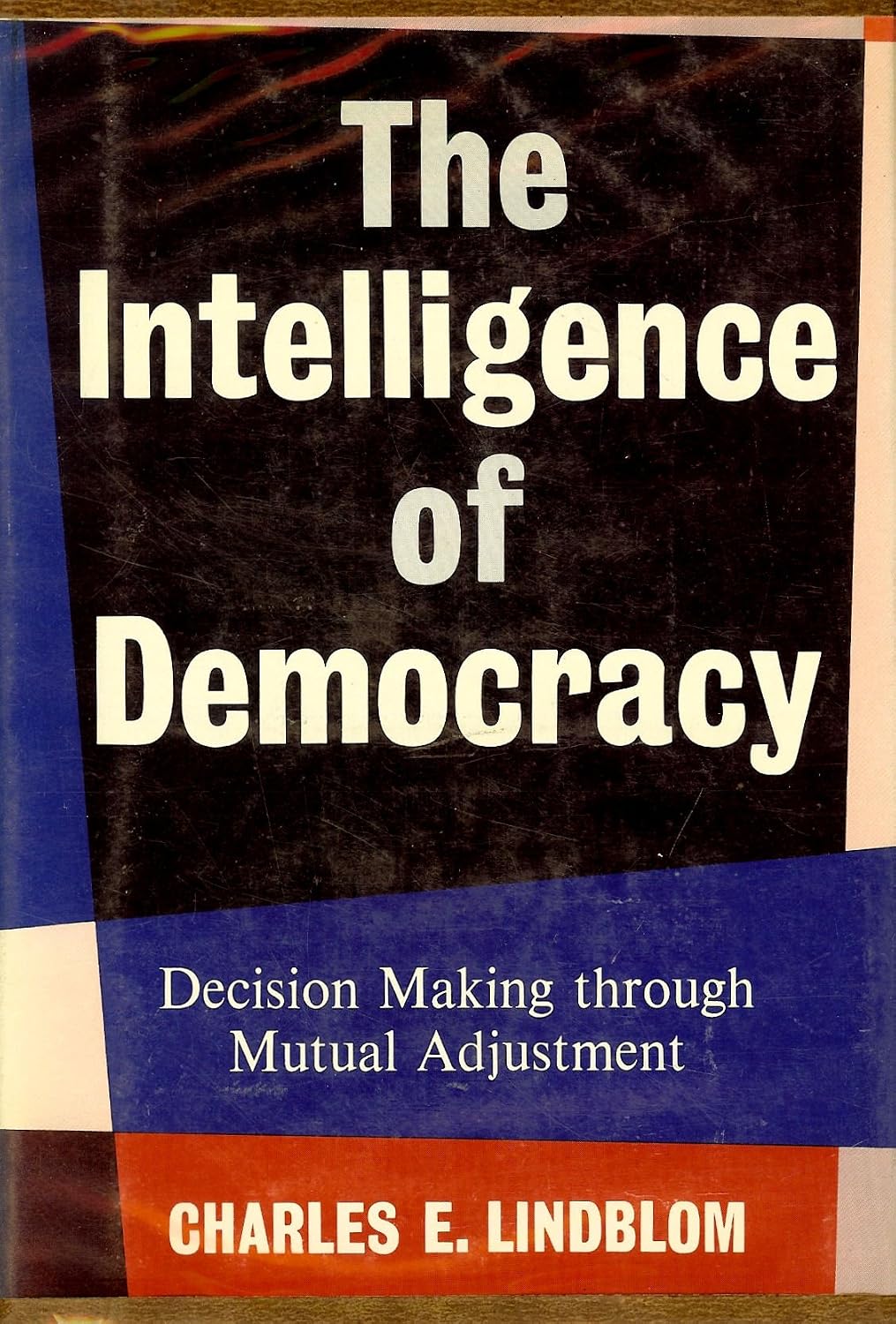
The Intelligence of Democracy: Decision Making Through Mutual Adjustment
 Charles E. Lindblom
Lindblom argues that in complex societies, effective central coordination of policy is impossible because no single decision-maker can command the necessary information. Coordination instead emerges through 'partisan mutual adjustment'—a process in which multiple actors with conflicting values and interests adjust their decisions to one another without central direction, dominant common purpose, or fully prescriptive rules. This decentralized mutual adjustment produces smarter policies than synoptic rational planning, and Lindblom presents it as the defining intelligence of democratic decision-making.
Key Details
Related Books
View AllSimilar books from the same category, ranked by shared topics and reader engagement.


.webp?alt=media&token=d5823825-9200-4590-80ba-207a9f340b65)
Key Insights — Read in 10 Minutes
What is the central claim of The Intelligence of Democracy?
Lindblom argues that effective central coordination of policy decisions is impossible in a complex society because no central decision-maker can obtain or process the information required . Coordination instead emerges through partisan mutual adjustment—decision-makers adjusting to each other without a central coordinator, without a dominant common purpose, and without fully prescriptive rules . This decentralized process, Lindblom contends, produces better policies than rational-synoptic planning and constitutes the intelligence of democracy.
What specific concept did Lindblom introduce with this book?
Lindblom introduced 'partisan mutual adjustment' as the mechanism by which democratic decision-making achieves coordination. The term describes how multiple actors, each pursuing their own values and interests, adjust their decisions in response to one another without central direction . This concept built on his earlier incrementalism (The Science of Muddling Through, 1959) and A Strategy of Decision (1963), extending it from a decision strategy into a full theory of how democratic systems coordinate policy .
How does this book relate to Lindblom's earlier 'The Science of Muddling Through'?
The 1959 article introduced incrementalism as a critique of rational-comprehensive policy analysis. The Intelligence of Democracy, published six years later, expands that argument into a broader theory of democratic coordination. Where Muddling Through focused on how individual decision-makers actually operate, The Intelligence of Democracy examines how multiple partisans adjusting to one another produces systemic coordination without central planning .
How has Lindblom's mutual adjustment thesis held up since 1965?
The framework remains influential but faces significant challenges. Critics note that Lindblom assumed a fundamental consensus on values that was exaggerated, particularly around issues of race and equality . His model treated partisans as disconnected monads, whereas network theory shows them as connected . Further, the theory assumes conditions—shared culture, resource slack, value agreement—that may not hold in globalized, networked, and increasingly conflictual policy systems .
Wealthy Psyche is an intellectual archive. We do not host, distribute, or sell book copies — physical or digital. We provide structured knowledge to help you think better, faster.