


Charles E. Lindblom
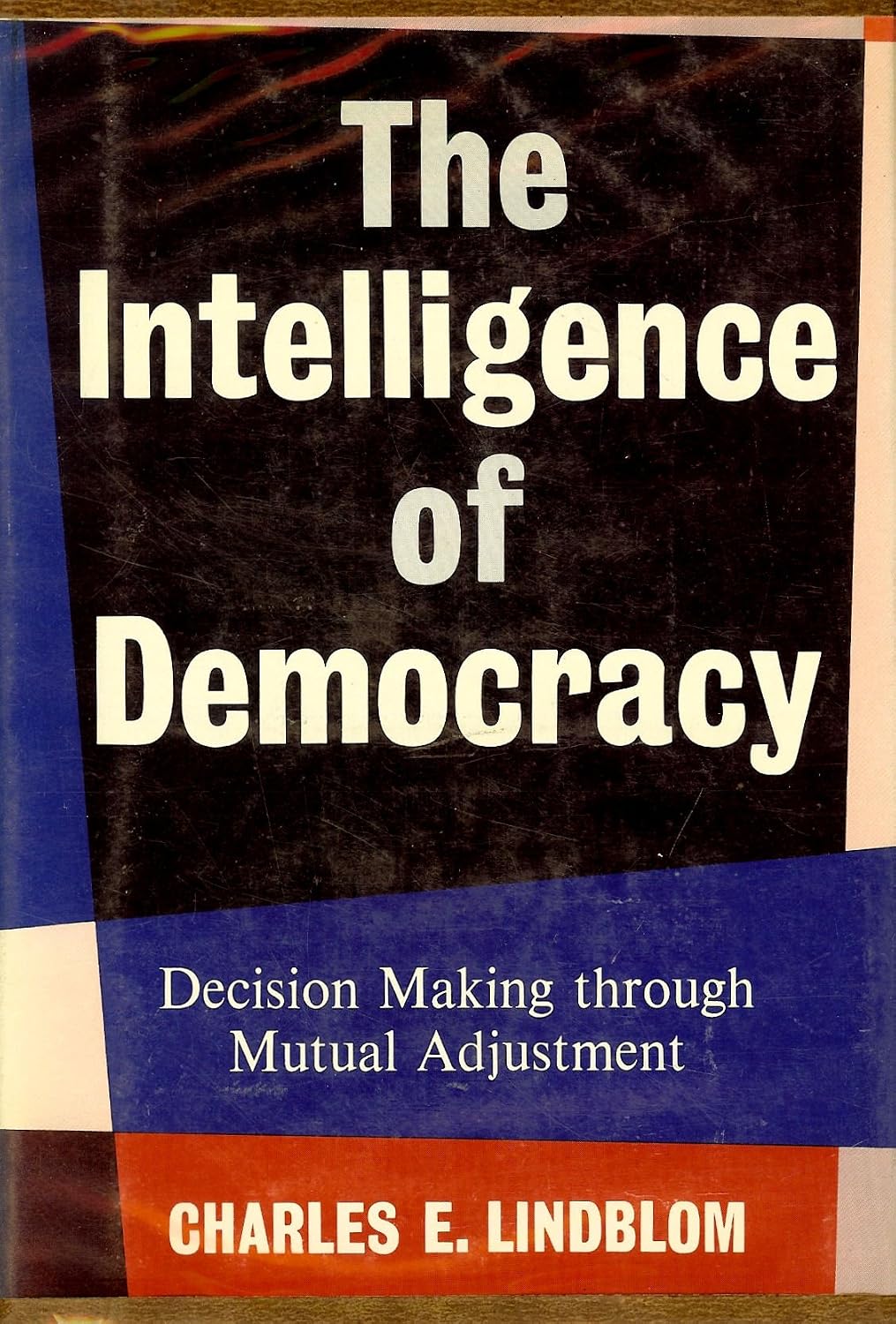
Charles Lindblom fundamentally reshaped public policy by demonstrating that rational-comprehensive decision-making is a myth. In his landmark 1959 article, *The Science of 'Muddling Through'*, he argued that policymakers rarely start from scratch; instead, they make incremental adjustments to existing policies through a process of 'successive limited comparisons'[reference:0][reference:1]. This theory of incrementalism directly challenged the prevailing ideal of rational planning, showing that real-world policy change is evolutionary and shaped by mutual adjustment among many participants[reference:2]. A Sterling Professor at Yale for 38 years and president of the American Political Science Association, Lindblom later critiqued the disproportionate power of business in *Politics and Markets* (1977)[reference:3][reference:4].
.webp?alt=media&token=d5823825-9200-4590-80ba-207a9f340b65)




✦What is Lindblom's theory of incrementalism, or 'muddling through'?
Incrementalism is the theory that policy-making is not a rational, comprehensive process where all alternatives are evaluated against clear goals. Instead, Lindblom argued that policymakers make small, successive adjustments to existing policies—a process he called 'muddling through.'[reference:5] They compare a limited set of policy options that differ only marginally from the status quo, relying on mutual adjustment among stakeholders rather than a single, top-down plan[reference:6]. This approach is both a description of how policy is actually made and a prescription for managing complexity.
✦How does Lindblom's incrementalism differ from the rational-comprehensive model?
The rational-comprehensive model assumes that policymakers can identify all possible goals, rank them, and systematically evaluate all alternatives to find the optimal solution. Lindblom argued this is impossible in practice due to limited time, information, and cognitive capacity. His 'branch' method—comparing policies that differ only marginally—is more realistic than the 'root' method of starting from first principles[reference:7]. Where rationalism seeks a grand solution, incrementalism embraces small, negotiable steps that are politically feasible and allow for course correction.
✦What is Lindblom's most famous book, and what is its central argument?
His most famous book is *Politics and Markets: The World's Political-Economic Systems* (1977)[reference:8][reference:9]. In it, Lindblom departed from his earlier pluralist optimism to argue that business holds a privileged position in capitalist democracies. Because governments depend on private investment for economic prosperity, they are systematically biased toward corporate interests over those of labor or the general public[reference:10]. The book was so controversial that global firms took out full-page ads to refute its claims[reference:11], and it presciently warned of the extreme inequality that would later emerge[reference:12].
✦How did Lindblom's thinking evolve over his career?
Lindblom's early work, including *Politics, Economics, and Welfare* (1953) with Robert Dahl, was more optimistic about pluralist democracy—the idea that competing groups balance each other[reference:13]. But by *Politics and Markets*, he had grown critical of this view, acknowledging that when elites gain advantages, they collude rather than compete, undermining democratic governance[reference:14]. His later work, like *Inquiry and Change* (1990), explored how social inquiry itself is constrained by power and ideology, showing a deepening skepticism about the possibilities for objective, transformative knowledge[reference:15].
✦Did Lindblom believe incrementalism was the best way to make policy?
Yes and no. He argued that incrementalism is often the *only* feasible approach in complex, pluralist systems, and that it has virtues: it is realistic, politically manageable, and allows for learning through trial and error. However, he also acknowledged its limitations. Incrementalism can entrench existing power structures and fail to address fundamental problems that require bold departure. In his 1979 follow-up article, *Still Muddling, Not Yet Through*, he reflected on these shortcomings while reaffirming the core insight[reference:16][reference:17].
✦What is a common misconception about Lindblom's work?
A common misconception is that 'muddling through' means policymakers are irrational or that Lindblom advocated for sloppy, unthinking decision-making. In fact, he argued that incrementalism is a *science*—a disciplined, systematic way of making decisions under conditions of uncertainty and cognitive limits[reference:18]. The 'muddling' is not chaos; it is a structured process of successive comparisons and mutual adjustment. Lindblom was describing a sophisticated, pragmatic approach to governance, not endorsing incompetence.
✦What real-world policies or systems reflect Lindblom's ideas?
Lindblom's ideas are visible in budget processes, where most year-to-year changes are marginal adjustments to the previous year's allocations. Regulatory rule-making, where agencies propose small changes and revise based on stakeholder feedback, also reflects incrementalism. His time in India with USAID (1963-65), contributing to the Green Revolution[reference:19], exemplified his belief in pragmatic, step-by-step problem-solving. Today, his framework remains foundational in policy analysis courses and informs how practitioners approach complex, contentious issues where comprehensive planning is unrealistic.