


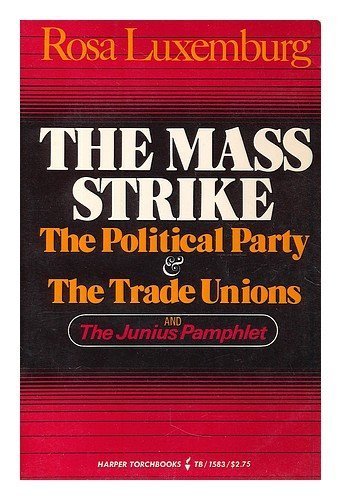
The Mass Strike, the Political Party and the Trade Unions
 Rosa Luxemburg
Written after Luxemburg's return from the 1905 Russian Revolution, this 1906 booklet argues that the mass strike is not a tactical weapon that can be 'decided' or 'propagated' by party leaders, but the spontaneous mode of motion of the proletarian masses in revolution. Drawing on Russian experience, she shows how economic and political demands fuse in the course of struggle, breaking down the artificial separation between trade union and party work. The mass strike emerges from objective social conditions, not organizational planning, a thesis that brought her into sharp conflict with both the trade union bureaucracy and Lenin's centralism.
Key Details
Related Books
View AllSimilar books from the same category, ranked by shared topics and reader engagement.


Key Insights — Read in 10 Minutes
What is the central claim of The Mass Strike, and what does it reject?
Luxemburg argues that the mass strike is not a tactical weapon that can be 'decided' or 'propagated' by party or union leaders, but 'the mode of motion of the proletarian mass, the phenomenal form of the proletarian struggle in the revolution' . She rejects the German Social Democratic Party's view that the mass strike is a defensive tactic to be deployed only at the right moment, and equally rejects the anarchist conception of the general strike as a single decisive blow. For Luxemburg, the mass strike emerges from objective social conditions and cannot be artificially staged.
What does Luxemburg mean when she says the mass strike is not 'made' but arises 'with historical necessity'?
Luxemburg argues that a genuine mass strike cannot be summoned by party resolution or agitation alone. It erupts from the contradictions of capitalist society at a particular moment—when economic suffering, political repression, and class consciousness converge . The task of socialist leadership is not to order a strike but to clarify the historical situation, provide political orientation, and help the movement develop toward revolutionary ends. This position placed her at odds with Lenin's emphasis on centralized party control .
How does Luxemburg dissolve the distinction between economic and political strikes?
Drawing on the 1905 Russian Revolution, Luxemburg shows that in a revolutionary mass action, economic and political struggle become 'one' . A strike that begins over wages can rapidly transform into a political challenge to state power as the class becomes conscious of the broader system of exploitation. The separation of economic and political struggle into separate spheres—trade union versus party—is, for Luxemburg, an 'abstract' and 'unhistorical' viewpoint that misses the actual dynamics of mass movements .
How does The Mass Strike differ from Lenin's approach to revolution?
Luxemburg emphasizes spontaneity and mass creativity; Lenin emphasizes organization, discipline, and the vanguard party's leading role. While both valued the 1905 experience, Lenin drew lessons about the need for centralized revolutionary leadership, while Luxemburg concluded that the German party's organizational fetishism was an obstacle. She argued that in a revolutionary situation, the unorganized and backward layers of the working class might prove the most radical, and that the party must not wait for spontaneous movements to fall from heaven but must 'hasten their development' .
Why did Luxemburg's pamphlet create conflict with the German trade union leadership?
German trade union leaders opposed the mass strike because they feared it would threaten their organizations' stability and resources. They advocated 'peace and quiet' for organizational growth, while Luxemburg argued that the mass strike was the very element in which organization could grow and develop internal strength . The pamphlet was directed against the February 1906 agreement in which the SPD executive secretly conceded autonomy to the trade unions on all strike questions, effectively abdicating political leadership to union bureaucrats .
What reception did The Mass Strike receive in the communist movement after Luxemburg's death?
In 1921, Karl Radek called it 'the first document of German communism,' claiming it marked the beginning of the split between communist and social democratic movements . However, in the Stalinist period, Luxemburg's position on party organization was attacked as 'erroneous,' and she was reinvented as a semi-Menshevik. Her pamphlet on mass strikes ironically remained on KPD reading lists even as her organizational views were condemned . The book was rehabilitated in 1926 but continued to be treated ambivalently in official communist historiography.
Wealthy Psyche is an intellectual archive. We do not host, distribute, or sell book copies — physical or digital. We provide structured knowledge to help you think better, faster.