


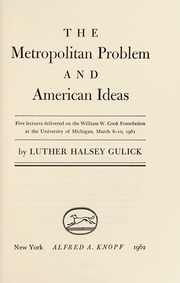
The Metropolitan Problem and American Ideas: Five Lectures Delivered on the William W. Cook Foundation at the University of Michigan, March 6-10, 1961
Gulick's 1962 lectures argue that the traditional American responses to urban growth—reliance on the market mechanism and faith in local municipal action or home rule—have failed to address the metropolitan problem. The first change needed, he contends, is to discard the notion that the problem is 'the city.' We are dealing not with a bounded municipality but with a sprawling urban agglomeration whose problems transcend every existing boundary. Gulick calls for all 'extensions' of American government—federal, state, and local—to be assigned appropriate roles, rejecting hierarchical notions of 'levels' in favor of coordinated intergovernmental action.
Key Details
Related Books
View AllSimilar books from the same category, ranked by shared topics and reader engagement.



Key Insights — Read in 10 Minutes
What is the central thesis of The Metropolitan Problem and American Ideas?
Gulick argues that two traditional elements of the American approach—the 'market mechanism' and 'local municipal action' or home rule—have failed to cope with metropolitanism . The first change needed, he writes, is to discard the notion that the problem is 'the city': 'We are not dealing with a city at all! We are dealing with people, industries, shops, offices, community institutions, recreations, methods of transport and easy communication, and a maze of urban services... which focus on many centers' . His remedy is to involve all historic elements of government—federal, state, and local—in the solution, assigning new roles to each .
Why did Gulick argue that the market mechanism and home rule had failed?
Gulick observed that 'in every big city the slums are spreading faster than they are being cleared up. Circulation of people and goods is becoming less and less satisfactory and more and more costly. Even the delightful expansion of suburban life is beginning to run into difficulties as the suburbs fill in' . The problems—slum clearance, mass transportation, traffic congestion, air pollution, sewage disposal, education—were broader than any single local government's boundaries, and most localities were financially hard-pressed . Private enterprise could not reap profits from basic urban infrastructure, so responsibility fell to the public sector, but no single unit could manage it alone .
What does Gulick mean by referring to federal, state, and local 'extensions' rather than 'levels' of government?
Gulick objected to the hierarchical connotation of 'levels,' which suggests a ranking of authority. He preferred 'extensions' to capture the idea that federal, state, and local governments are all extensions of a single people's governance, operating in different functional spheres rather than in a chain of command . One reviewer found this terminological shift 'rather more vital and even revolutionary' than it first appeared, because it implied a mode of analysis in which functions are shared and coordinated rather than divided and ranked .
Who did Gulick believe should lead the effort to address metropolitan problems?
Gulick argued that it was 'too late for city governments to take the lead in reaching their own salvation.' Only the President, 'who leads the most comprehensive constituency in metropolis and who is now elected by urban voters, can start the change' . He called for 'honest recognition' from Washington that federal aid to metropolitan areas was not a handout but a national necessity, given that over two-thirds of the population lived in urban complexes . At the same time, he insisted the states held a key constitutional role and urged highly urbanized states to establish departments of local government affairs .
How was the book received by contemporary reviewers?
Reviewers praised Gulick's demolition of 'stereotypes concerning home rule, boundaries, levels of government, and the extent to which extra-governmental solutions... will suffice' . One called it 'a readable, provocative, disturbing book' that offered 'bold, inventive treatment' . Another found the section on American ideals 'most stimulating' while judging the action program 'not as satisfying,' though acknowledging that no reader 'would expect a detailed blueprint for solving all our problems' . A reviewer in The Journal of Politics noted that Gulick took a 'normative and prescriptive approach' consistent with his career .
What was the original format and publication context of this work?
The book comprises five lectures delivered on the William W. Cook Foundation at the University of Michigan between March 6 and 10, 1961 . It was published by Alfred A. Knopf in New York in 1962 as a 166-page volume . Gulick delivered the lectures while serving as chairman of the board of the Institute of Public Administration, following his tenure as City Administrator of New York City from 1954 to 1956 . The volume was reprinted in 1966 .
Wealthy Psyche is an intellectual archive. We do not host, distribute, or sell book copies — physical or digital. We provide structured knowledge to help you think better, faster.