


Luther Halsey Gulick III
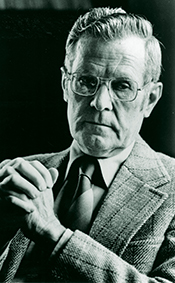
Luther Gulick is the public administration theorist who gave the world POSDCORB—the enduring acronym for the seven functions of a chief executive: Planning, Organizing, Staffing, Directing, Co-ordinating, Reporting, and Budgeting. He coined the term in his 1937 memo *Notes on the Theory of Organization*, prepared while serving on President Franklin D. Roosevelt's Brownlow Committee[reference:0][reference:1]. Gulick argued that these functional elements constituted the universal work of administration, providing a practical framework for structuring executive responsibility[reference:2]. As president of the Institute of Public Administration from 1921 to 1962, he bridged theory and practice, advising governments on reorganization and management[reference:3].

Papers on the Science of Administration
.jpg?alt=media&token=1dc242f3-bd65-4db9-aea8-beafcca6a354)
American Forest Policy: A Study of Government Administration and Economic Control
Administrative Reflections from World War II
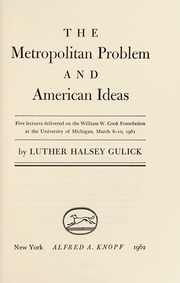
The Metropolitan Problem and American Ideas: Five Lectures Delivered on the William W. Cook Foundation at the University of Michigan, March 6-10, 1961




✦What does POSDCORB stand for and why is it important?
POSDCORB is an acronym for Planning, Organizing, Staffing, Directing, Co-ordinating, Reporting, and Budgeting[reference:4]. Gulick coined it in his 1937 *Notes on the Theory of Organization* to answer the question: 'What is the work of the chief executive?'[reference:5]. It provided a universal, practical framework for understanding administrative functions and became one of the most widely used heuristics in public administration and management education.
✦How did Gulick's POSDCORB differ from Fayol's administrative functions?
Both theorists sought to systematize management. Henri Fayol, a French industrialist, proposed five functions: planning, organizing, command, coordination, and control. Gulick expanded and adapted this framework for the public sector, adding staffing, reporting, and budgeting to create a more comprehensive model suited to government administration[reference:6]. While Fayol's work was rooted in private industry, Gulick's POSDCORB was explicitly designed for public service professionals[reference:7].
✦What role did Gulick play in the Brownlow Committee?
Gulick served on President Franklin D. Roosevelt's Committee on Administrative Management, better known as the Brownlow Committee, from 1936 to 1938[reference:8]. The committee's landmark 1937 report recommended sweeping reforms to the executive branch, including the creation of the Executive Office of the President. Gulick's *Notes on the Theory of Organization* was prepared as a memorandum for this committee and contained the first formulation of POSDCORB[reference:9].
✦What is the 'span of control' and how did Gulick contribute to this concept?
The span of control refers to the number of subordinates a manager can effectively supervise. Gulick's POSDCORB framework helped highlight this principle[reference:10]. He argued that no worker should have more than two masters and that the span of control had a 'top-down' aspect, while the homogeneity of work groups had a 'bottom-up' aspect[reference:11]. This concept became a central tenet of classical organizational theory.
✦What is a common misconception about Gulick's work?
A common misconception is that Gulick's POSDCORB was merely a dry, abstract checklist. In fact, it was a practical tool derived from his extensive experience as a government consultant and administrator. He developed and refined the concept based on his executive-level work, including reorganizing New York City's administration and co-authoring the report to reorganize the U.S. presidency[reference:12]. POSDCORB was intended as a working framework for practitioners, not just a classroom exercise.
✦How has Gulick's POSDCORB been criticized?
Gulick's POSDCORB has faced significant criticism, most notably from Herbert Simon, who argued in his 1946 article *The Proverbs of Administration* that such principles were contradictory and lacked scientific validity[reference:13]. Simon contended that for every administrative 'principle,' one could find an equally valid opposing principle. However, defenders have noted that Gulick's essay was more nuanced than often assumed and that POSDCORB remains a valuable heuristic for understanding the scope of executive work[reference:14].