


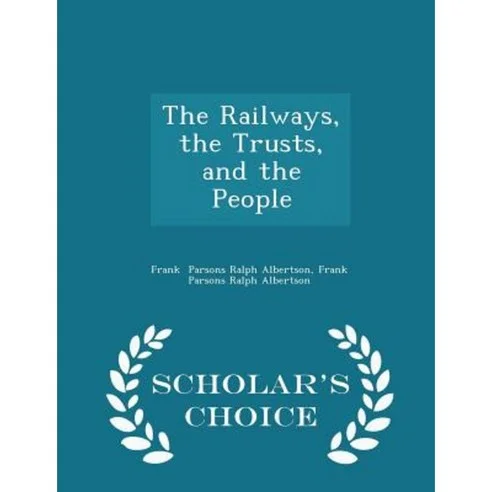
The Railways, the Trusts, and the People
.webp?alt=media&token=26f7855a-af85-4b64-bd71-d83e1505187c) Frank Parsons
Frank ParsonsParsons argues that railway consolidation and industrial trusts have fused into a single system of monopolistic wealth, creating a feudalism that concentrates imperial power in a handful of financiers. The book's central claim is that railway rebates and special privileges were the fostering cause of the great trusts—Oil, Coal, Sugar, Beef—and that only public ownership can secure impartial service for the public good rather than private profit. Part I documents the abuses; Part II examines how other nations, particularly Germany, solved the problem through nationalization.
Key Details
Related Books
View AllSimilar books from the same category, ranked by shared topics and reader engagement.



Key Insights — Read in 10 Minutes
What is the central argument of The Railways, the Trusts, and the People, and what does it reject?
Parsons argues that railway consolidation and industrial trusts have interlocked into a single system of monopolistic wealth, creating what he calls 'a feudalism of monopolistic wealth' that gives a handful of financiers 'practically imperial power' . The book's distinctive claim is causal: railway rebates and special transit privileges were the fostering cause of the great industrial trusts—Standard Oil, the anthracite coal combination, the Sugar and Beef trusts . Parsons rejects the view that regulation can solve this problem. He argues that England's rigid control could not stamp out abuses, and that even Germany could not eliminate unjust discrimination until it nationalized its railways . The only adequate remedy is public ownership.
How does the book document the relationship between railway rebates and the formation of industrial trusts?
Parsons argues that the Oil Trust, Coal Trust, Sugar Trust, and Beef Trust owed their development largely to railway rebates and special transit privileges . His mechanism is straightforward: if a railway manager has an interest in a coal mine, iron company, or oil combine, he will give it advantages that crush its rivals. The trusts and the railways became interlocking interests, with 450 to 500 trusts holding aggregate capitalization of roughly $20 billion. Parsons quotes his own observation from Germany: producers and dealers there were treated impartially by state railways, and this comparative immunity from aggressive trusts was attributed chiefly to that fact .
What is the structure of the book, and what does each part accomplish?
The work is divided into two parts, paged continuously across two volumes . Part I, 'Relations of the Railways to the Public,' deals with the history of American railways and documents the evils and abuses that made the railway problem an overshadowing political and economic issue . Part II, 'The Railroad Problem in the Light of Comparative Railroad History,' analyzes how other nations met and solved the question, covering leading systems of three continents and discussing rate-making, capitalization, employee treatment, and the political and social effects of public versus private railways . The second part aims at 'the causes and the remedies' for the transportation ills described in the first .
How did contemporary reviewers assess the book's literary quality and its argument for public ownership?
A reviewer in the Annals of the American Academy found the book 'wearisome to a degree,' noting that Parsons could not resist including every fact that seemed important, and that 'it is unfortunate that so valuable a work should suffer so from the author's lack of literary discretion' . The same reviewer acknowledged that Parsons should be given credit for understanding the railroad problem with great clarity, and that his discussion of remedies naturally included an argument for state ownership . Parsons himself acknowledged the practical difficulties, stating that 'the difficulties in the way of public ownership of railways in this country at present are very great, and that much good may be accomplished by judicious regulation' .
What is the relationship between this book and The Heart of the Railroad Problem?
The Heart of the Railroad Problem is an expansion of Chapter III, 'Discriminations,' from this larger work . Parsons states in the preface to the smaller volume that as his studies progressed, he became more and more convinced that the heart of the railroad problem lies in the question of impartial treatment of shippers . The larger work provides the comprehensive historical and comparative context; the smaller book isolates the discrimination question for sustained treatment. Both were completed early in 1906, shortly before the passage of the railway rate act of June 29, 1906, and the reviewer noted that had the volume appeared a few months later, the discussion would have been largely modified .
Who assisted Parsons in writing this book, and what was C. F. Taylor's editorial role?
The title page credits Ralph Albertson for assistance and C. F. Taylor as editor . Albertson was a social reformer and writer associated with the Christian Socialist movement and The Arena circle. Taylor was Parsons's publisher and the editor of the Equity Series, which issued this work as volume 8, numbers 3–4 . The collaboration was substantive: Taylor had planned the Equity Series to deal with leading public questions, and his editorial role in Parsons's municipal and economic works was described in earlier volumes as providing criticisms and suggestions of the greatest value.
Show 1 more insights
What does Parsons identify as the ultimate solution, and how does he frame the practical path forward?
Parsons argues that public ownership under good political conditions is the only way to make railways serve the public good, stop extortion and favoritism, secure due diffusion of wealth and power, and remove the antagonism between owners and the public . But he is a practical man as well as a radical one. He acknowledges that the economic and governmental changes necessary to make public ownership safe and successful constitute the essence of the ultimate railroad problem . In the meantime, he allows that judicious regulation may accomplish much good, while insisting that regulation alone cannot secure the needful dominance of public interest .
Wealthy Psyche is an intellectual archive. We do not host, distribute, or sell book copies — physical or digital. We provide structured knowledge to help you think better, faster.