


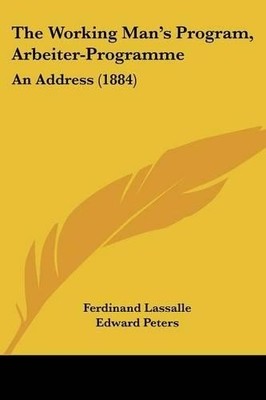
The Working Man's Programme (Arbeiter-Programm): An Address
 Ferdinand Lassalle
Delivered as a Berlin lecture in 1862 and published soon after, this address introduced the idea of the working class as the principle of a new historical epoch. Lassalle argues that history moves through epochs defined by a ruling economic interest: the landed nobility in the Middle Ages, and the bourgeoisie in the present. The working class, because its emancipation coincides with the abolition of all class rule, represents the next and final stage. He uses this historical framework to reject liberal self-help and propose state-financed producer associations as the economic path to workers' freedom. The lecture earned him a term of imprisonment.
Key Details
Related Books
View AllSimilar books from the same category, ranked by shared topics and reader engagement.


Key Insights — Read in 10 Minutes
What is the central argument of The Working Man's Programme?
Lassalle argues that the working class is not merely one class among many but the principle of a new historical epoch. He traces history as a succession of epochs defined by the ruling economic interest: the landed nobility dominated the Middle Ages, and the bourgeoisie now dominates. Because the working class's emancipation coincides with the abolition of all class rule, it represents the next and final stage of historical development. This framework rejects liberal self-help and justifies state intervention on the workers' behalf.
What specific remedy did Lassalle propose for the workers' poverty?
Lassalle proposed state-financed producer associations—cooperative workshops owned and managed by workers themselves, with capital advanced by the State as a sleeping partner. He argued these associations would eliminate the distinction between wages and profit, allowing workers to receive the full proceeds of their labor. This remedy, developed more fully in his 1863 'Open Reply Letter,' became the economic core of Lassallean socialism and a point of contention with Marx, who viewed state-financed cooperatives as futile within a capitalist state.
How does The Working Man's Programme differ from Marx's approach to workers' emancipation?
Lassalle treats the State as an autonomous moral entity capable of acting in the workers' interests—a position Marx rejected. For Lassalle, universal suffrage would give workers political power, which they would then use to obtain state credit for producer associations. Marx, by contrast, viewed the State as an instrument of class rule and expected emancipation to come through the revolutionary self-organization of the proletariat, not through state benevolence. This fundamental disagreement shaped the split between Lassalleans and Marxists in German Social Democracy.
Why was Lassalle imprisoned for delivering this lecture?
The address was delivered in Berlin in 1862 and published soon after. Lassalle's demand for universal, equal, and direct suffrage—today unremarkable, but revolutionary in Prussia in 1862—was deemed seditious by the authorities. He was tried and sentenced to a term of imprisonment. The prosecution treated the lecture as an incitement against the state, even though its radical demand was limited to the franchise. The imprisonment made Lassalle a martyr in the eyes of the emerging workers' movement.
How did this lecture relate to the founding of the General German Workers' Association?
The Working Man's Programme made Lassalle the recognized spokesman of German workers. In response to a request from the Leipzig workers' committee in 1863, he wrote the 'Open Reply Letter,' which elaborated the programme's economic and political demands. The committee then invited him to lead a new organization, and the General German Workers' Association (ADAV) was founded in May 1863 with Lassalle as president. This was the first independent workers' party in Germany, the organizational fruit of the ideas he had first articulated in this address.
What is the significance of the title 'Arbeiter-Programm'?
The German title 'Arbeiter-Programm' literally means 'Workers' Programme'—it presents itself not as abstract theory but as a practical programme for the working class. The English title, 'The Working Man's Programme,' retains this programmatic character. The lecture was later called 'the Wittenberg Theses' of the new socialist movement, a reference to Luther's 95 Theses, suggesting it marked a new epoch in the struggle for the workers' cause. The title reflects Lassalle's ambition to provide German workers with a clear statement of principles and demands.
Show 2 more insights
How did Marx and Engels respond to Lassalle's programme?
Marx and Engels rejected Lassalle's economic and political approach. Engels criticized the 'iron law of wages' as outdated, arguing it presupposed a perfectly free labor market that no longer existed once workers organized or the state legislated on labor conditions. Marx objected even more strongly to the proposal of state-financed producer associations, which he saw as a futile attempt to buy socialism from a bourgeois state. He also distrusted Lassalle's tactical flirting with Bismarck, which he regarded as a betrayal of revolutionary principles.
How has Lassalle's reputation and influence been assessed by later historians?
Historians acknowledge Lassalle as the first man in Germany, and one of the first in Europe, to succeed in organizing a party of socialist action. His agitational genius galvanized the German working class, and the ADAV he founded eventually merged with the Marxist Social Democratic Workers' Party in 1875 at Gotha, forming the SPD. However, his theoretical contribution is generally regarded as inferior to Marx's, and his trust in state benevolence has been criticized as politically naive. His legacy is as an organizer and agitator, not as an economic thinker.
Wealthy Psyche is an intellectual archive. We do not host, distribute, or sell book copies — physical or digital. We provide structured knowledge to help you think better, faster.