


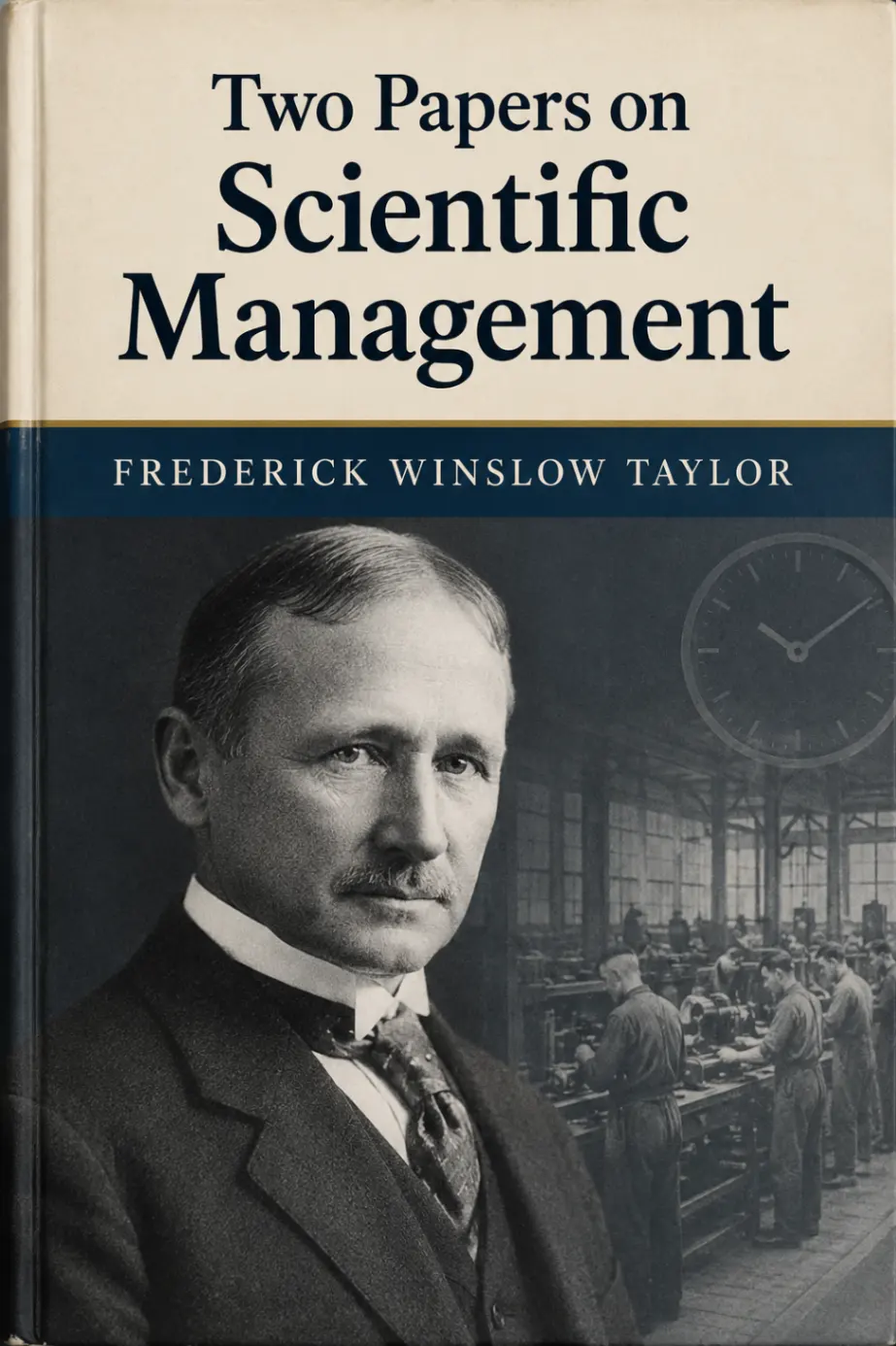
Two Papers on Scientific Management: A Piece-Rate System and Shop Management
 Frederick Winslow Taylor
This compilation pairs two of Taylor's early papers that together establish the operational basis of scientific management. 'A Piece-Rate System' argues that wage schemes must be designed so that workers are rewarded for increased output rather than penalized for it, proposing differential rates to align incentives with effort. 'Shop Management' lays out the planning department, time study, standardization, and functional foremanship through which work is scientifically determined. The book's distinctive contribution is showing that scientific management was built from two joined premises: a motivational argument about incentives and an organizational argument about centralized planning. Together they precede and ground the later programmatic Principles of Scientific Management.
Key Details
Related Books
View AllSimilar books from the same category, ranked by shared topics and reader engagement.



Key Insights — Read in 10 Minutes
What is the central claim of Two Papers on Scientific Management, and what does it reject?
The central claim, across both papers, is that industrial efficiency depends on aligning incentives with output and on transferring method determination from workmen to systematic management. Taylor rejects the prevailing piece-rate practices that penalized workers for exceeding output, and the rule-of-thumb methods by which foremen and skilled workers decided how work should be done. The first paper proposes differential piece rates so that higher output earns higher pay; the second designs the planning department, time study, standardization, and functional foremanship through which work is scientifically determined. Together the papers show that scientific management rested on two joined premises — a motivational argument about incentives and an organizational argument about centralized planning — rather than on either alone.
What is the differential piece-rate system, and why did Taylor advocate it?
The differential piece-rate system pays workers a higher rate per unit once they exceed a specified standard of output and a lower rate below it, creating a strong incentive to meet or exceed the standard. Taylor advocated it because he believed existing piece-rate schemes were unstable: when workers increased output, managers would cut the rate, leading workers to restrict output in self-defense, a practice he called soldiering. By promising that higher output would reliably yield higher pay, differential rates were meant to align worker and management interests. Critics argued the system intensified pressure and could be used to extract more effort without proportionate reward, and its fairness depended on accurate standard setting.
How do the two papers relate to each other?
The papers address complementary problems. 'A Piece-Rate System' addresses motivation: how to design wages so that workers willingly increase output rather than restricting it. 'Shop Management' addresses organization: how to determine and prescribe efficient methods through planning, time study, and functional supervision. Taylor's implicit argument is that incentives alone are insufficient without scientific method, and method alone is insufficient without incentives that make cooperation rational for workers. Read together, they show scientific management as a combined motivational and organizational program. This is why the pairing is useful: each paper supplies half of the system's logic, and the later Principles of Scientific Management synthesizes both into a broader philosophy.
How do these papers relate to The Principles of Scientific Management?
They precede and ground the later book. The Principles of Scientific Management, published in 1911, distills the system into four principles and frames it as a harmony-of-interests doctrine with a public, programmatic tone. The two earlier papers are more technical and operational, showing the concrete incentive design and shop organization from which the doctrine was abstracted. Reading the papers first reveals that Taylor's famous principles were generalizations from practice rather than ideas conceived abstractly. This is the value of the compilation for historians: it documents the development of scientific management from piece-rate and planning experiments to a general managerial philosophy, a progression often compressed in summaries of the Principles.
What are the main criticisms of the incentive logic Taylor proposed?
Criticisms focus on fairness, sustainability, and worker welfare. Labor advocates argued that differential rates could be used to intensify work and that promised rewards were vulnerable to managerial rate-cutting despite Taylor's assurances. Later research in organizational psychology emphasized that pay is only one motivator and that intrinsic motivation, autonomy, and social factors matter, sometimes being undermined by tightly controlled incentive schemes. The human-relations tradition associated with Elton Mayo challenged the assumption that workers respond mainly to economic incentives and prescribed method. These critiques do not eliminate the historical importance of Taylor's incentive design, but they mean it should be read as a contested intervention rather than a neutral efficiency measure.
Wealthy Psyche is an intellectual archive. We do not host, distribute, or sell book copies — physical or digital. We provide structured knowledge to help you think better, faster.