


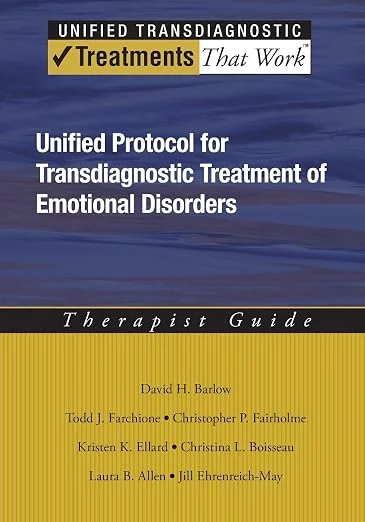
Unified Protocol for Transdiagnostic Treatment of Emotional Disorders: Therapist Guide
The Unified Protocol's central thesis is that anxiety and unipolar depressive disorders share a common maintaining mechanism—neuroticism expressed as aversive, avoidant reactions to intense emotions—and can therefore be treated with a single transdiagnostic protocol rather than separate diagnosis-specific manuals. The Therapist Guide operationalizes this by distilling common principles from empirically supported CBT treatments into modules targeting mindful emotion awareness, cognitive reappraisal, countering emotional behaviors, and interoceptive and situational exposure. The protocol's target is not symptom topography but the dysfunctional emotional avoidance that sustains disorder across diagnostic boundaries.
Key Details
Related Books
View AllSimilar books from the same category, ranked by shared topics and reader engagement.



Key Insights — Read in 10 Minutes
What is the central claim of the Unified Protocol, and what does it reject?
The Unified Protocol claims that emotional disorders—anxiety and unipolar depression—share a common maintaining mechanism: neuroticism, expressed behaviorally as aversive and avoidant reactions to intense emotional experiences. Short-term avoidance provides relief but increases the likelihood of future negative emotions, sustaining disorder . The protocol therefore rejects the premise underlying diagnosis-specific treatment manuals: that each DSM category requires a distinct protocol targeting its unique symptom topography. Instead, it distills common principles from empirically supported CBT protocols—mindful awareness, cognitive reappraisal, countering avoidance, and exposure—into a single modular treatment applicable across diagnostic boundaries . This transdiagnostic stance was a deliberate departure from the disorder-specific tradition that dominated evidence-based practice in the 2000s.
What specific framework did the Unified Protocol introduce, and where is it used today?
The Unified Protocol introduced a modular, emotion-focused transdiagnostic CBT delivered in eight modules: motivation enhancement, psychoeducation and emotional tracking, present-focused awareness, cognitive flexibility, countering emotional behaviors, interoceptive exposure, situational emotion exposure, and relapse prevention . Its core innovation is treating neuroticism and emotion avoidance as the treatment target rather than disorder-specific symptoms. The protocol is used today in individual and group formats across public mental health systems, university clinics, and online adaptations . A 2021 systematic review and meta-analysis by Carlucci, Saggino, and Balsamo provided quantitative synthesis of its efficacy , and the second edition (2018) expanded applications to eating disorders, non-suicidal self-injury, substance use, and anger .
How does the Unified Protocol relate to Barlow's earlier triple vulnerability model?
The Unified Protocol is the clinical translation of the triple vulnerability model Barlow elaborated in Anxiety and Its Disorders. The model posits that emotional disorders arise from a generalized biological vulnerability (neuroticism), a generalized psychological vulnerability (diminished sense of control from early experiences), and a specific psychological vulnerability directing anxiety toward particular stimuli . The Unified Protocol targets the first two—neuroticism and generalized psychological vulnerability—because these are shared across disorders. The specific vulnerability explains why one person develops social anxiety and another panic disorder, but the protocol treats the shared substrate rather than the specific surface manifestation. In this sense, the Unified Protocol operationalizes the theoretical claim that diagnostic categories are surface expressions of underlying transdiagnostic vulnerabilities.
What evidence supports the Unified Protocol's efficacy?
A randomized controlled trial by Farchione and colleagues (2012) provided initial efficacy evidence, comparing the Unified Protocol to a waitlist condition in a heterogeneous emotional disorder sample . Subsequent systematic reviews and meta-analyses, including Carlucci, Saggino, and Balsamo (2021), synthesized growing evidence across trials . A 2018 study examined efficacy for comorbid psychopathology accompanying emotional disorders compared to treatments targeting single disorders . Meta-analytic evidence supports the protocol's effects on anxiety, depression, and emotion regulation outcomes . However, the evidence base, while robust, continues to develop regarding long-term outcomes and direct comparisons with gold-standard disorder-specific protocols for specific diagnoses.
How does the second edition differ from the 2011 first edition?
The 2018 second edition expanded the protocol's scope considerably. While the first edition was designed for anxiety and unipolar mood disorders, the second edition provides guidance on applying the Unified Protocol to eating disorders, non-suicidal self-injury, substance use, and anger . New chapters introduce functional assessment and group-format delivery. Patient materials were revised, streamlined, and made more user-friendly . The core module structure and theoretical rationale remain continuous with the first edition, but the second edition reflects a decade of dissemination experience and adaptation research. Clinicians using the first edition should note that the second edition's expanded transdiagnostic scope and practical guidance on group delivery represent substantive additions rather than cosmetic revisions.
What is a common misreading of the Unified Protocol's transdiagnostic claim?
A frequent misreading treats "transdiagnostic" as meaning the protocol ignores diagnosis entirely or is a generic, one-size-fits-all CBT. In fact, the Unified Protocol requires clinicians to conduct functional assessment of the individual's emotional avoidance patterns and to tailor exposure targets and cognitive work accordingly . The transdiagnostic claim is about shared maintaining mechanisms, not about denying phenomenological differences among disorders. Another misreading assumes the protocol is intended to replace all disorder-specific treatments; Barlow and colleagues position it as an alternative that may be more efficient for comorbid presentations, not as a universal replacement for protocols with strong disorder-specific evidence. The protocol's modular structure allows flexible emphasis, not rote uniform delivery.
Show 1 more insights
What is the relationship between the Therapist Guide and the client Workbook?
The Unified Protocol is published as a paired set: a Therapist Guide and a corresponding client Workbook. The Therapist Guide contains the theoretical rationale, session-by-session instructions, and clinical decision-making guidance for delivering the eight modules. The Workbook contains patient-facing psychoeducational materials, worksheets, and between-session exercises that correspond to each module. The second edition revised both volumes in tandem, streamlining patient materials for usability . Clinicians using the protocol should treat the pair as an integrated treatment package; the Therapist Guide alone does not contain the patient-facing forms and exercises that constitute the between-session work, and the Workbook alone lacks the clinical rationale and delivery guidance necessary for competent implementation.
Wealthy Psyche is an intellectual archive. We do not host, distribute, or sell book copies — physical or digital. We provide structured knowledge to help you think better, faster.