


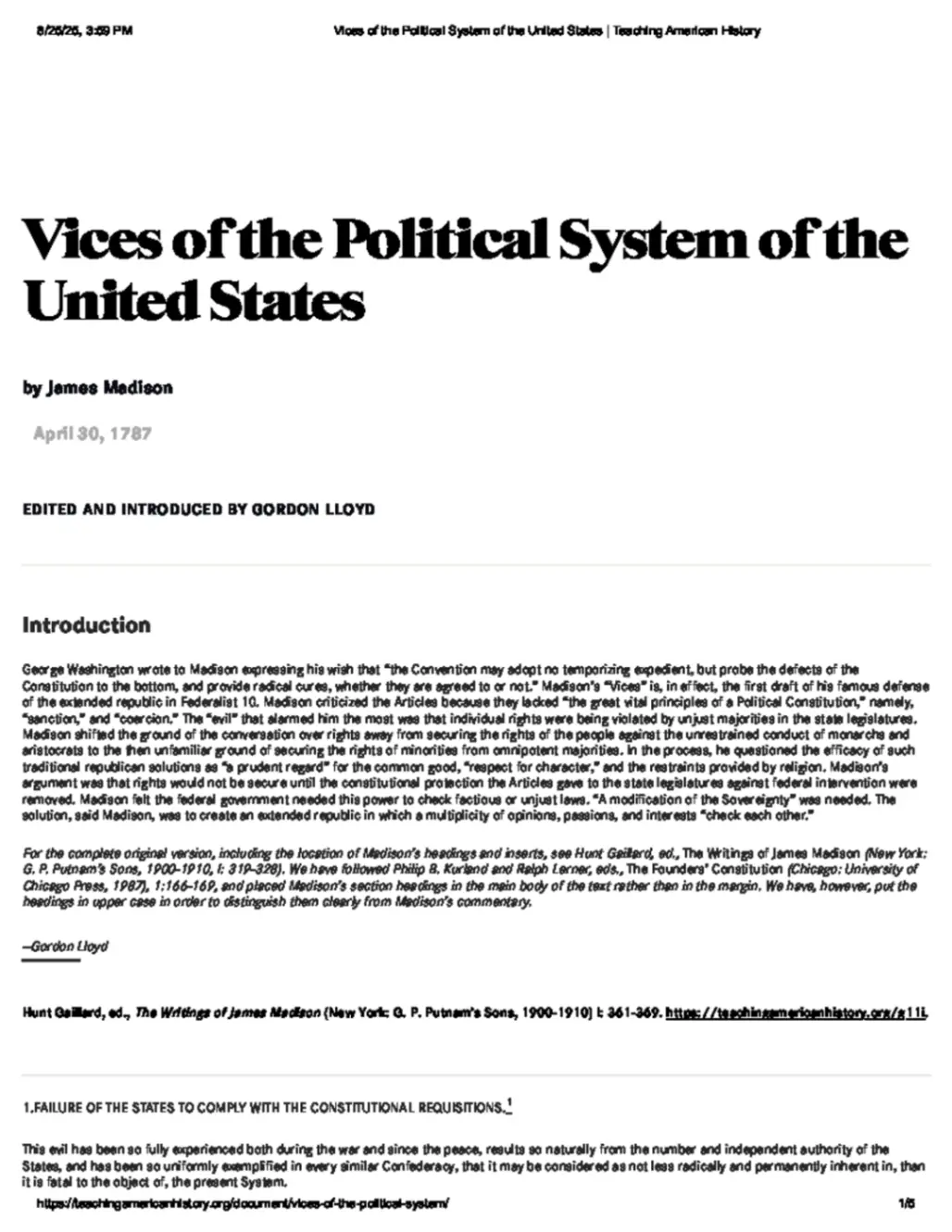
Vices of the Political System of the United States
 James Madison
Written by Madison in April 1787 as a private memorandum before the Philadelphia Convention, Vices of the Political System of the United States diagnoses eleven specific defects in the Articles of Confederation. Its central argument is that the root vice is not merely institutional weakness but the states' tendency to violate national treaties, encroach on each other, and pass mutable, unjust laws that trample minority rights. Madison distinguishes the "vices" of the federal system from those of the state legislatures, concluding that a republic must enlarge its sphere and empower a national government to veto state laws—the germ of his later extended-republic theory.
Key Details
Related Books
View AllSimilar books from the same category, ranked by shared topics and reader engagement.
.webp?alt=media&token=aa57557c-98c6-4edb-ba61-0189bc741142)
.webp?alt=media&token=fe90549a-9842-4d96-b442-a481f7724ad7)
Key Insights — Read in 10 Minutes
What is the central claim of Vices of the Political System of the United States, and what does it reject?
Madison argues that the Articles of Confederation's deepest flaw is not simply that Congress lacks power, but that the states themselves are the primary source of instability—they violate treaties, encroach on one another, and pass mutinous, unjust laws that oppress minorities. He rejects the view that the remedy is merely stronger state autonomy or a looser league. Instead, he proposes a national negative on state laws and a larger republic, anticipating Federalist No. 10's extended-republic argument.
What specific framework did this memorandum introduce, and how did it shape the Constitution?
Madison's memorandum introduced a systematic taxonomy of federal defects—eleven numbered vices—separating failures of the confederation structure from failures of state legislatures. The most influential proposal was a national veto over state legislation, which he saw as the only way to protect minority rights and enforce treaties. Though the Convention rejected the universal negative, the Virginia Plan and the Supremacy Clause reflect its logic. The memorandum is the intellectual bridge between the Articles' critique and the Constitution's federal design.
How does Vices differ from The Federalist Papers in purpose and audience?
Vices is a private memorandum, written for Madison's own preparation and circulated among a few allies before the Philadelphia Convention. The Federalist Papers are public, persuasive essays aimed at ratification. Vices is diagnostic and blunt, listing defects and proposing remedies without rhetorical softening; The Federalist Papers are defensive and theoretical, presenting the Constitution as a coherent solution. Vices shows Madison thinking through federalism as a problem; The Federalist Papers show him defending the answer.
How has Madison's diagnosis in Vices held up since 1787?
Many of Madison's specific complaints—states violating treaties, currency chaos, interstate trade disputes—were resolved by the Constitution's structural changes: the Supremacy Clause, federal courts, and congressional power over commerce. His deeper worry, that state legislatures could be factions and unjust, has proven durable and is still cited in federalism debates over state lawmaking and minority rights. His proposed national veto over state laws was never adopted, and scholars debate whether its absence left the federal balance more state-centered than he intended.
What real-world systems or practices trace back to the arguments in Vices?
The memorandum's logic informed the Virginia Plan, the Supremacy Clause, and the constitutional structure of enumerated national powers. Modern federalism doctrine—preemption of state law, dormant Commerce Clause cases, and treaty enforcement—echoes Madison's concern about state interference with national interests. It also underpins scholarly accounts of why the Constitution created a compound republic rather than a league. The universal negative he proposed survives only as a rejected alternative, which is itself a key data point in federalism scholarship.
What is a common misconception about Vices of the Political System of the United States?
A common misconception is that it is a published book or a set of essays like The Federalist Papers. It is neither: it is a private memorandum Madison wrote in April 1787, not published in his lifetime and not intended as a public argument. It is also often read as a simple indictment of the Articles of Confederation, but Madison's sharpest criticism targets the states, not Congress. That distinction matters for understanding why he favored a national veto over state laws.
Wealthy Psyche is an intellectual archive. We do not host, distribute, or sell book copies — physical or digital. We provide structured knowledge to help you think better, faster.