


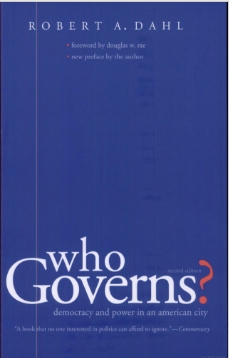
Who Governs? Democracy and Power
 Robert A. Dahl
Dahl's study of New Haven asks who actually governs in a democracy where resources are unequally distributed. Through detailed analysis of three policy arenas—political nominations, urban redevelopment, and public education—he finds that power is not monopolized by a single elite but dispersed among different groups who dominate distinct issue areas. Only the mayor exercises influence across all domains. Dahl argues that this pattern of 'dispersed inequalities' supports a pluralist interpretation: democracy works not through unified elite rule but through competition and bargaining among specialized leadership groups, with voters exercising indirect influence through competitive elections.
Key Details
Key Insights — Read in 10 Minutes
What was Dahl's central finding about power in New Haven?
Dahl concluded that political power in New Haven was fragmented rather than concentrated. By tracing decision-making across political nominations, urban redevelopment, and public education, he found that different individuals and groups dominated different policy spheres. Social and economic notables were active in some areas but not others. Only the mayor, accountable through elections, wielded influence across all three domains. This pattern of specialized influence led Dahl to describe New Haven as a pluralist democracy in which competing leadership groups check one another, and citizens exercise indirect influence through the ballot .
How does Dahl define power, and what does that definition exclude?
Dahl defines power as A's ability to make B do something B would not otherwise do—a behavioral, decision-focused conception. This definition requires observable, overt action in concrete decisions. Critics like Peter Bachrach and Morton Baratz argued it excluded 'nondecisions': cases where powerful actors keep issues off the agenda altogether. Steven Lukes later added that power also operates by shaping preferences so that people accept their subordinate position. Dahl's operational rigor made his findings testable, but the method rendered invisible the structural power that works through agenda control and preference formation .
Why did Dahl's study miss the racial hierarchy that shaped New Haven?
Dahl's empirical method required overt, measurable manifestations of power in decision-making. Racial supremacy in 1950s New Haven operated largely through institutionalized patterns so entrenched they were invisible in quotidian political dealings—housing segregation, employment discrimination, and spatial hierarchy were not 'decisions' in the sense his study tracked. His research team debated making race more prominent but their rigorous methodology found it playing little role. Critics argue this was precisely the problem: the most consequential power operates through structures that never surface as contested decisions .
How does Dahl's pluralist conclusion differ from Floyd Hunter's elite theory?
Floyd Hunter's Community Power Structure (1953), studying Atlanta, concluded that a small 'power elite' of business leaders dominated community decisions. Dahl's New Haven study directly challenged this. Hunter used reputational analysis—asking knowledgeable informants who held power—which Dahl criticized as measuring reputation rather than actual influence. Dahl traced concrete decisions instead, finding that business elites were not uniformly dominant. The methodological dispute became foundational: reputational approaches tend to find elites because they ask about perceived power, while decisional approaches tend to find pluralism because they examine who actually wins specific fights .
How has the pluralist argument held up since 1961?
Subsequent research complicated Dahl's optimistic picture. G. William Domhoff and others argued that Dahl's case selection missed structural business influence that operated outside contested decisions. The civil rights era made racial exclusion impossible to ignore as a central feature of American democracy. Dahl himself later acknowledged limitations, and his 2005 preface reflects on the book's blind spots. Yet the study remains canonical because it established the decisional method and framed the core empirical question. Contemporary scholars now recognize both pluralist competition and structural inequality as coexisting features, rather than treating them as mutually exclusive .
What does Dahl mean by 'dispersed inequalities'?
Dahl observed that New Haven had moved from 'cumulative inequalities,' where the same individuals and families dominated all political, economic, and social spheres, to 'dispersed inequalities,' where different resources confer influence in different arenas. Wealth helps in redevelopment decisions but not necessarily in party nominations. Social standing matters in some contexts, organizational skill in others. This dispersal meant no single group could dominate everything, creating space for democratic competition. Dahl saw this as a historical achievement of American urban politics, though critics noted that some inequalities, particularly racial ones, remained cumulative rather than dispersed .
Wealthy Psyche is an intellectual archive. We do not host, distribute, or sell book copies — physical or digital. We provide structured knowledge to help you think better, faster.