


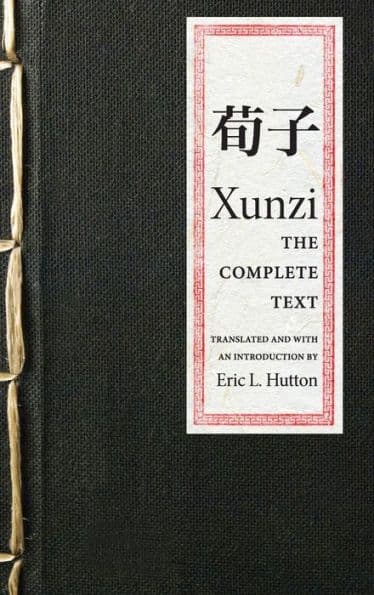
Xunzi (The Complete Text)

The Xunzi is a stratified collection of essays rather than a single treatise, and its unifying argument is that human nature is bad and that goodness is produced through conscious activity (wei), ritual practice, and the mind's capacity to know the Way. The text's distinctive method is externalist: it grounds moral transformation in teachers, models, and the ritual forms established by the sage-kings, not in innate moral sprouts. The complete text also preserves Xunzi's epistemology of the mind's emptiness, unity, and stillness, his critique of physiognomy and divination, and his influential essays on rectifying names and the wrongness of human nature.
Key Insights
✦What is the central thesis of the Xunzi, and what does it reject?
The text's most famous claim is that human nature is bad (xing e): people are born with self-interested desires that, if followed without correction, produce conflict and disorder. This rejects Mencius's claim that human nature is good and that moral cultivation consists in nourishing innate sprouts. Xunzi's alternative is that goodness is the product of conscious activity (wei)—the deliberate transformation of raw human material through ritual, teachers, and the standards established by the sage-kings. The mind's natural capacity to know the Way is essential, but the Way itself is learned from outside. Moral order is an achievement of culture and practice, not a maturation of nature .
✦How does the Xunzi conceive of the Way (Dao), and what is its relationship to ritual?
For Xunzi, the Way is explicitly the human way, not the way of Heaven or Earth . It is the path through which human beings are guided, and its content is ritual and righteousness. Ritual is the concrete embodiment of the Way: Xunzi compares ritual to markers that indicate the deep places when fording a river, warning that without clear markers, people fall into chaos . The sage-kings established these markers, and the gentleman's task is to follow them. The Way is thus a standard for judgment and conduct, not a cosmic principle to be contemplated. It is learned, practiced, and transmitted through the classics and the example of teachers .
✦What is the significance of the 'Jie Bi' (Undoing Fixation) chapter for Xunzi's epistemology?
The 'Jie Bi' chapter develops Xunzi's account of how the mind can know the Way. The mind's problem is fixation (bi): it becomes one-sidedly attached to one aspect of reality and loses the whole. The remedy is the discipline of emptiness (xu), unity (yi), and stillness (jing). Emptiness means not letting what is already stored in the mind interfere with new input; unity means not letting one content interfere with another; stillness means not letting dreams or distractions disturb clear knowing. These are not mystical states but cognitive disciplines for achieving objectivity. The goal is to grasp the Way as a stable standard, free from the distortions of partial perspective .
✦How does Xunzi's essay 'Contra Physiognomy' (Fei Xiang) fit into the complete text's broader project?
The Fei Xiang chapter dismantles the physiognomists' claim that bodily features reveal moral character and fortune. Xunzi argues that ugliness does not prevent sagehood and beauty does not prevent tyranny, citing historical examples on both sides. The chapter's positive thesis is a hierarchy: judging form is inferior to judging the mind, and judging the mind is inferior to selecting the proper method. The rejection of physiognomy is consistent with Xunzi's broader anti-fatalism and his insistence that moral character is produced through conscious activity, not given by nature or read from the body. The body is raw material, not a moral index .
✦What is the textual history of the Xunzi, and how do the standard English translations differ?
The received Xunzi contains 32 chapters, but the text has a complex history. The oldest extant commentary is by Yang Liang (fl. 818 CE), who noted textual problems and inconsistencies. Modern scholarship treats the text as stratified, with some chapters likely composed by Xunzi's disciples or later followers. The standard complete English translation is John Knoblock's three-volume Xunzi: A Translation and Study of the Complete Works (Stanford, 1988–1994), which includes extensive annotation and scholarly introduction. Eric Hutton's Xunzi: The Complete Text (Princeton, 2014) is a more recent one-volume translation aimed at classroom use. Knoblock's edition remains the standard scholarly resource, while Hutton's is more accessible for general readers .
✦How has Xunzi's relationship to Confucius and Mencius been understood in the tradition?
Xunzi presents himself as a defender of Confucius's Way against what he saw as the errors of rival schools, including Mencius. He criticized Mencius by name for claiming that human nature is good, arguing that this doctrine removes the need for ritual and teachers. Yet Xunzi also criticized other Confucians for excessive ritualism or for failing to understand the mind's role in knowing the Way. Later Confucian tradition, especially from the Song dynasty onward, tended to privilege Mencius and treat Xunzi as heterodox because of his claim that human nature is bad. Modern scholarship has revised this judgment, recognizing Xunzi as a systematic thinker who developed the Confucian tradition in a distinctive direction rather than departing from it .
Wealthy Psyche is an intellectual archive. We do not host, distribute, or sell book copies — physical or digital. We provide structured knowledge to help you think better, faster.