


Rein Taagepera
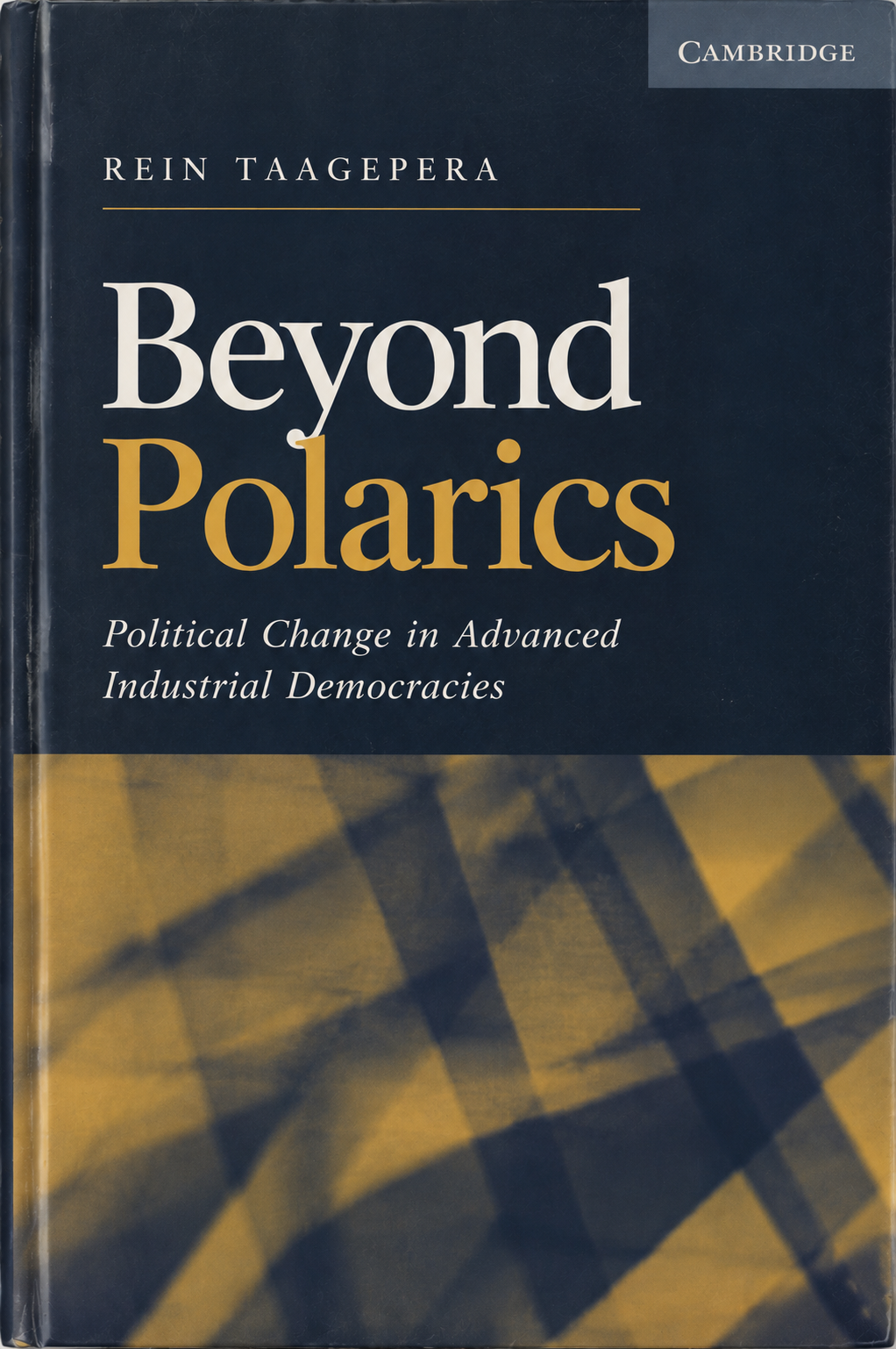
Rein Taagepera (b. 1933) brought the physicist's instinct for parsimonious, predictive models to political science, fundamentally reshaping the study of electoral systems. His signal contribution is the development of logical, quantitatively predictive models that explain how electoral rules determine party system outcomes—from the effective number of parties to seat-vote equations and cabinet duration. In *Seats and Votes* (1989) and *Votes from Seats* (2017), co-authored with Matthew Shugart, he formalized the 'seat-vote equation' that predicts a party's seat share from its vote share across a wide range of electoral systems, extending and generalizing the classic cube law. His work insists that social science can achieve genuine prediction, not merely post-hoc explanation—a physics-inflected epistemology that has made him one of the most cited electoral system scholars globally.
.jpg?alt=media&token=91deb02c-3b3c-487c-a0da-805e963a3a4d)
.jpg?alt=media&token=9ff20ca1-96f2-4e0f-8d15-9e47d8409f44)
.jpg?alt=media&token=6aff10c3-989e-46ad-8cac-3abd539d94ed)




✦What is the 'seat-vote equation' and why is it important?
The seat-vote equation is a predictive formula that translates a party's vote share into its expected seat share under a given electoral system. Taagepera generalized the classic 'cube law'—which held for two-party plurality systems—into a family of equations that apply to proportional representation and mixed-member systems. This allows scholars and practitioners to predict, before an election, how votes will translate into seats, making it an indispensable tool for electoral system design, redistricting, and understanding partisan bias.
✦How does Taagepera's approach to political science differ from traditional empirical work?
Taagepera argues that social science has over-relied on empirical curve-fitting without underlying logical models. His approach—explicitly inspired by his physics training—insists on deriving predictions from first principles and logical constraints before looking at data. In *Making Social Sciences More Scientific* (2008), he contends that genuine scientific progress requires models that predict new phenomena, not merely describe past patterns. This epistemology has made him a distinctive voice in a discipline often dominated by post-hoc regression analysis.
✦What are the 'four laws of party seats and votes'?
In *Votes from Seats* (2017), Taagepera and Shugart distill electoral system logic into four foundational relationships: the seat-vote equation (predicting seat share from vote share), the law of minority attrition (predicting how many parties will be represented), the cube root law of assembly sizes (predicting optimal legislature size from population), and the relationship between district magnitude and the effective number of parties. Together, these laws provide a coherent, mathematically grounded framework for understanding how electoral institutions shape party systems.
✦How does Taagepera's work on predicting party sizes relate to Duverger's Law?
Taagepera has extended and refined Duverger's Law, moving beyond the simple prediction that plurality favors two-party systems. His models can predict the *effective number of parties* as a function of district magnitude and assembly size, providing a continuous, quantifiable prediction rather than a categorical one. He has shown that Duverger's Law is a special case of a more general logical relationship—one that holds across both plurality and PR systems, once the mechanical constraints of seats and votes are properly specified.
✦What role did Taagepera play in Estonia's transition to democracy?
Taagepera was a key figure in Estonia's post-Soviet democratic transition. In 1991, he served on the Estonian Constitutional Assembly, helping design the new republic's institutions. In 1992, he ran for President of Estonia, finishing third with 23% of the popular vote—a race he later admitted he entered partly to split the vote of the leading candidate and help Lennart Meri win. He also founded the Res Publica Party (2001–02), which went on to form a governing coalition. His practical experience in constitution-making directly informed his academic work on electoral system design.
✦What did Taagepera get right, and what remains contested in his predictive approach?
Taagepera's models have proven remarkably successful at predicting the effective number of parties and seat-vote relationships across a wide range of democracies. However, critics argue that his models are 'logical' rather than 'causal'—they describe constraints rather than the strategic behavior of voters and elites. His framework also struggles with highly fragmented or clientelistic party systems where institutional constraints are weaker than social cleavages. Nonetheless, his insistence that prediction is the gold standard of scientific knowledge has permanently raised the bar for empirical political science.
✦What is a common misconception about Taagepera's work?
A frequent error is to treat Taagepera's models as mere 'curve-fitting' exercises. In fact, he explicitly rejects curve-fitting in favor of deriving equations from logical constraints—for example, that seat shares must sum to 100% and that the relationship between seats and votes must be monotonic. His models are built from such boundary conditions, not from data. The data then test whether the logically derived predictions hold, rather than being used to generate the model in the first place. This is the physicist's method, not the statistician's.